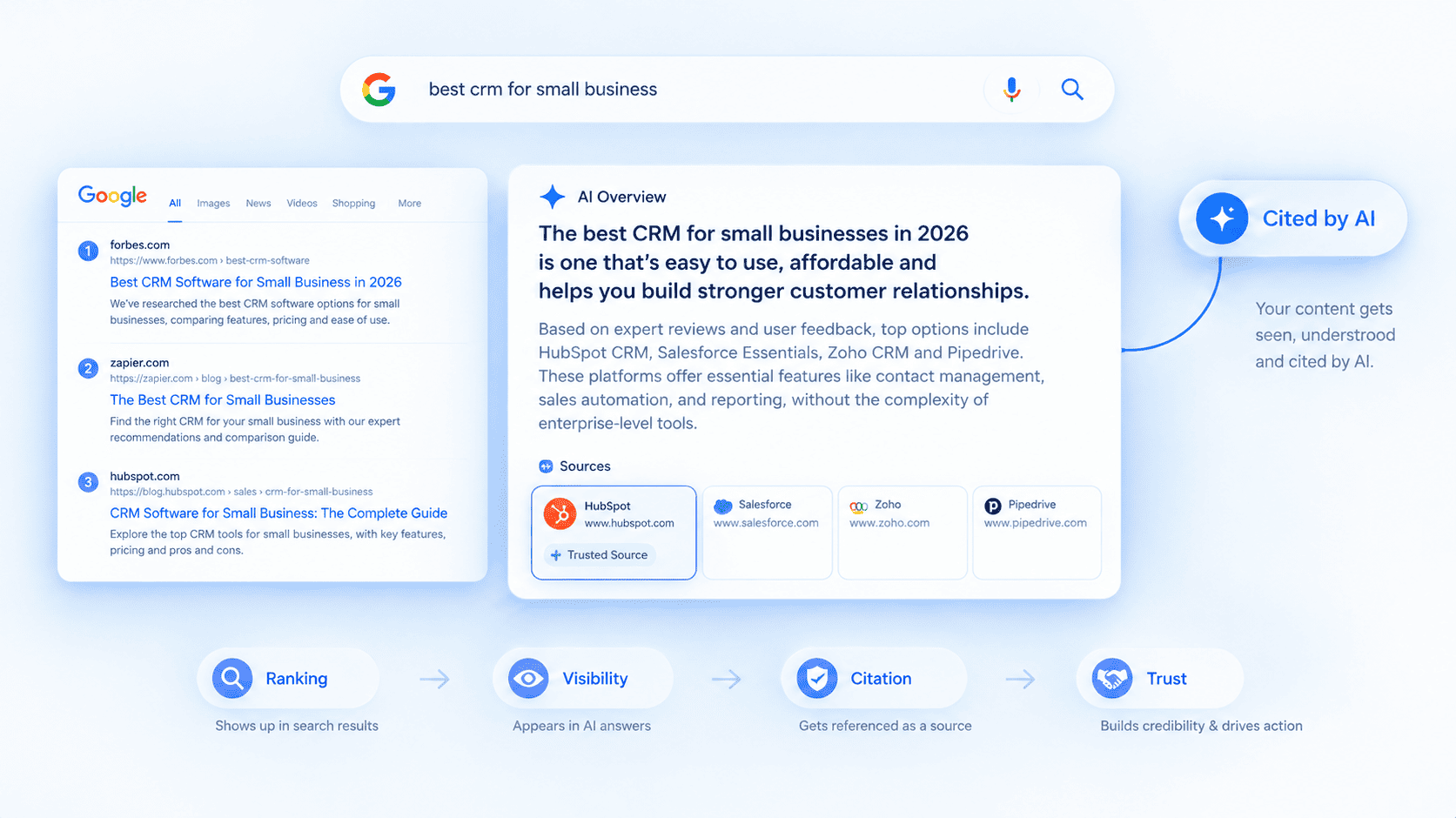
How AI Search Is Changing SEO: From Ranking to Being Cited
Oct 01, 2026 / 41 min read
October 2, 2026 / 34 min read / by Team VE

A modern content brief has to do much more than hand a writer a keyword and a word count. It should explain the buyer’s decision, the evidence the article needs, the ideas Google must understand, and the parts an AI system may extract, compare or cite.
The old SEO brief was built for production. It gave the writer a primary keyword, secondary terms, competitor URLs, a suggested structure and a target length. That was often enough to produce something search-friendly, but it also produced a lot of articles that looked remarkably similar because every writer was starting from the same ranking pages and being asked to cover roughly the same ground.
In 2026, a good brief needs to begin much earlier in the thinking. It should tell the writer what the reader is actually trying to decide, where the uncertainty sits, which claims need evidence, what examples will make the argument real, and what the finished page should contribute that is difficult to find elsewhere.
AI search adds another layer to that job because content is increasingly being interpreted before it is visited. Google AI Overviews, AI Mode, ChatGPT, Gemini, Perplexity and other answer engines can extract definitions, compare options and assemble answers from several sources at once.
The brief therefore has to create enough clarity for machines without flattening the article for humans. Entities should be clear, evidence should sit where the claim appears, examples should carry the argument, and the structure should help a buyer move naturally from question to decision. The brief becomes less of a writing instruction sheet and more of an editorial strategy for the page.
Kladana, a cloud ERP platform serving manufacturers, wholesalers, retailers and growing SMBs, offers a useful example of how much leverage sits inside the briefing stage. Over a 15-month SEO programme, Kladana built a more structured content system around briefs, technical cleanup and internal linking, eventually growing monthly organic traffic from under 5,000 visits to around 32,000.
Each brief captured the search intent, the funnel stage, the competing pages, the gaps worth addressing, the internal-link destination and the commercial role of the article before the draft began. By April 2025, every writer was working from the same framework, which gave the programme far more consistency as output increased.
Such discipline matters because the brief is where the article’s logic gets set. A page on CRM implementation cost, for example, becomes much stronger when the writer already knows that the reader is trying to understand licensing, migration, integrations, internal resource requirements, rollout risk and the cost of fixing a poor implementation later. Those are the questions that shape the article. The keyword still matters because it tells the team where demand exists, but the buying situation gives the page its direction.
The same thinking improves how evidence is planned. A pricing claim can be marked for external verification before writing starts. A section on implementation risk can require input from someone who has actually managed a migration. A comparison can be designed around the trade-offs the buyer is weighing.
FAQs can be drawn from sales conversations, and internal links can be chosen around the next question the reader is likely to ask. The writer receives more than a topic. They receive the commercial context needed to make the page feel informed from the first paragraph.
It becomes even more important in a search environment where the same article may surface in Google results, AI Overviews, ChatGPT, Gemini or Perplexity, and may also be read by a buyer who has already consumed several summaries before reaching the page.
A strong brief gives everyone involved in the article a shared view of what the page needs to accomplish, what it needs to prove and why it deserves to exist. By the time the drafting begins, much of the strategic work has already been done.
A keyword tells you what someone typed. The buying moment tells you what is pushing the search forward. That distinction matters more now because buyers increasingly research on their own before speaking to sales. Gartner’s 2026 B2B buyer research found that 67% of buyers preferred a rep-free experience and 45% had used AI during a recent purchase.
Search, content and AI tools are becoming part of the private evaluation process, which means the brief has to reflect the decision the buyer is actually trying to make rather than the phrase that happened to trigger the search.
Consider “SEO vs PPC vs content marketing”. A founder may be deciding where the next $5,000 should go. A marketing head may need leads this quarter. Another business may be questioning whether rising acquisition costs justify building more organic demand.
All three could type a similar query, but the article should feel different depending on the pressure behind it. A useful brief captures the urgency, the budget constraint, the sales cycle and the maturity of the website before anyone starts outlining sections.
B2B technology makes the same point at a larger scale. McKinsey’s 2026 Global B2B Pulse found that buyers now use an average of ten channels during the purchase journey. A brief for “best CRM for small business” therefore needs to anticipate the questions that appear after the first search, including migration effort, integrations, implementation cost, user adoption, reporting flexibility and support quality. Those questions are where the buying decision actually develops.
A simple line can keep the brief commercially grounded before drafting begins: The reader is trying to decide whether… “CRM implementation cost” becomes “whether the company can afford the full implementation once migration, integration and internal time are included.”
“Dedicated digital marketer vs agency” becomes “which model gives the business enough capability without creating excessive management overhead.” “Local SEO services” becomes “whether stronger local visibility can generate enough qualified demand to reduce dependence on paid acquisition.”
Once that sentence is clear, the rest of the brief gets sharper without becoming longer. Examples become easier to choose, evidence requirements become clearer, comparisons feel more relevant and FAQs start answering real objections rather than repeating definitions. The article gains direction because every part of it is serving the same decision.
A good brief still needs to understand what Google is already rewarding, because the search results reveal the basic expectations around intent, format and depth. The mistake comes when competitor research ends there. Handing a writer the top five URLs and asking them to cover the same headings usually produces a page that is competent, familiar and easy to forget. The more useful question is what those ranking pages leave unresolved for the buyer.
Aleyda Solis has become one of the most practical voices on this shift. She is the founder of Orainti, a long-time international SEO consultant and the creator of SEOFOMO and Crawling Mondays, and much of her 2026 work has focused on how AI search changes content prioritization.
In her AI Search Content Prioritization Framework, she argues that content deserves investment when it gives the user something an AI answer cannot fully satisfy on its own, such as proprietary evidence, current information, meaningful comparison, context-specific guidance or a next action.
Her analysis of 40 leading sites also found that the pages receiving AI referrals and the pages earning AI citations often serve different jobs. That is exactly the kind of distinction a modern brief should capture before a writer starts building an outline.
A SERP review can therefore be kept tight while still going much deeper than a heading scrape:
| What to Look For | What the Brief Should Capture |
| What already ranks | The baseline topics, formats and intent Google clearly understands |
| What the top pages keep repeating | Areas where the category has become generic or over-explained |
| What buyers still need to know | Cost, risk, fit, timing, implementation, comparison or proof gaps |
| What AI tools currently answer | Questions already being summarized and the sources being cited |
| What requires a click | Calculators, live data, detailed evidence, product experience, pricing or deeper comparison |
| What exists outside the SERP | Reviews, Reddit discussions, YouTube comments, sales objections and community questions |
Take for example a brief around “outsourcing digital marketing operations”. Google may already be full of articles explaining cost savings, access to specialists and scalability. The stronger angle sits one layer deeper. Which parts of marketing benefit from external execution? Which decisions still need to stay close to leadership because they involve positioning, customer knowledge or commercial judgment?
How much management overhead changes between an agency, freelancer, in-house hire and dedicated remote marketer? What happens when reporting is weak or ownership is unclear? Those questions give the article commercial depth because they reflect the decision the reader is actually trying to make.
AI search makes the wider research layer even more important. Solis’s September 2026 AI Search Optimization Checklist starts by asking which AI-assisted journeys matter commercially, where the brand is being shown or misrepresented, which sources are influencing those answers and what evidence is missing.
A content brief should borrow that discipline without becoming a research project of its own. The SERP tells you what already earns visibility. The wider conversation tells you what the next useful page still needs to say.
A stronger content brief needs to tell the writer what the page is actually about at an entity level. Keywords are still useful because they reveal demand, but entities give the page its shape. A technical SEO audit article, for example, may need to connect crawlability, indexation, canonical tags, Core Web Vitals, XML sitemaps, redirects, schema, analytics and conversion paths.
A page about a dedicated remote digital marketer may need to explain the relationship between staff augmentation, agency retainers, freelancers, in-house hiring, reporting, data security, onboarding and execution. If those relationships are fuzzy in the brief, they usually stay fuzzy in the final article.
Proof needs the same level of planning. The brief should make clear which claims require external evidence, which ones come from company experience, and where an example is enough to make the point. A statement about search behaviour, AI Overviews or structured data should be sourced.
A point about how a company handles onboarding can come from first-hand operating experience. A hypothetical example can help explain a decision, provided it is clearly framed as a scenario rather than presented as fact. Separating those three types of proof before writing begins is one of the easiest ways to reduce weak claims and accidental hallucination.
A simple brief can tag evidence like this:
Extraction is the third layer, and it matters because more content is now being summarized before the click. The writer should know which parts of the page need to stand on their own: a definition, a short comparison, a decision table, a process, a checklist or a concise answer to a recurring buyer question.
Google’s guidance for AI features continues to emphasise useful, accessible and well-structured content, so the job is not to manufacture “AI blocks”. It is to make the important parts of the argument explicit enough that a reader, a crawler and an answer engine can all understand the same thing.
A practical content brief can therefore include one compact evidence-and-extraction section:
| Brief Field | What the Writer Needs to Know |
| Core entities | Which products, services, roles, tools, concepts and relationships must be explained clearly |
| Claims needing sources | Which factual statements require external verification |
| First-hand evidence | Which insights can come from internal experts, customer work or delivery experience |
| Examples | Which business situations will make the advice concrete |
| Extractable elements | Which definition, comparison, table, checklist or FAQ should be easy to reuse |
| Review owner | Who checks technical accuracy, brand positioning or commercial claims before publication |
By the time a writer starts drafting, the brief should already have answered the questions that usually make or break the article. Who is the reader? What are they trying to decide? Which parts of the topic are already well covered? Where is the useful gap? What evidence is required? Which examples will make the argument credible?
Which internal pages should the article naturally connect to? It sounds obvious, yet many briefs still arrive as a keyword, a title, a word count, a few competitor URLs and a list of headings. The writer then has to invent the strategy while writing the article.
A much stronger brief looks closer to an editorial assignment. Search Engine Land’s recent work on building content briefs around audience situations makes a similar point: search volume is useful, but the situation around the search often tells you more about what the content actually needs to address.
That is especially relevant now because the first query is only one part of the journey. Search Engine Land’s 2026 analysis of conversational search argues that the follow-up question can be even more revealing, because it shows what the user still needs after the first answer.
A practical modern brief can therefore be compact while still carrying much more intelligence:
| Brief Field | What It Should Tell the Writer |
| Reader and buying moment | Who is searching and what are they trying to decide now? |
| Primary search theme | What topic or query family anchors the page? |
| Editorial angle | What will this article explain better, differently or more usefully than existing pages? |
| SERP gaps | What do current ranking pages cover well, miss, simplify or leave unresolved? |
| AI answer check | What are AI tools already saying and which sources are being cited? |
| Entity map | Which products, services, roles, concepts, tools and relationships need to be clear? |
| Proof requirements | Which claims need research, first-hand expertise or a concrete example? |
| Examples | Which real company or business situations should carry the argument? |
| Decision aids | Where would a table, checklist or comparison genuinely help? |
| Internal links | Which service, case-study or related pages answer the next question? |
| FAQ direction | Which objections or follow-up questions deserve their own answer? |
| Review owner | Who checks technical accuracy, commercial nuance or subject expertise? |
This structure removes guesswork without turning the brief into bureaucracy. A writer working on “website marketing audit”, for example, should already know whether the reader has traffic but weak leads, whether the problem is suspected to be ads, SEO or conversion, and which symptoms the article needs to unpack.
The brief might call for examples around mismatched intent, slow mobile pages, weak trust signals and broken tracking, while also pointing the writer toward the service or audit page that becomes the logical next step. The article then develops as an argument rather than a sequence of topics.
AI search gives the brief one extra job: it should identify the parts of the article that need to remain useful even when lifted out of context. Marcus Miller’s recent ASC framework for AI search makes that point well by separating the broader message, the business evidence and the content that gets surfaced at different stages of discovery.
A direct answer near the top, a clear comparison, a strong piece of evidence or a concise decision rule can all travel into an AI-generated response while the full article still gives the human reader more depth. The brief should plan for both without making the writing feel mechanical.
AI is genuinely useful before the writing starts because briefing involves a lot of repetitive research work. A strategist may have dozens of sales-call notes, competitor pages, Reddit discussions, support questions and keyword clusters to make sense of before assigning an article.
AI can group those inputs, surface recurring themes, summarize competing pages and identify gaps much faster than a person working manually. Used well, that gives the human strategist more time to decide what actually matters.
The risk appears when the tool starts making the editorial decisions as well. A model can suggest an outline for “how much does outsourced bookkeeping cost?”, but it does not know which cost drivers matter most to your buyers unless you give it that context.
It can generate ten FAQs, but it cannot know which objections repeatedly stall your sales process. It can summarize competitor pages, but it cannot decide whether the category is over-explaining the same idea or missing a commercially important angle. The brief still needs someone who understands the audience, the business and the consequences of getting the advice wrong.
Google’s own guidance on using generative AI content is useful because it keeps the focus on quality, accuracy and added value rather than the tool itself. For a small team, that creates a sensible division of labour:
A lean team can gain a lot from that split. An accounting firm may have one marketing manager, an outsourced writer and a partner who can spare thirty minutes for review. AI can organize fifty customer questions into themes and draft an outline before the partner joins. The partner’s time is then spent where it has the most value: correcting assumptions, adding the details that come from real client work and explaining where the advice changes in practice.
The brief becomes the safeguard that keeps efficiency from turning into sameness. It tells the writer which parts AI can help organize and which parts require human judgment, evidence or expert input. That is especially important now because producing a polished first draft is easy. Producing a page that sounds informed, accurate and commercially useful still depends on the quality of the thinking that happens before the draft exists.
Eaton offers a strong example because its content problem was not a lack of information. It was the complexity of the buying process. The company sells into machine builders, where engineers, operations leaders, procurement teams and commercial stakeholders often need different answers before a purchase moves forward.
In 2026, Content Marketing Institute recognised Eaton’s Buyer-First Content Engine for mapping content around the questions different stakeholders needed answered across a long B2B journey. The programme was built on validated customer research and field feedback, then organised around a few recurring business needs rather than a conventional list of funnel-stage topics.
This is the level of thinking a strong brief should bring into the article structure. A page about a website marketing audit, for example, becomes more useful when it follows the experience the reader is actually having.
Traffic exists, leads are disappointing, the team suspects the ads, and the audit begins to uncover a more complicated picture involving weak message match, slow mobile pages, thin proof, poor form tracking and weak follow-up. The article can then move naturally from symptom to diagnosis to decision instead of presenting SEO, UX, content and conversion as four disconnected headings.
Gartner has been pushing B2B marketers in a similar direction. Its January 2026 research on a “Questions to Answer” content strategy argues that deals can stall when buyers cannot find satisfactory answers to the questions that matter at a given point in the decision.
A useful brief should therefore map the sequence of uncertainty, not simply the sequence of keywords. What does the reader need to understand first? Which question appears once that is clear? Where does proof become necessary? Which objection is likely to surface before action?
A compact journey map can help the writer see that flow before drafting:
| Reader Moment | Question the Content Needs to Answer | Useful Content Device |
| Problem recognition | What is actually going wrong? | Diagnostic example or symptom checklist |
| Understanding options | What are the realistic ways to solve it? | Comparison or decision table |
| Evaluating fit | Which approach makes sense for this type of business? | Industry or use-case examples |
| Reducing risk | What could go wrong, and how is it managed? | Case study, expert input or proof |
| Commercial evaluation | What affects cost, time and internal effort? | Pricing framework or implementation detail |
| Next step | What should the buyer do now? | Clear action or related commercial page |
The same structure works well for AI search because the page contains several useful answer units without becoming a pile of disconnected FAQ blocks. A reader who wants the quick answer can find it early, while someone making a serious decision can keep moving through the argument.
Google’s search fundamentals still apply across its AI experiences, so the brief does not need to create two separate articles, one for people and one for machines. It needs one coherent page where each section answers the next logical question and the whole piece leads somewhere commercially useful.
Examples become valuable when they help the reader understand how an idea changes in practice. A brief that says “include examples” gives the writer very little direction. A stronger brief specifies the situation the example needs to illuminate.
For a managed IT provider, an article about cybersecurity services might follow a 75-person company that has grown beyond break-fix support and is now dealing with Microsoft 365 access controls, endpoint security, backups, phishing risk and cyber-insurance requirements. The example gives the reader a business context in which the recommendation can be judged.
The same principle works particularly well for B2B SaaS. Imagine a company writing about customer onboarding software. Generic advice about improving onboarding says very little to a buyer. A useful example could follow a customer-success team managing 500 new accounts a month, with activation dropping because implementation steps are spread across email, spreadsheets and support tickets.
Suddenly, onboarding time, product adoption, support load, completion rates and churn become connected. The article can explain which metrics matter, what the software is actually solving and where technology alone will not fix a poor process.
A strong brief should therefore give each example a job:
Specificity is what makes these examples useful. “A retailer should improve its marketing” carries almost no information. A Shopify merchant spending heavily on Meta Ads while repeat purchase rate is falling creates a real analytical problem.
The article can now examine customer acquisition cost, contribution margin, discount dependency, creative fatigue and retention together. A reader facing a similar situation can recognise themselves in the example and use the reasoning even if their numbers are different.
The brief should also distinguish between real examples and illustrative scenarios. Named companies, customer results and performance claims need verification. A hypothetical example can still be extremely useful when it is clearly presented as one. Mixing the two is where credibility starts to erode, especially when AI-assisted writing makes invented detail sound perfectly plausible.
The best examples leave the reader with a way to think, not simply a story to remember. A law firm can show how visa-related client questions become service-page FAQs. A staffing company can demonstrate how time-to-productivity changes the economics of hiring.
A software company can show why implementation effort matters as much as license price. When examples are chosen at the briefing stage with that level of intent, they become part of the evidence supporting the article rather than an ornament added after the argument is finished.
The brief should still be useful when the draft comes back. That is where it earns its second job. The writer may have covered the topic, used the primary keyword and delivered the expected length, yet the article can still feel generic, under-evidenced or commercially weak.
A strong brief gives the editor something more concrete to judge against: whether the buyer’s decision is actually clearer, whether the promised evidence made it into the draft, whether the examples add anything, and whether the page says something worth publishing.
That matters more as AI increases content volume. Content Marketing Institute’s 2025 B2B research found that 81% of B2B marketing teams were already using generative AI, while only 4% of respondents reported a high level of trust in AI output.
The same research found that 43% of B2B marketers struggled to differentiate their content from competitors. The bottleneck is becoming less about producing words and more about deciding which words deserve to survive the edit.
A practical quality gate does not need a complicated scoring system. Five checks usually tell you whether the article has substance:
| Quality Check | What the Editor Should Be Able to See |
| Decision value | The reader can make, narrow or better understand a real business decision |
| Original contribution | The page contains a useful angle, example, observation, framework or evidence beyond the obvious |
| Proof | Important factual claims are sourced and experience-led claims are clearly grounded |
| Commercial relevance | Cost, risk, fit, timing, implementation or next steps appear where the topic requires them |
| Editorial clarity | The article has a coherent argument and the important answers are easy to locate and understand |
Imagine a draft on “how to choose an SEO agency”. It may contain all the expected sections and still miss what buyers actually care about. Does it explain how to assess reporting quality? Can the reader tell whether an agency understands revenue beyond rankings?
Does it show what access the agency should need to analytics, CRM and ad accounts? Are contract length, ownership of assets and measurement discussed? A brief that identified those questions beforehand gives the editor a clear basis for sending the draft back when they are missing.
The same discipline protects good writers as much as it protects the brand. They are no longer being told that a draft “needs more depth” or “doesn’t feel strategic” after the work is done. The original brief already established what depth meant for that article. It gives SEO, editorial, subject-matter and commercial teams one shared standard, which is increasingly valuable when content is being created faster and distributed across more surfaces.
For an SMB, the best content brief is usually the one a small team can use every week without stripping out the thinking that makes the article valuable. A founder-led services company may have one marketing manager, an external writer and a subject-matter expert who can spare half an hour for review.
In that environment, the brief has to concentrate the important decisions into a small space: who the reader is, what they are trying to decide, which proof matters, what examples will make the topic real, and where the article should lead next.
A local SEO article is a good example. “Local SEO for service businesses” is still too broad to brief well. A dental group trying to improve map-pack visibility has different problems from a plumbing company dependent on emergency calls or an accounting firm trying to attract higher-value local clients.
The brief becomes useful once it captures the commercial situation: perhaps reviews are weak, Google Business Profile categories are inconsistent, location pages are thin, or call tracking is making attribution unreliable. The writer can then build around the actual problem instead of assembling a general overview.
For most SMB teams, a compact brief can cover the essentials in one or two pages:
The discipline comes from answering those questions before the assignment moves forward. A brief for “hire an SEO specialist” should already know whether the buyer needs technical SEO, content growth, local visibility or broader organic strategy.
A brief for “outsourced bookkeeping cost” should know whether the reader is comparing an in-house hire, a local accounting firm and a remote team, because that choice determines which costs and trade-offs need explaining. The strategy should already be visible when the writer receives the assignment.
For a growing content programme, that consistency compounds quickly. Writers understand what good looks like, subject experts know where their input is needed, editors can spot missing depth earlier, and related articles begin to reinforce one another instead of behaving like isolated blog posts. A relatively simple brief can therefore become the operating layer that keeps a larger body of content coherent as more people contribute to it.
Before a content piece is approved, ask one question: does the reader leave the page better equipped to make the decision that brought them there? This is a far more useful standard than checking whether every keyword, heading and CTA made it into the draft. A page can be technically optimized and still leave the reader with the same uncertainty they had at the beginning.
The answer becomes easier to judge when the brief has done its job. A piece on hiring an SEO specialist should help a business understand which capabilities actually matter, how technical SEO differs from content-led growth, what evidence to ask for, and where a generalist may struggle.
An article on outsourced bookkeeping should help the buyer understand pricing drivers, scope boundaries, handover effort, data access, reporting cadence and the point at which an in-house hire may become more practical. Useful content makes the decision feel more manageable.
A quick final check can stay simple:
A modern SEO brief earns its value by setting that standard before the writing begins. It gives the writer enough context to produce something specific, gives the editor a clear basis for judging quality, and gives the business a better chance of publishing content that can work across search, AI discovery, sales and buyer research. The brief is ultimately where a topic becomes an editorial asset rather than another item on the publishing calendar.
A modern SEO content brief should give the writer enough context to understand the business problem behind the search, not just the keyword. At minimum, it should identify the audience, the buying moment, the primary search theme, the article’s editorial angle, important entities, proof requirements, examples, internal links, relevant external sources, FAQ direction, and the person responsible for reviewing technical or commercial accuracy. The source document frames the brief as a decision document that connects buyer intent, search requirements and AI extraction needs.
The useful test is whether the writer can explain what the reader is trying to decide before drafting begins. A brief for “outsourced bookkeeping cost”, for example, should already indicate whether the reader is comparing an in-house hire, an accounting firm or a remote team, and which cost drivers need to be explained. The clearer the decision, the easier it becomes to choose evidence, examples, comparisons and a commercially relevant next step.
A traditional SEO brief often centres on keywords, search intent, ranking pages, headings and internal links. A brief designed for Generative Engine Optimization and Answer Engine Optimization adds another layer: it considers how clearly the article explains important entities, relationships, definitions, comparisons and direct answers that an AI system may summarize or cite. The source specifically calls out entities, proof, examples, FAQs and citation-worthy material as important additions.
This does not mean turning the article into a collection of short answer blocks. The main piece still needs a coherent argument for a human reader. The brief should simply identify the parts that deserve exceptional clarity, such as a definition, a comparison table, a decision rule, a checklist or an FAQ answer. Those elements make the article easier to understand across search, AI discovery and direct reading.
AI can be very useful during briefing and drafting when it is used for lower-risk support work. It can cluster customer questions, summarize competitor themes, organize research, produce a rough outline and help turn sales-call notes into patterns. For a small content team, those tasks can save considerable time and allow the strategist or editor to focus on higher-value decisions.
The important boundary is judgment. The source makes clear that human review should own accuracy, examples, brand positioning and commercial nuance. A writer should verify statistics, pricing, product capabilities, legal or financial claims and platform guidance before publication. AI can help organize the work, while the final point of view, evidence and interpretation should remain grounded in real expertise.
There is no useful fixed number. A strong article usually centres on one main topic and naturally covers the related questions, entities and subtopics that belong to that problem. A page about conversion tracking, for example, may include GA4 events, Google Ads conversions, CRM stages, call tracking, offline conversions and duplicate tracking because those concepts are part of the same decision.
The brief should therefore focus on topical coherence rather than keyword accumulation. If several terms help explain the same buyer problem, they belong together. If they pull the article into unrelated directions, they probably belong on separate pages. The writer should be able to see one clear subject and one clear reader journey, even when the page covers a broad semantic field.
Competitor headings are useful for understanding what Google already associates with the topic and what readers may reasonably expect to find. They can reveal common subtopics, dominant formats and areas of consensus. The problem begins when those headings become the entire outline, because the final article often ends up resembling every other ranking page.
A stronger brief uses competitor research to identify gaps. The source recommends asking what Google already rewards, what the ranking pages avoid, and what a buyer would still need after reading them. The final article can then preserve necessary coverage while adding better evidence, sharper examples, clearer commercial context or a decision framework the existing pages lack.
They are useful because they reveal the questions people ask when they are confused, frustrated or close to a decision. Keyword data shows that demand exists, but community discussions and sales conversations often explain the pressure behind that demand. Someone asking why their Google Ads agency is “not showing any work” may actually be worried about transparency, accountability and wasted budget.
Those patterns can improve the brief by informing the article angle, objections, examples and FAQs. The source specifically recommends looking beyond the SERP to Reddit, Quora-style discussions, YouTube comments, reviews, sales objections and support tickets. The goal is to learn from recurring concerns and language, while keeping private or personally identifiable information out of the finished content.
Internal links are best planned before drafting because they help shape the reader journey. The brief should identify which service pages, product pages, case studies and related articles naturally answer the next question the reader is likely to have. That gives the writer a reason for each link instead of treating internal linking as a last-minute SEO task.
A page about SEO content briefs, for instance, might logically connect to hiring SEO specialists, hiring content writers, digital marketing outsourcing, topical authority or AI citation strategy. The source treats internal linking as part of the brief itself because those connections build topical authority and create commercial paths through the site.
Yes, when they answer genuine follow-up questions that the main article has not already resolved. Strong FAQs are useful for pricing concerns, implementation questions, risk, hiring trade-offs, measurement problems and edge cases. They can also give AI systems clear, direct answers to recurring buyer questions without weakening the broader editorial flow.
The source warns against using FAQs as a repetitive SEO device. A weak FAQ asks five versions of the same definition. A strong one expands the article by handling objections and practical questions that would otherwise interrupt the main argument. The brief should therefore specify which FAQ questions add something new rather than leaving the writer to invent them at the end.
Structured data should be considered when it genuinely fits the page type and follows the applicable search-engine guidelines. Depending on the content, that may include Article, Organization, Product, LocalBusiness, Review or other relevant schema. The brief can flag the opportunity so the technical team knows what may need implementation.
Its role should remain proportionate. The source explicitly notes that schema is not a substitute for useful content, credible evidence or a clear user experience. A good brief therefore treats structured data as part of the technical layer surrounding the article, while keeping the editorial priority on clarity, usefulness and accuracy.
A good brief makes the article easier to write, easier to edit and harder to make generic. The writer should understand the reader’s decision, the editorial angle, the required examples, the source rules, the internal links, the purpose of any table, the FAQ direction and the review process. If the brief only provides keywords, competitor URLs and a word count, too much strategy is still being left to chance.
The strongest test comes when the draft is reviewed. An editor should be able to point to the brief and explain exactly why a section lacks evidence, why an important buyer question is missing, or why an example is too generic. The source describes the brief as a quality-control tool for editors, SEOs, designers and subject-matter experts, which is a useful standard because it keeps everyone working from the same definition of a publishable page.
Oct 01, 2026 / 41 min read

Sep 30, 2026 / 28 min read

Sep 29, 2026 / 27 min read