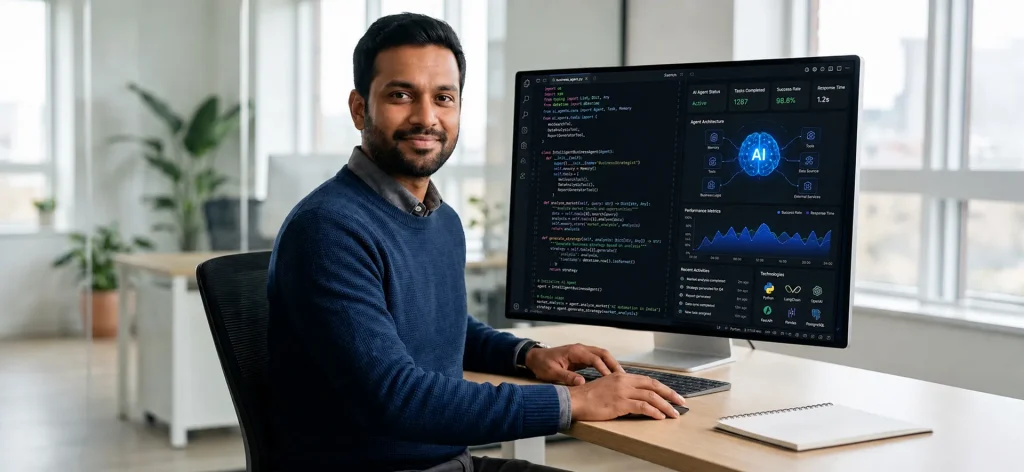
Hire AI Developers in India
for Intelligent Business Solutions
Starting from Just US $14/Hour
TL;DR:
- Hire AI developers to build production-ready AI applications across machine learning, NLP, computer vision, analytics, and business automation.
- Develop, integrate, and optimize applied AI solutions with dedicated AI engineers experienced in enterprise platforms and modern AI frameworks.
- Scale AI initiatives through dedicated AI specialists backed by ISO 27001:2022 and ISO 9001:2015 certified development practices.
Build AI solutions that solve real business problems across operations, customer experiences, and decision-making. Hire AI specialists to design, develop, and integrate production-ready AI apps, including machine learning, natural language processing, computer vision, AI-powered chatbots, and enterprise automation. They build reliable AI systems that integrate with existing business applications and support long-term operational growth.
AI Development Services for Modern Enterprises
Hire artificial intelligence developers with experience supporting global clients and
cross-border AI development projects across diverse business requirements.

Machine Learning Solutions

Natural Language Processing

AI-Powered Chatbots

Data Analytics Services

Computer Vision

Generative AI


Testimonials on Real-World AI Applications
Explore how businesses work with artificial intelligence specialists through responsive
communication, overlapping working hours, and reliable remote collaboration.
-

With VE’s AI developer, we built an AI model from scratch, developed a RAG tool using Pinecone, and transformed it into a complete RAG-based answer generation system with an AI wrapper powered by ChatGPT.
Aw Ming Sheng
Founder, FundFlicks, Singapore
-
He (Nitai) was the best AI developer I worked with because he really understands my requirements. He's supportive and smart, and fast in his work. He also provided me with advice on the architecture.
Francesco Picciariello
CEO, Overthink, Italy
-
We finally stopped chasing bugs and started shipping features. The VE team wasn’t just capable; they were ahead of us.
Jordan Broudy
CIO, Brandcil, USA


How It Works
Share your requirements, review matched profiles, and start working
with the AI developer who fits your goals.
Share Your Requirements
Tell us about your AI goals, required expertise, technology stack, working hours, and current challenges. We use these requirements to understand the role and identify the right fit.
Review Matched Profiles
Review AI developer profiles selected around your requirements, experience, and areas of expertise. Choose the professional who best aligns with your AI priorities and existing technology workflows.
Start With a 1-Week Free Trial
Work with your selected AI developer for one week to evaluate technical capability, communication, development quality, and overall fit before committing to an ongoing engagement.
Scale Your AI Development
Once the fit is established, your AI developer works as a dedicated extension of your team. Scale development around your priorities, communication, workflows, and ongoing AI requirements.
Start With a Free Trial
Share your requirements and our team will help you get started quickly.
- No credit card required
- No long-term contracts
- Cancel anytime
Dedicated AI Specialists for Business Innovation
Hire AI engineers who support distributed teams through structured communication,
remote collaboration, and proven project coordination processes.


Tools Behind Intelligent Applications
Hire dedicated AI developers who follow established security, data protection, and
compliance practices across AI development and integration workflows.
-
AI & ML Frameworks
TensorFlow PyTorch
Keras
scikit-learn
PyTorch
Keras
scikit-learn
-
Natural Language Processing
spaCy
NLTK
Hugging Face
Sentence Transformers
-
Computer Vision
OpenCV
YOLO
Detectron2
MediaPipe
-
Cloud & MLOps
AWS SageMaker
Azure AI Foundry
Google Vertex AI
Docker
-
APIs & Enterprise Integration
REST APIs
GraphQL
FastAPI
Apache Kafka


Financial institutions rely on AI to improve fraud detection, risk assessment, and customer experiences. Hire AI engineers to build intelligent solutions that automate financial processes while supporting faster, data-driven decisions.

Healthcare organizations generate large volumes of clinical and operational data every day. Hire AI developers to build intelligent applications for medical imaging, document processing, predictive analytics, and workflow automation.

Manufacturing environments rely on AI to improve quality, efficiency, and production visibility. Hire AI developers to build computer vision, predictive maintenance, and intelligent automation solutions for connected operations.

Retail businesses use AI to personalize customer experiences while improving inventory and demand planning. Hire AI experts to build recommendation engines, analytics solutions, and intelligent retail apps that support business growth.

Insurance providers increasingly rely on AI to streamline underwriting, claims processing, and document analysis. Hire AI developers to build intelligent applications that improve operational efficiency and accelerate customer service.
AI Development Agency vs. Virtual Employee
See which support model gives you the right balance of control, support, and flexibility.
| Criteria | Traditional AI Development Agency | Virtual Employee |
|---|---|---|
| Resource Allocation | AI developers shared across multiple client projects | Dedicated AI developer focused on your business |
| Technical Familiarity | Knowledge may be distributed across project teams | Builds familiarity with your AI systems, data, tools, and requirements |
| Communication | Usually coordinated through project or account managers | Direct communication with your dedicated AI developer |
| Development Control | Work managed within agency processes and project scope | AI development priorities aligned directly with your team |
| Flexibility | Changes may require scope discussions or revised estimates | Priorities can adapt as AI requirements evolve |
| Continuity | Resources may change based on project or agency requirements | Ongoing support from a dedicated AI development resource |
| Technology Alignment | Technology choices guided by agency project approach | Development aligned with your existing stack and business workflows |
| Cost Structure | Typically project-based pricing or retainers | Hourly engagement based on development time |
Case Studies on Applied AI Solutions
Explore how businesses hire remote AI developers to deliver AI projects through coordinated
collaboration across time zones and overlapping working hours.

Building TheChat - A multi-model AI assistant for natural conversation, image modification and semantic file search.
Read More about Building TheChat - A multi-model AI assistant for natural conversation, image modification and semantic file search.
How we built FundFlicks - an AI-powered platform that thinks like a trader, not a bot.
Read More about How we built FundFlicks - an AI-powered platform that thinks like a trader, not a bot.Articles on Innovative AI Solutions
Explore how businesses hire AI experts to address operational challenges
through practical AI implementations for global teams.

Why AI Systems Require Oversight Even After Deployment
Jun 26, 2026 / 24 min read

What Skills AI Specialists Use in Real Production Work
May 27, 2026 / 30 min read

The True Cost of Running AI Systems at Scale
May 27, 2026 / 33 min read
Artificial Intelligence Development FAQs
Reliable AI depends on continuous validation rather than one-time testing. VE’s dedicated AI developers evaluate models through cross-validation, benchmark testing, and real-world performance assessment before deployment. After launch, drift monitoring and ongoing performance reviews help maintain accuracy as business data and operating conditions evolve.
Hiring an AI developer through Virtual Employee follows a simple, structured process:
- Share your requirements – Tell us about your business objectives, AI use case, preferred technologies, engagement model, and project scope.
- Review shortlisted candidates – We identify AI developers whose technical expertise and industry experience align with your requirements.
- Interview and evaluate – Assess shortlisted candidates through technical discussions or a trial before making your selection.
- Onboard and begin development – Your dedicated AI developer integrates with your existing team and starts contributing to your AI initiatives.
Businesses often use the terms AI developer and AI engineer interchangeably. On this page, both refer to professionals who design, build, integrate, and optimize AI solutions, so regardless of which term you search for, you’re accessing the same dedicated AI development service.
Most organizations prefer adding AI to existing systems rather than replacing software that already works well. VE’s offshore AI developers integrate AI models with business applications, including Salesforce CRM, ERP platforms, cloud environments, and custom software, helping AI become part of everyday operations with minimal disruption.
AI delivers the greatest value when it’s applied to specific business problems. VE’s remote AI developers help organizations:
- Detect fraudulent transactions and unusual business activity
- Forecast customer demand, sales trends, and inventory requirements
- Extract information from invoices, contracts, and other business documents
- Automate customer support through intelligent chatbots and NLP
- Perform image recognition, quality inspection, and visual analysis using computer vision
Protecting business data is built into every AI engagement. VE follows ISO 27001:2022-certified information security practices and ISO 9001:2015-certified quality management processes, supported by NDA-backed confidentiality, role-based access controls, and monitored development environments to help safeguard sensitive business information.
Delivery timelines depend on the complexity of the AI solution. AI chatbots and workflow automation projects can often be completed within 2-6 weeks, while custom machine learning applications, computer vision solutions, and enterprise AI implementations typically require 2-6 months, depending on project scope, data readiness, and integration requirements.
AI performance requires continuous improvement as business requirements, data, and user behavior evolve. Hire AI developers who provide ongoing monitoring, model optimization, feature enhancements, and performance reviews through the same structured delivery approach used during development, helping AI solutions remain reliable over time.
AI readiness is evaluated by assessing whether your business has:
- Clearly defined business objectives and measurable AI use cases
- Reliable, accessible, and sufficient business data
- Existing systems that can integrate with AI solutions
- Processes where automation or AI-driven decision-making can deliver measurable value
4500+ Clients in 48 Countries Have Accelerated Their Business Growth with VE’s Developers. You Could Be Next!
Hire AI DevelopersHire AI Developers to Build Production-Ready AI Solutions
Artificial intelligence is moving beyond isolated experiments into everyday business operations. Organizations increasingly hire AI developers to build intelligent applications that analyze business data, automate repetitive work, improve decision-making, and integrate AI into existing products, enterprise platforms, and customer experiences.
Building production-ready AI requires far more than training a model or integrating a pre-built API. Applied AI systems must work reliably with business data, existing software, security policies, and operational workflows while remaining accurate as business requirements evolve. Dedicated AI developers combine machine learning, natural language processing, computer vision, predictive analytics, and enterprise integration expertise to deliver AI solutions that solve measurable business problems instead of isolated technical challenges.
Virtual Employee’s AI developers in India build production-ready AI applications across machine learning, NLP, computer vision, business intelligence, workflow automation, and enterprise integrations. Businesses looking for specialized capabilities can also hire generative AI developers for LLM-focused implementations, hire AI agent developers for autonomous workflow automation, or hire machine learning experts for advanced model engineering through VE’s dedicated service teams.
What This Section Covers
This section explains when businesses achieve the greatest value by hiring AI developers, why organizations continue to expand applied AI teams through India, how Virtual Employee delivers AI engineering through dedicated employees, staff augmentation, project-based delivery, and dedicated teams, and the long-term operational advantages of building AI capabilities that evolve alongside changing business requirements.
When Hiring AI Developers Creates the Highest Business Impact
Organizations typically hire AI developers once AI becomes part of everyday business operations rather than an isolated innovation project. The highest business impact usually appears when intelligent systems must integrate with existing applications, improve decision-making, automate repetitive work, and continue evolving as business priorities change. Common situations include:
- Business Decisions Requiring Predictive Intelligence: Historical business data often contains patterns that traditional reporting cannot identify. Hire AI engineers to develop predictive analytics solutions that improve fraud detection, customer churn prediction, demand forecasting, and operational planning without replacing existing business systems.
- Growing Volumes of Unstructured Business Data: Customer emails, contracts, invoices, reports, images, and support conversations quickly become difficult to process manually. Dedicated artificial intelligence specialists build NLP and computer vision solutions that classify documents, extract information, analyze sentiment, and improve business efficiency across high-volume workflows.
- AI Becoming Part of Existing Business Applications: Most organizations want AI to enhance the software they already use rather than replace it. Dedicated AI developers integrate intelligent capabilities with CRMs, ERP platforms, cloud environments, internal applications, and APIs, allowing AI to become part of established business operations.
- Automation Extending Beyond Simple Rules: Many operational processes involve changing business conditions that traditional automation cannot easily handle. AI developers build intelligent systems that evaluate data, recommend actions, automate repetitive decisions, and improve workflow efficiency while operating within defined business guardrails.
- AI Moving from Pilot Projects to Production: Early AI prototypes often demonstrate technical feasibility without addressing long-term reliability. Production AI requires structured validation through cross-validation, performance testing, drift monitoring, monitoring frameworks, and operational guardrails that help maintain model accuracy as business data evolves. Industry research from Gartner also highlights the need for continuous monitoring, ongoing validation, and runtime enforcement as AI initiatives move from experimentation into production.
Organizations experiencing several of these situations often gain greater long-term value through dedicated AI developers than through isolated proof-of-concept projects. Continuous engineering support enables AI systems to improve alongside changing business priorities while maintaining operational reliability and measurable business outcomes.
Why Companies Choose to Hire AI Developers in India
India has become one of the preferred destinations to hire AI developers in India because organizations increasingly need engineering teams capable of building reliable AI systems across analytics, automation, enterprise software, and modern data platforms. Rather than relying exclusively on consultants or project-based outsourcing, many organizations now expand engineering capacity by choosing to outsource to India, allowing them to scale AI initiatives without significantly increasing internal recruitment overhead.
- Expertise Across Applied AI Technologies: Modern AI development combines machine learning, NLP, computer vision, predictive analytics, recommendation systems, and MLOps into a single engineering discipline. Offshore AI developers build solutions using frameworks such as TensorFlow, PyTorch, scikit-learn, Keras, and MLflow, while supporting cloud-native deployment across AWS, Kubernetes, and FastAPI-based enterprise environments.
- Dedicated Teams That Support Long-Term AI Growth: AI initiatives continue evolving long after the first deployment. Dedicated AI developers remain aligned with changing business rules, application enhancements, performance optimization, and ongoing AI improvements, helping organizations avoid repeatedly recruiting new engineering resources.
- Flexible Engagement Models for Every Stage: Organizations rarely require the same delivery model throughout an AI initiative. Virtual Employee supports staff augmentation, dedicated teams, and project-based delivery, allowing businesses to expand AI engineering capacity according to product maturity, internal capability, and project complexity.
- Cost Efficiency That Supports AI Investment: Hiring offshore AI developers allows organizations to reduce engineering costs by up to 60-70% compared with building equivalent in-house teams. Lower recruitment, infrastructure, and operational costs enable businesses to invest more in AI innovation, cloud modernization, product development, and long-term business transformation.
- Global Collaboration with Distributed Engineering Teams: AI projects depend on regular communication between engineering, product, and business stakeholders. Dedicated AI developers in India routinely collaborate with organizations across North America, Europe, Australia, and the Middle East through overlapping working hours that support sprint planning, architecture reviews, testing, and production releases.
Businesses looking for long-term AI capability increasingly choose dedicated offshore teams over short-term implementation projects because engineering continuity helps AI solutions evolve alongside changing business priorities while maintaining consistent delivery standards.
How VE’s AI Developers Strengthen Long-Term AI Delivery
Building an AI solution is only the beginning. Long-term business value depends on how effectively AI continues to improve as business priorities evolve, data changes, and products expand. Dedicated AI developers provide the continuity needed to maintain, optimize, and extend AI capabilities without repeatedly rebuilding engineering knowledge or restarting development efforts.
Unlike project-based engagements where delivery often ends after implementation, Virtual Employee’s dedicated AI developers become an extension of your engineering team. They remain familiar with your products, business rules, data architecture, technology stack, and operational workflows, enabling faster iteration, better technical decisions, and more consistent delivery over time.
- AI Development That Evolves with Your Business: AI initiatives rarely remain static. New data sources, changing customer expectations, evolving regulations, and additional business requirements often require continuous model refinement, workflow enhancements, and feature expansion. Dedicated AI developers support this ongoing evolution while maintaining alignment with your long-term product roadmap instead of treating each enhancement as a separate project.
- Engineering Continuity Across Every Stage: Effective AI development depends on preserving technical knowledge throughout the project lifecycle. The same dedicated developers continue supporting architecture decisions, model improvements, enterprise integrations, testing, deployment, and production optimization, reducing unnecessary knowledge transfer and helping teams move from one release to the next more efficiently.
- AI That Fits Existing Business Systems: Successful AI rarely operates in isolation. Dedicated AI developers integrate intelligent capabilities into existing CRM platforms, ERP systems, cloud environments, internal applications, APIs, and business workflows, helping organizations strengthen current operations without replacing established technology investments.
- Flexible Delivery Models That Scale: Every AI initiative progresses differently. Virtual Employee supports dedicated AI developers, staff augmentation, project-based delivery, and dedicated engineering teams, allowing businesses to expand technical capacity as products mature, priorities shift, and AI adoption grows across the organization.
- Production Support Beyond Initial Deployment: Production AI requires continuous monitoring, optimization, and refinement rather than one-time implementation. Dedicated AI developers continue supporting model performance, workflow improvements, enterprise integrations, feature enhancements, and operational stability to help AI solutions remain accurate, reliable, and aligned with changing business needs.
How Ongoing AI Development Stays Organized
Building AI successfully requires more than technical expertise. It also depends on structured execution, clear ownership, and continuous collaboration throughout the development lifecycle.
Virtual Employee’s dedicated AI developers follow an organized delivery approach that helps businesses maintain visibility while AI solutions continue evolving.
- Shared Planning from Day One: Every engagement begins with clearly defined objectives, delivery milestones, technical priorities, and communication expectations. This shared understanding helps development remain aligned with business outcomes throughout the project.
- Dedicated Ownership Throughout Delivery: The same AI developers remain involved across planning, development, testing, deployment, and ongoing improvements. Consistent ownership reduces repeated onboarding, preserves product knowledge, and supports faster delivery as new requirements emerge.
- Transparent Progress and Collaboration: Regular sprint reviews, progress updates, technical discussions, and collaborative planning sessions help stakeholders monitor development without losing visibility into priorities, timelines, or implementation progress.
- Continuous Improvement After Deployment: AI systems continue learning from new business requirements long after launch. Dedicated developers support performance monitoring, model refinement, feature enhancements, and production optimization, so AI solutions remain effective as data, workflows, and business objectives evolve.
A Practical Framework for Moving AI from Pilot to Production
Successful AI implementations rarely move directly from experimentation to enterprise-wide deployment. Most production-ready AI initiatives progress through a structured engineering approach that helps reduce technical risk while improving long-term business outcomes.
| Stage | What Happens | Business Outcome |
| Identify the Business Problem | Prioritize use cases with measurable operational or commercial value before development begins. | AI solves problems that directly support business objectives. |
| Prepare Data & Integrations | Validate business data, enterprise systems, APIs, and security requirements before building AI models. | Reduces implementation delays and integration challenges. |
| Develop & Validate AI Models | Build, test, benchmark, and refine models using representative business scenarios before deployment. | Improves accuracy and production readiness. |
| Deploy with Governance | Introduce AI using monitoring, access controls, human approvals, and performance tracking. | Supports reliable enterprise adoption with lower operational risk. |
| Continuously Optimize | Refine models, workflows, and integrations as business priorities, data, and user needs evolve. | Maintains long-term AI performance and business value. |
Organizations that follow a structured implementation approach generally move from pilot projects to production more smoothly than those treating AI as a one-time deployment.
In-House Hiring vs. AI Development Outsourcing
| Criteria | In-House AI Team | Freelancers | VE’s AI Developers |
| Hiring Time | 6-12 weeks | Depends on availability | Typically within 48 hours |
| Starting Cost | US $90-180/hr (US)£60-120/hr (UK) | Project-based pricing | From US $14/hr |
| AI Expertise | Limited by internal hiring | Individual specialization | Machine learning, NLP, computer vision, analytics & enterprise AI |
| Enterprise Integration | Internal engineering required | Usually project-specific | CRM, ERP, APIs, cloud platforms & business systems |
| Team Scalability | Recruitment dependent | Limited availability | Scale up or down on demand |
| Knowledge Continuity | Internal retention required | Ends with the project | Dedicated long-term engineering support |
A Practical Checklist: Should You Hire AI Developers?
Dedicated AI development becomes valuable when artificial intelligence is expected to strengthen business operations rather than support isolated experiments or one-time implementations.
Consider expanding your AI team if your organization is experiencing:
- Business processes that would benefit from predictive analytics, automation, or intelligent decision-making.
- AI pilots that need to become secure, production-ready business applications.
- Growing volumes of business data that require machine learning, NLP, or computer vision capabilities.
- Existing software platforms that need AI integrated into customer, operational, or internal workflows.
- Limited in-house expertise in applied AI engineering, enterprise integrations, or model deployment.
- Ongoing optimization requirements as business data, products, and operational priorities continue evolving.
Organizations experiencing several of these situations often gain greater long-term value from dedicated AI developers than from short-term implementation projects. Continuous engineering support helps AI solutions evolve alongside changing business priorities while maintaining performance, security, and operational reliability.
Common Challenges That Delay AI Adoption
Many AI initiatives deliver promising prototype results but encounter operational challenges during enterprise deployment. In most cases, the difficulties stem from implementation planning rather than the AI models themselves.
| Challenge | Business Impact |
| Business objectives are not clearly defined before development. | AI solves technical problems without delivering measurable business outcomes. |
| Business data is incomplete, inconsistent, or poorly prepared. | Model performance becomes unreliable in production. |
| AI is deployed without integrating existing enterprise systems. | Teams continue relying on manual processes alongside AI. |
| Monitoring and governance are introduced after deployment. | Performance issues remain undetected until users are affected. |
| AI models are not updated as business data changes. | Prediction accuracy gradually declines over time. |
Organizations that address these challenges early are typically better positioned to scale AI reliably across business operations.
A Modern Approach to AI Development
Artificial intelligence has evolved beyond isolated prediction models and standalone automation tools. Modern AI applications combine machine learning, natural language processing, computer vision, analytics, and enterprise integrations to help organizations automate decisions, improve customer experiences, and strengthen everyday business operations.
As enterprise AI adoption grows, success depends on more than selecting the right framework or pre-trained model. Organizations must integrate AI with existing business systems, establish reliable data pipelines, validate model performance, monitor production environments, and continuously refine AI as business requirements evolve.
For many organizations, dedicated AI developers provide the continuity needed to support this evolution. Instead of rebuilding engineering teams for every AI initiative, businesses gain long-term technical capability that remains aligned with product roadmaps, operational priorities, and changing technology environments.
Modern AI success is no longer measured by whether a model produces accurate predictions. Long-term value depends on how effectively AI integrates with business operations, adapts to changing data, supports enterprise workflows, and continues delivering measurable outcomes as organizations scale AI adoption.
Key Insight for Business Leaders
While 78% of organizations report using AI in at least one business function, McKinsey notes that scaling AI across the enterprise remains a challenge for many organizations. The organizations that move beyond isolated AI initiatives are typically those that invest in dedicated engineering capabilities, reliable integrations, and continuous optimization rather than treating AI as a one-time project.
Organizations that treat AI as an ongoing engineering capability rather than a one-time implementation are better positioned to improve operational efficiency, strengthen decision-making, automate business processes, and expand AI adoption across multiple functions. Dedicated AI developers contribute to this continuity by remaining familiar with business systems, data architecture, engineering standards, and long-term product roadmaps.
Hiring AI developers is therefore more than expanding technical capacity. It is an investment in building intelligent business applications that continue delivering measurable value as technology, customer expectations, and operational requirements evolve.
Reviewed & Updated: September 2026