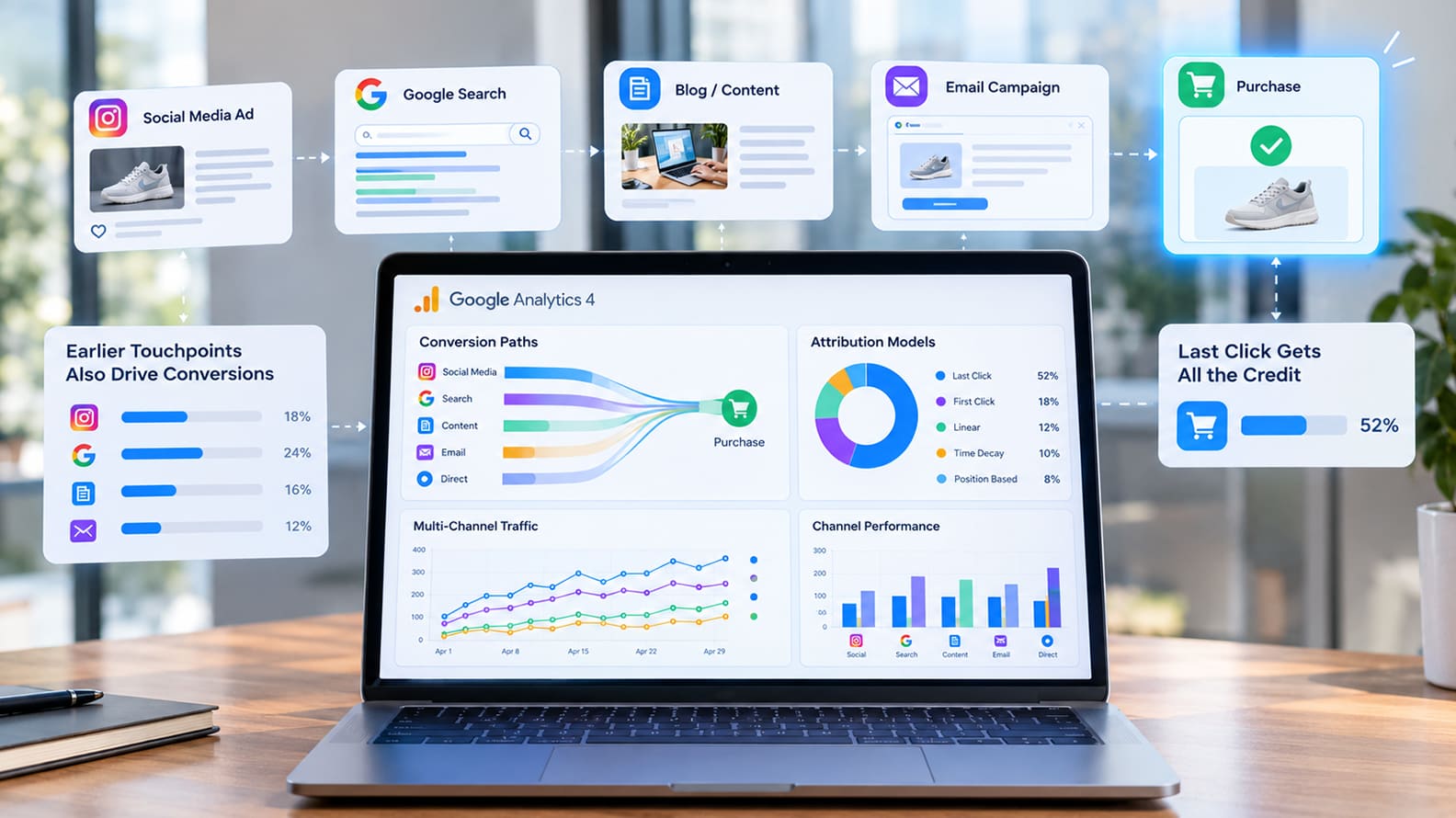
GA4, Attribution, and the Problem With Last-Click Reporting
Oct 15, 2026 / 19 min read
October 16, 2026 / 27 min read / by Team VE

A practical guide for small and mid-sized businesses to measure social media by the attention, trust, conversations and commercial movement it actually creates.
Social media becomes expensive when attention is treated as the result. Reach, likes, followers and impressions can show whether content is being noticed, but they say little on their own about whether the right buyers understand the company better, trust it more, visit the website, start a conversation or remember the brand when the need becomes real.
For SMBs, the stronger strategy is to give social media a clear commercial job. That may be building trust, showing proof, answering objections, supporting sales, creating remarketing audiences, improving hiring credibility or helping buyers discover the business. The right metrics follow from that job, not from whatever number happens to be largest in the platform dashboard.
Duolingo’s 2025 TikTok campaign generated 34.8 million impressions, reached 26.9 million people and delivered a 12.63% engagement rate by extending the absurd, recognisable world it had already built around Duo the Owl.
TikTok’s case study describes the campaign as a continuation of Duolingo’s existing brand lore, with the product’s own mechanics folded into the storytelling. The result matters because the attention was attached to something distinctive enough for people to recognise and participate in.
Strava used the same platform very differently. Its 2026 “Proof of Life” campaign produced an 85% increase in app downloads during the campaign period, alongside a 15% lift in ad recall among Gen Z and millennial audiences, according to TikTok’s campaign data.
Kleinanzeigen, meanwhile, used creator-led storytelling to generate more than 55 million campaign views and a 3.3% lift in usage intention. Social media was doing a different commercial job for each brand. Duolingo was deepening cultural memory. Strava was driving adoption. Kleinanzeigen was shifting intent. The metric only becomes useful once the job is clear.
That distinction matters more now because audiences are becoming harder to impress. Sprout Social’s 2026 research found that consumers want brands to prioritise human-created content and adapt their behaviour to the norms of each platform.
Its wider 2026 data also found that 66% of consumers had become more selective about what they engage with, while 83% said they encounter AI-generated “slop” at least sometimes. Producing more content is becoming easier at exactly the moment attention is becoming more selective.
For any small business, social media therefore needs a commercial role before it needs a content calendar. One company may need it to create product discovery while another may use it to make expertise visible, give sales proof, improve hiring credibility, build remarketing audiences or stay familiar through a long buying cycle.
Reach, likes, views and follower growth still matter because they show whether content travelled but their real value comes from what changed after the right people saw it.
Buffer’s 2026 analysis of more than 52 million social posts found median engagement rates of roughly 6.2% on LinkedIn, 5.6% on Facebook, 5.5% on Instagram and 4.6% on TikTok. Useful benchmarks, certainly, yet Buffer also points out that every platform defines engagement differently, and even its own year-on-year shifts can reflect changes in algorithms, audiences and account mix.
A 4% engagement rate can mean one thing on LinkedIn and something quite different on X. The number only becomes useful once the business knows what behaviour it is trying to encourage. Buffer’s report is valuable precisely because it treats engagement as a diagnostic signal, not a universal scorecard.
The distinction becomes clearer when a brand has a strong commercial reason for being on social media. Adobe does not need every LinkedIn post to generate a lead so its social content often showcases creators, product workflows and customer work because the brand sells into a market where inspiration, capability and professional credibility all influence purchase.
HubSpot uses LinkedIn differently again, mixing research, product education, operator advice and personality because its audience includes marketers, founders and sales teams at different stages of consideration. The lesson for an SMB is not to imitate either feed but to understand why these posts exist and what kind of movement they are meant to create.
Likes and follower growth can often become actively misleading. A post can outperform the account average because it is funny, topical or broadly relatable while attracting people who have little connection to the company’s market. Another can look mediocre in the dashboard and still be much more valuable because it is saved by target buyers, forwarded internally, clicked through to a case study or mentioned later in a sales conversation.
Sprout Social’s 2025 research found that marketing leaders broadly believe social influences goals such as revenue and customer acquisition, while many teams still struggle to connect their reporting to those outcomes. This gap is where vanity metrics become dangerous as they are easy to show precisely because the harder commercial signals sit elsewhere.
A better reading of social performance therefore works in layers. Reach tells you whether distribution is growing while saves, shares, meaningful comments and profile visits tell you whether the content is earning deeper attention.
On the other hand, website behaviour, branded search, direct messages, CRM notes and sales-call references tell you whether that attention is beginning to matter commercially. Once these layers are separated, the next decision becomes much easier: which platform should carry which job for the business?
Different platforms create different kinds of commercial value, which is why “we should be on LinkedIn, Instagram and TikTok” is rarely a strategy in itself. Mastercard’s APAC team, for example, used LinkedIn to amplify the voices of six business leaders across markets including India, Singapore and Australia.
According to LinkedIn’s case study, the programme increased company-page followers by 130%, click-through rate by 175% and engagement rate by 169% year on year. The more interesting part is how the channel was being used. Mastercard wanted senior people to become visible around subjects they genuinely understood, then used paid distribution to place those perspectives in front of relevant business audiences.
Dreamdata pushed the same idea much closer to revenue. The B2B attribution company used employee videos across LinkedIn, then amplified the best-performing ones with Thought Leader Ads to named accounts.
LinkedIn reports that employee-led ads generated three to four times the engagement of brand-led creative, while 83% of closed-won deals during the measured period had been influenced by its Thought Leader Ads. Social was carrying expertise into the buying process, creating website traffic and feeding retargeting audiences at the same time.
A consumer brand can need something completely different from the same medium. Pet wellness company Finn used TikTok creators and shoppable content to turn discovery directly into purchase. Its TikTok Shop campaign generated more than 16 million impressions and over 5,500 purchases, with a 6% purchase rate. Eletta Boutique uses TikTok in an even more native way, combining scheduled product drops with live styling advice and product demonstrations.
TikTok’s case study reports 1,630 orders in a week and a 7.79 return on investment. In both cases, the platform is doing much more than keeping the brand visible. Discovery, reassurance and purchase are happening unusually close together.
For a small business, platform choice becomes clearer once the commercial job is defined. LinkedIn makes sense when expertise, peer credibility and professional trust carry the sale. TikTok or Instagram can be stronger when discovery, demonstration, creators and visual proof shape demand.
YouTube earns its place when buyers need explanations that survive beyond the feed. Community-led platforms become valuable when the business needs to hear how people describe the problem in their own language. The useful question is therefore what the buyer needs from social media at that stage of the decision. Once this is clear, content becomes much easier to design.
The strongest social feeds are rarely the ones covering the most topics. They are the ones that become associated with a handful of useful ideas. Mastercard’s In the Loop series is a good current example. Since launching in August 2025, the recurring LinkedIn format has reached more than 2.6 million professionals, generated 9.8 million impressions and 4.2 million video views, with LinkedIn recording a 9% lift in brand favourability.
The format works because Mastercard keeps returning to finance, commerce and leadership questions its audience already cares about, instead of reinventing the editorial proposition every week. LinkedIn’s case study shows how a repeatable series can build recognition while still leaving room for different stories and speakers.
Ravio takes the same principle down to a much smaller scale. Its Reward Hours webinar series focuses on compensation and rewards professionals, a narrow audience with a narrow set of recurring problems. The series launched in January 2025 with 168 attendees and had grown to 405 attendees by early 2026.
The growth is modest beside Mastercard, but the strategic value is obvious because the people showing up are exactly the people Ravio wants to reach. Ravio’s own account of the programme argues that recurring formats work because audiences begin to recognise what a brand is useful for, which is a stronger position than filling a calendar with unrelated one-offs.
The same logic applies to individual posts. LinkedIn and Ipsos’ 2025 B2B Marketing Benchmark found that marketers were using short-form video and thought leadership heavily for awareness, then leaning more on customer success stories, testimonials and ROI-focused case studies as buyers moved closer to a decision.
The useful takeaway is not that every SMB needs six “content pillars”. It is that content should keep returning to the few questions buyers need answered at different stages, with the form changing as the decision gets closer.
For most SMBs, three or four recurring territories are enough. One might explain the problem, another shows proof, a third addresses the questions that slow a sale, and a fourth gives the company a recognisable point of view. The topics can change every week without the strategy feeling repetitive because the underlying questions remain stable.
Once the editorial spine is clear, founder and employee content becomes much easier to use well, because people are now being asked to bring real expertise into subjects the brand has already decided it wants to own.
In B2B, buyers increasingly encounter the people behind a company before they speak to sales. Edelman and LinkedIn’s 2025 B2B Thought Leadership Impact Report, based on nearly 2,000 professionals, found that hidden buyers inside finance, legal, compliance and operations actively use thought leadership to evaluate vendors.
The report also found that 86% of hidden decision-makers value ideas that challenge assumptions. For smaller firms, that creates an opening because expertise can travel further when it comes from someone who visibly understands the problem.
The example of Smokeball Australia shows how powerful that can become when the voice comes from customers as well as employees. The legal-tech company promoted customer video testimonials through LinkedIn Thought Leader Ads and, according to LinkedIn’s case study, achieved twice the video view rate, 8.7 times the completion rate and a 186% increase in return on ad spend compared with conventional video ads using the same footage.
The creative had not suddenly become better. It’s just that the endorsement simply carried more weight when prospective buyers saw peers speaking in their own names.
Founder and employee content works on the same principle, provided the person has something worth saying. A senior consultant explaining why a project went off track can reveal more about a firm’s judgement than another polished capability post.
An engineer unpacking a design trade-off, a recruiter explaining why apparently strong candidates fail late in a process, or a product lead discussing an implementation mistake can make expertise visible before a buyer ever asks for credentials. LinkedIn and Edelman’s research matters here because B2B buying groups are wider than the obvious decision-maker, and many of the people influencing the decision are consuming content long before they appear in the CRM.
The implication for an SMB is fairly simple. The company page can carry announcements, case studies and product news, while the strongest expertise often belongs with identifiable people who can explain how they think.
Social works better when those voices are connected to the few subjects the business wants to own, which naturally leads to the next question: what should those people actually publish if the aim is to build trust without turning every post into personal-brand theatre?
Social content becomes far more persuasive when buyers can see the work itself. LinkedIn and Ipsos’ 2025 B2B Marketing Benchmark found that customer success stories are among the most widely used formats during the consideration stage, while testimonials, product reviews and ROI-focused case-study videos become increasingly important closer to conversion.
That progression makes intuitive sense. As the buying decision becomes more serious, buyers want less commentary and more evidence that the company can actually deliver.
Salesforce used that logic in India when it wanted to build relevance with mid-market decision-makers. Its LinkedIn campaign was developed specifically around the needs of Indian mid-sized companies, with localized messaging designed to show how Salesforce could support their growth and customer relationships. The value came from making the product feel applicable to a very specific business context.
For an SMB, the scale will obviously be smaller, but the editorial lesson travels well. A software company can show how a customer solved an implementation problem. A design firm can unpack why one landing page iteration performed better than another. A manufacturer can show the operational thinking behind a difficult production decision. The proof becomes the content.
Panasonic took a more visual version of the same approach for the LUMIX S9. Its TikTok campaign worked with creators who could actually demonstrate the camera in use, generating more than 29 million impressions in two weeks and beating performance benchmarks by 191%.
A product such as a camera benefits from being seen through the hands of people who know how to use it. Many SMBs have an equivalent form of proof sitting unused in project files, customer calls, before-and-after work, product demonstrations, implementation notes or support conversations.
The larger point is that social media does not always need another opinion. Often, it needs more evidence. Generic advice has become cheap to produce, especially as AI makes competent content abundant. Work that shows what changed, how a decision was made, what the customer experienced or what the team learned is harder to imitate because it comes from actual delivery.
Once a business starts publishing from that material, measurement also gets more interesting, because the next question is no longer simply whether people engaged with the post. It is whether the proof helped move someone closer to the business.
Teamwork.com gives a clearer picture of what good social measurement looks like once the platform dashboard stops being the endpoint. After connecting LinkedIn activity with conversion and revenue data, the company reported a 250% increase in Lead Gen Form completion rates, a 12x increase in conversions attributed to LinkedIn and more than 350 influenced deals at 2x return on ad spend.
LinkedIn’s case study is useful because the company was measuring the journey from attention to pipeline, not just whether a post performed well inside the feed.
Templafy found a similar pattern. Its LinkedIn campaign produced an 81% increase in pipeline generation, a 46% reduction in cost per opportunity, a 30% increase in branded search and a 14% rise in direct traffic. These numbers sit across different systems, but together they show what social media was changing around the business. Visibility was increasing, more people were searching for the brand directly, and pipeline was improving at the same time.
For an SMB, the useful scorecard can stay fairly simple:
| Signal | What It Really Helps You Understand |
| Reach and impressions | Whether the content is being distributed widely enough |
| Saves, shares and meaningful comments | Whether people find the content useful enough to keep or pass on |
| Profile visits and qualified clicks | Whether attention is turning into curiosity about the company |
| Branded search and direct traffic | Whether repeated social exposure is creating memory |
| DMs and commercial questions | Whether people are moving from passive attention to active interest |
| CRM and sales-call mentions | Whether social is showing up inside real buying conversations |
| Influenced pipeline or assisted conversions | Whether social is contributing to commercial movement beyond last-click attribution |
Platform analytics still matter because they show which topics and formats travel. Google Analytics 4 and clean UTM tagging add what happens after the click. CRM notes and sales feedback complete the picture because many buyers will see several posts, search the brand later and only then speak to sales. A prospect saying, “I have been following your founder for months,” may never have followed a neat conversion path, but the influence is still commercially real.
A useful social report should therefore explain how attention is moving through the business. Reach and engagement belong in it, but beside branded search, qualified traffic, direct messages, sales usage and influenced opportunities. Once those signals are read together, the team can tell which content is building genuine momentum and which posts are simply producing activity.
Ahrefs has always treated social media as more than a publishing channel. In its own account of how it ran Twitter, the team described using the platform to test formats, gather feedback, respond to industry conversations and learn which topics repeatedly earned attention.
Its social reporting then fed those observations back into future content decisions. Ahrefs’ breakdown of its Twitter strategy is especially useful because it shows a company using social media as a live feedback loop around its audience, not simply as a place to distribute finished marketing.
The same idea is now built into the product itself. Ahrefs added a Comments and Mentions report to its Social Media Manager in 2026 so teams can see where a brand is being mentioned across posts, captions and comments, then respond with the full context visible.
That may sound like a workflow feature, but the underlying principle is bigger. Social gives companies access to language, objections and reactions that rarely appear in a neat research report. Buyers tell you what they are confused about, what they disagree with, which competitor they compare you with and which claims they do not quite believe.
For an SMB, some of the most useful social signals may therefore never show up in an engagement chart. A repeated question under a product video can expose weak website copy. A sales objection appearing in LinkedIn comments can become the next case study. A complaint gaining traction around a competitor can reveal an unmet expectation in the category.
Even silence can be informative when a topic the team expected to perform repeatedly fails to move the audience. Social becomes much more commercially useful when the company treats those reactions as market intelligence that can improve the website, sales deck, product messaging and next campaign.
This also changes what a good monthly review should feel like. The team still needs the numbers, but it should leave the meeting knowing something new about the market. Which idea is gaining traction with the right audience?
Which question keeps returning? Which proof is reducing doubt? Which message looks popular but is attracting the wrong people? Once social media starts answering those questions, it becomes easier to decide what deserves more investment and what should disappear from the calendar.
By 2026, simply producing more social content has become a weak strategy. Sprout Social’s latest research on social saturation found that 87% of marketers planned to expand onto new networks even as audiences were becoming more selective about what they engaged with.
The pressure to be everywhere is rising at the same time as attention is becoming harder to earn. More posts, more channels and more formats can therefore create the appearance of momentum while adding very little to how the market sees the brand.
The audience is already signalling what it wants less of. In Sprout Social’s Q1 2026 Pulse Survey, 28% of consumers said brands should stop posting unlabeled AI-generated content, 23% wanted less engagement bait, 12% wanted brands to post less frequently and 9% were tired of forced use of trending audio or memes.
The same research found stronger demand for educational content, community-focused posts and behind-the-scenes material. By Q3, originality had become the second most important reason people said a favourite brand stood out on social, behind only product quality.
Pinterest handled that tension well at Coachella. Instead of chasing another digital trend, it used behaviour already emerging on its own platform, where searches for “analog aesthetic” had risen more than 260%, and created a phone-free physical experience around charm making, beauty touch-ups and junk journaling.
Sprout’s analysis uses the activation as an example of a brand responding to culture in a way that still felt recognisably like Pinterest. The lesson is useful for smaller companies too. A trend becomes valuable when it gives the brand a natural way to express something it already stands for.
For an SMB, the calendar should therefore get lighter as the strategy gets clearer. Festival greetings, generic awareness-day posts, recycled AI carousels and borrowed memes can easily consume the same production time as a strong customer story, expert explanation or piece of original evidence.
Hootsuite’s 2026 Social Trends report reaches a similar conclusion from another direction, arguing that human-made authenticity, audience alignment and platform-specific behaviour are becoming more important as AI accelerates content production. The useful discipline is simple: publish when the business has something worth adding to the feed, and let repetition come from a recognisable point of view rather than a quota.
This naturally leads to the final question for the article: once a business stops chasing volume and vanity, what should social media actually be expected to contribute over time?
Social media earns its place when it changes what the market knows, remembers and trusts about the business. For some companies, that shows up as more branded search. For others, it appears in better sales conversations, stronger recruitment, repeat website visits or prospects arriving already familiar with the company’s point of view. None of those outcomes requires every post to perform dramatically. They require enough consistency for the right audience to recognise what the business stands for.
Adobe is a good example of how that compounds. Its social presence repeatedly showcases creators, product workflows, customer work and practical uses of its tools across channels. The result is not a single “winning post” but a steady accumulation of proof around the brand’s place in creative work. Adobe’s own social and creator ecosystem reflects that wider strategy, where product education, inspiration and user stories reinforce one another instead of sitting in separate silos.
The same principle applies at a much smaller scale. A specialist B2B firm that consistently explains one hard problem, shows how it approaches the work and brings credible people into the conversation will gradually become easier to remember.
A local service business that keeps showing finished work, customer proof and practical guidance builds confidence before the enquiry. An ecommerce brand that repeatedly demonstrates product fit, usage and customer outcomes reduces hesitation in ways a follower count never captures.
For SMBs, the useful end state is straightforward. Social should help the business become more familiar to the right people, more credible when they investigate, and more useful when they are deciding. Once that starts happening, likes, reach and follower growth still have a place in the report. They simply sit where they belong, as signals inside a much larger picture of commercial relevance.
Vanity metrics are numbers that can look impressive without showing whether the business is actually making progress. Reach, impressions, likes, follower growth and video views all have a role because they show how widely content travelled and whether people noticed it. The problem begins when those numbers are presented as proof that social media is improving trust, demand, pipeline or revenue.
The better approach is to treat them as signals within a larger picture. Reach can indicate distribution. Saves and shares can suggest usefulness. Profile visits can show curiosity. Direct messages, branded search, qualified website visits, CRM notes and sales-call references begin to show whether that attention is influencing real buyer behaviour. A metric becomes useful when the business is clear about what it is allowed to prove.
Small and mid-sized businesses should track a combination of platform activity, audience quality and commercial movement. Useful platform signals include reach, saves, shares, meaningful comments, profile visits, video completion and direct messages. Beyond the platform, website behaviour, branded search, newsletter sign-ups, remarketing audience growth, qualified leads and CRM notes help show whether social activity is feeding the wider marketing system.
The mix should follow the role social media plays in the business. A consumer brand may care about product discovery, creator engagement, store visits and purchases. A professional services company may care more about branded search, founder-content engagement, sales-call mentions and influenced opportunities. A useful scorecard reflects the buying journey rather than forcing every business into the same dashboard.
Social media is working when the right audience is becoming more familiar with the company, understanding its offer more clearly and moving closer to a meaningful next step. That movement may appear as website visits, product exploration, direct messages, consultation requests or purchases. In longer sales cycles, it may show up more quietly through branded search, repeat profile visits, saved content or prospects arriving at sales conversations already aware of the company.
One strong post proves very little. Patterns are more useful. If certain topics repeatedly attract relevant people, customer proof gets shared internally, sales teams reference social content during conversations and website behaviour improves around stronger campaigns, social is contributing to the business even when the path cannot be captured neatly through last-click attribution.
LinkedIn is often the strongest starting point for B2B businesses because decision-makers, founders, employees, consultants and industry specialists already use it in a professional context. It works particularly well when the sale depends on expertise, judgement, credibility and peer validation. Founder content, expert commentary, customer proof and thought leadership can all become useful before a buyer is ready to speak to sales.
It should still be chosen because of buyer behaviour, not because LinkedIn is automatically the default B2B platform. YouTube may be stronger when buyers need detailed explanation. Reddit and specialist communities may reveal how customers discuss the problem. Email and the company website can provide deeper education. The useful question is where the buyer looks for reassurance at each stage of the decision.
There is no ideal posting frequency that applies to every business. A small team publishing three genuinely useful posts a week can create more value than a larger team producing daily filler. Frequency helps only when the underlying content is strong enough to earn attention and reinforce something the business actually wants to be known for.
Capacity should shape cadence. A useful rhythm leaves enough time to create strong material, respond to people, learn from performance and reuse the best ideas across formats. One customer story, one expert post and one objection-handling piece can do more commercial work than seven unrelated updates published simply because the calendar has empty spaces.
The strongest B2B content usually begins with real commercial friction. Customer questions, implementation lessons, buying objections, project mistakes, industry changes, cost misunderstandings and operational trade-offs all provide richer material than generic tips because the insight comes from actual experience.
That experience can be expressed through case studies, founder posts, customer stories, short videos, practical explainers, expert commentary or strong points of view. The format matters less than specificity. A good B2B post usually helps the reader understand a decision, avoid a mistake or see a problem more clearly. Content becomes easier to trust when the business can show how it arrived at the insight.
Founder and employee content can be extremely effective when the person has genuine expertise and a clear reason to speak. Buyers often find an identifiable expert more credible than a company account making the same claim. A product lead discussing an implementation trade-off or a consultant explaining why a project failed can reveal more about the quality of the business than another polished corporate post.
The strongest programmes create editorial direction without turning employees into scripted distribution channels. Different people can speak from different areas of experience, while clear guardrails protect confidentiality, customer names, commercial claims and regulated topics. The goal is to make expertise visible in a natural voice, not to manufacture personal brands for everyone in the company.
Paid and organic social media solve different problems. Organic social helps a business develop a recognisable voice, test ideas, show proof, learn from the audience and build familiarity over time. Paid social adds distribution control, allowing the company to place stronger content in front of defined audiences, target accounts or remarketing pools.
The two usually work best together. Organic activity can reveal which customer stories, expert posts and messages resonate with the right audience. Paid distribution can then extend the reach of the strongest material. Using paid media to amplify weak content simply makes poor messaging more expensive, while good organic learning gives the business better raw material to scale.
Yes, although social rarely behaves like a pure direct-response channel in every service category. It can generate direct messages, consultation requests and inbound enquiries, but its influence often begins earlier by building familiarity, explaining expertise and reducing uncertainty before a buyer is ready to act.
That is especially important in professional services, B2B and other high-consideration categories. A prospect may see several posts, read a case study, search the company name later and only then book a meeting. Social may have shaped the decision without receiving the final attribution. Measuring only direct leads can therefore understate the role the channel played in creating confidence and demand.
A useful monthly report should explain what changed and what the business learned. It should cover which topics reached the right people, which posts earned deeper engagement, where qualified traffic came from, which questions appeared in comments or direct messages, how social influenced branded search or sales conversations, and which content was reused elsewhere in the business.
The report should also lead to decisions. A good review helps the team identify which themes deserve more attention, which formats can be dropped, which proof should be amplified and where buyer behaviour is changing. Social reporting becomes valuable when it improves the next month of marketing rather than simply documenting the previous one.
Oct 15, 2026 / 19 min read

Oct 14, 2026 / 27 min read

Oct 13, 2026 / 33 min read