Social Media Strategy for Small Businesses: What to Measure Beyond Likes and Followers
Oct 16, 2026 / 27 min read
October 8, 2026 / 27 min read / by Team VE
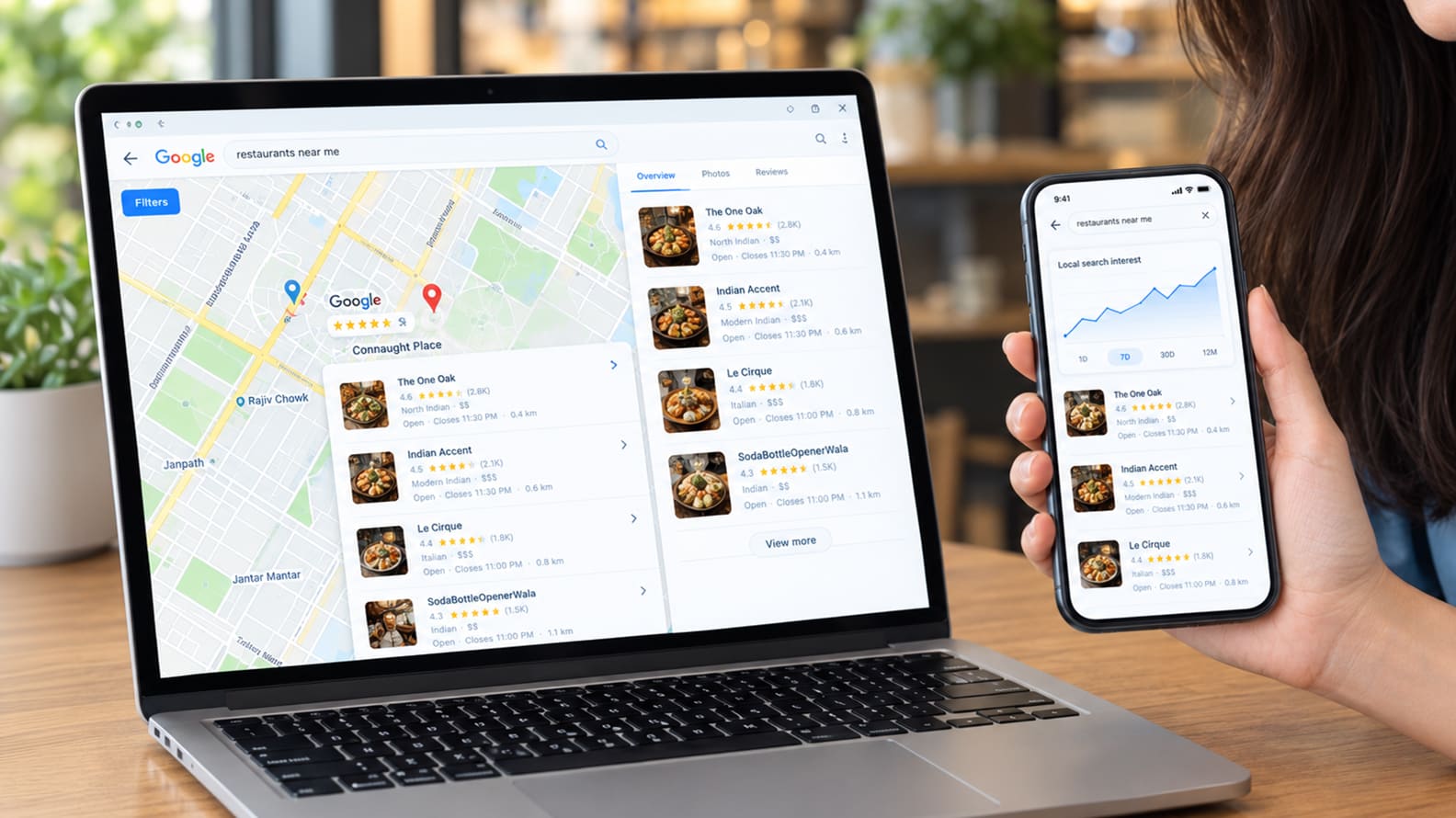
A practical guide to improving your Google Business Profile, reviews, local pages and lead tracking so more nearby customers choose you without overspending on ads.
Local SEO works when a nearby customer can quickly understand three things: what you do, whether you serve their area, and why they should trust you over the other businesses on the screen. For a clinic, accountant, law firm, home-services company, managed IT provider or any other local service business, that decision is shaped by much more than rankings. Google Business Profile accuracy, recent reviews, clear service and location pages, real proof, useful photos and an easy way to call or book all influence whether visibility becomes an inquiry.
This is also where many SMBs waste money on ads. Paid search can bring immediate traffic, but it cannot repair a weak profile, stale reviews, vague landing pages or slow follow-up. A stronger local presence makes organic discovery more valuable and can make paid traffic work harder too. The practical goal is to build a local presence that consistently turns searches into calls, bookings, quote requests and qualified leads.
A local search rarely ends with someone clicking the first result and immediately calling. A homeowner looking for an HVAC company in Florida, a patient comparing dentists in Manchester, or a business owner searching for an accountant in Toronto will usually check a few things first.
They may open the Google Business Profile, skim recent reviews, look at photos, compare opening hours, check whether the right service is listed and then visit the website if they still need reassurance. That entire sequence can happen in a few minutes, and every weak point gives the next business on the screen a chance to win the inquiry.
The numbers from real service businesses show how commercially important that journey can be. Reynolds Air & Heat focused its local SEO around actions that mattered to the business, particularly service calls.
After improving its website content, Google Business Profile and review activity, the company recorded a 49% increase in phone calls from its Google Business Profile and a 63% increase in website clicks. The useful lesson is not that one optimization suddenly changed everything. The profile and website became more effective at helping people decide whether this was the business they wanted to contact.
A separate home-services local SEO case study reported 34,010 Google Search and Maps views turning into 2,606 measurable actions, including 1,743 website visits, 572 direction requests and 291 calls. That works out to roughly one action for every 13 profile views. For an owner, that is a much more useful way to think about local SEO than watching a ranking report move from position four to position three. The real question is what people do once they find you.
Google’s own local ranking guidance says visibility is largely influenced by relevance, distance and prominence. You cannot control where every potential customer is standing, but you can control much of what they see when your business appears.
The services listed on the profile, the categories you choose, the freshness of the reviews, the quality of the photos, the accuracy of the hours and the page someone reaches after clicking through all influence whether that visibility becomes a call or disappears into another browser tab.
For most SMBs, this is where local SEO should begin. Search for your own business the way a new customer would, then compare it with the two or three competitors showing up beside you.
If their profile explains the service more clearly, their reviews are fresher, their photos feel more credible or their website makes the next step easier, you already know where some of the opportunity sits. The next section should go straight into the Google Business Profile, because for many service businesses it is the most visible part of the local buying journey.
For many service businesses, the Google Business Profile is the first thing a potential customer sees, and it often gets more attention than the homepage. That makes basic profile setup far more important than it looks. Google’s own Business Profile guidance says complete and accurate information helps businesses appear in relevant local results, while categories, reviews, hours, photos and other details all influence how useful the profile is to searchers.
The biggest mistakes are usually very ordinary. A physiotherapy clinic may list itself under a broad category but forget to add the specific treatments it actually wants enquiries for. A home-services company may have the right phone number but outdated weekend hours.
A law firm may have dozens of strong reviews but almost no recent photos of the team, office or consultation environment. None of these issues is dramatic, but together they can make a business look less active and less trustworthy than the competitor sitting one result below it.
A stronger profile usually comes down to getting a few practical things right:
Google’s photo guidance is also more specific than many businesses realise. It recommends clear, well-lit images that represent reality without excessive editing, and it allows businesses to add photos that help customers understand the location, products and services.
For a roofing company, that might mean recent job-site photos and branded vehicles. For a dental practice, it could mean the reception area, treatment rooms and clinicians. For a consultancy, it may simply be the team and office environment. The goal is to help someone quickly see that the business is real and active.
It is also worth remembering that a Business Profile is not static. Google can make updates based on information from users and other sources, which is why its profile update guidance recommends reviewing suggested changes rather than assuming the listing will stay accurate forever.
A small monthly check can catch the kind of errors that quietly cost leads, such as wrong hours, an incorrect service category or a customer-facing detail that no longer reflects the business.
A service business with a 4.8-star rating can still look weak if the last meaningful review is eight months old. That matters because buyers are paying attention to recency far more than many businesses realise. BrightLocal’s 2026 Local Consumer Review Survey found that 74% of consumers care most about reviews written within the last three months, while 47% would not use a business with fewer than 20 reviews.
The same research also found that 31% of consumers will only use businesses rated 4.5 stars or above. For a clinic, law firm, contractor or local consultancy, that means an old review profile can quietly make the business look less active even when the underlying service is good.
The quality of the reviews matters just as much as the count. “Great service” is pleasant, but it tells the next customer almost nothing. A review that says the engineer arrived within two hours, explained the fault clearly and fixed the issue without pushing unnecessary work gives a future customer something concrete to trust.
A dental patient mentioning how the clinic handled an emergency appointment is more useful than another generic five-star comment. Google also confirms in its local ranking guidance that review count and positive ratings can contribute to local prominence, so stronger reviews can influence both visibility and the decision that follows.
The practical opportunity is to make review collection part of normal customer communication instead of a desperate push every few months. A property maintenance company can ask after the job is signed off. A clinic can ask after the follow-up appointment. An accountant can ask after a successful filing period or advisory project.
The request should be simple and honest, and the business should never tell customers what rating to leave. What helps is prompting them to describe the service they actually received, because those details naturally create stronger proof for the next person reading.
Responses matter too. BrightLocal’s 2026 research found that people increasingly notice whether businesses reply quickly and thoughtfully, especially when the review is negative. A calm response that acknowledges the issue and explains how the business handled it can be more reassuring than silence, because it shows future customers what happens when something goes wrong.
For SMBs, the real review strategy is therefore not “get more stars”. It is to keep recent, specific customer experiences visible enough that someone comparing three local businesses can see clear evidence that yours is active, responsive and trusted.
Location pages go wrong when they are created for Google first and customers second. A plumbing company serving ten towns does not need ten versions of the same page with only the city name changed. A buyer in Bristol, Austin or Vancouver wants to know whether the business genuinely serves their area, how quickly it can respond, what kind of work it does there and whether other customers nearby have used it successfully.
This is why strong service-area pages need local evidence. Whitespark’s guide to service-area landing pages recommends using location-specific reviews, project photos, relevant service information, maps, contact details, guarantees and other proof that the business actually operates in that market.
It also draws an important distinction between a physical location page and a service-area page. One represents a real branch. The other explains how the business serves customers in an area where it may not have an office.
A useful example is a roofing company expanding across several cities. Instead of publishing “Roofing Services in City A”, “Roofing Services in City B” and “Roofing Services in City C” with nearly identical copy, each page can show recent projects from that area, local weather or building considerations, neighbourhoods covered, expected response times, testimonials from nearby customers and the exact services available there.
A managed IT provider can do something similar with onsite coverage, sectors served locally, client examples and response commitments. A dental group can make each branch page useful with clinician profiles, treatment availability, parking or transport information, opening hours, reviews and booking options.
Smart ways to make a location page genuinely local:
Google’s people-first content guidance is useful here because it asks whether a page provides original, helpful information and gives people enough detail to achieve what they came for. If the only reason a city page exists is because a keyword tool showed search volume, it will usually feel thin. If it helps someone in that market understand what they can book, who will serve them, what proof exists nearby and what happens next, the page has a much stronger reason to exist.
For most SMBs, five strong location pages will usually do more than fifty weak ones. Prioritise the markets where there is real demand, real coverage and enough local proof to make the page useful. Once those pages start earning traffic and enquiries, expand from there. That keeps the site cleaner, the content stronger and the local footprint much easier to maintain.
Paid search is useful when a business needs demand now. An emergency plumber cannot wait six months for every local keyword to improve. A new clinic may need bookings while its organic presence is still developing. A law firm entering a new city may want immediate visibility while reviews and local pages catch up. In those situations, Google Ads and Local Services Ads can buy time, but they work best when the rest of the local presence is already credible enough to convert the click.
Google’s Local Services Ads overview makes that connection quite explicit. The ad can show services, service area, hours and reviews, and in many markets the business also has to complete verification steps before appearing.
Google’s current screening requirements can include licence, insurance, background and business checks depending on the category and country. In the US, Local Services advertisers are also required to have a public, verified Google Business Profile. Paid visibility and local trust are increasingly tied together.
A simple scenario shows where businesses waste money. A roofing company can pay to appear for “roof repair near me”, but if the click lands on a generic homepage with no local project photos, weak reviews, no clear emergency response information and a slow quote form, the ad has only accelerated the buyer’s exit.
The same budget works harder when the person lands on a page that immediately confirms the service, area, availability, relevant proof and next step. The media did its job by creating the visit. The local SEO assets still have to close the confidence gap.
Before increasing local ad spend, check these five things:
This is the useful relationship between local SEO and paid media. Ads create speed. Local SEO creates the proof around that attention. When both are aligned, the business is in a much better position to judge whether the next dollar should go into more media, a stronger landing page, better reviews or a service area that is already converting well.
Local SEO becomes hard to manage when reporting stops at rankings and impressions. A service business can move up in Maps, grow website traffic and still end the month wondering why the phone is quiet. The more useful question is which searches and local touchpoints are producing calls, bookings, quote requests and customers that are actually worth serving.
Google already gives part of that picture through Business Profile Performance, where businesses can see interactions such as calls, website clicks, bookings and direction requests. Google Search Console adds the queries and pages bringing people into the site, while Google Analytics can show what happens after they arrive.
For businesses where phone calls drive a meaningful share of revenue, tools such as CallRail or WhatConverts can connect individual calls and forms back to the marketing source that generated them.
The important part is tying those signals back to lead quality. A garage-door company may discover that one suburb generates lots of calls but very few jobs because most enquiries fall outside its profitable service range. A legal practice may find that a lower-traffic immigration page produces better consultations than a much busier general legal page.
A physiotherapy clinic may see plenty of clicks from “physio near me”, while its sports-injury page drives fewer visits but considerably more completed bookings. Those are the kinds of patterns that should decide where the next round of SEO work goes.
A useful local SEO dashboard can stay quite lean:
| Track this | What it helps you decide |
| Calls, forms and bookings | Whether visibility is becoming enquiries |
| Qualified lead rate | Whether the right customers are finding you |
| Close rate by source | Which channels and locations create revenue |
| Business Profile actions | Whether the profile is persuading people to act |
| Search queries by service and location | Which pages and markets deserve more attention |
| Review themes and recency | Whether your proof matches the services you want to grow |
Once those numbers are visible, local SEO gets much less mysterious. If calls rise but close rate falls, the problem may be targeting or clarity in the offer. If profile views are strong but website clicks and calls are weak, the profile may need better reviews, photos or service information. If one city page consistently produces high-quality leads, that is a far stronger signal for expansion than a keyword-ranking report alone.
A surprising amount of local SEO happens away from your own website. A prospective customer may find your business on Google, then check Apple Maps, Yelp, a local chamber directory, an industry association or a supplier page before deciding whether the company feels established. If the phone number is different, the address is old or the business name varies across those places, the problem is not only SEO. It creates the kind of small doubt that can cost a call.
Google itself says local business information can come from several sources, including the company website, third-party data and user contributions. That is why keeping core business details consistent matters. The same principle applies beyond Google.
Apple Business Connect lets businesses control how they appear across Apple Maps and other Apple services, while Bing Places for Business gives owners similar control over their Microsoft listing. For a local service business, these are basic visibility assets, especially when customers are using different devices, maps and search engines.
The useful part is deciding which listings actually matter. A law firm should care more about respected legal directories and local bar associations than hundreds of generic listing sites. A home-services company may get more value from Google, Apple Maps, Bing, Yelp, local chambers and supplier directories. A clinic should prioritise healthcare directories, insurance networks and professional bodies that real patients might actually use.
A simple cleanup usually starts with:
Tools such as BrightLocal and Whitespark can help identify and clean up important citations, but the goal is not to get listed in as many places as possible. It is to make sure the important places are accurate, credible and useful. For an SMB, ten strong listings that customers actually encounter are far more valuable than a hundred forgotten directory submissions.
Local discovery is changing because people are no longer using search only as a list of links. Google says AI Overviews now has more than 2.5 billion monthly active users, while AI Mode has crossed one billion monthly users, which means more people are asking longer, more conversational questions and expecting the search experience to help narrow the choice for them.
For a local business, that raises the value of having clear, consistent information across the profile, website, reviews and other trusted sources because AI-led search still needs reliable evidence about what the business does, where it operates and why it is relevant.
You can already see this shift inside Maps. Google says its newer AI-powered Maps experiences combine Gemini with live map data, business information and review signals to answer more specific questions about nearby places.
A customer may ask for “a family dentist open on Saturday with good reviews for nervous patients” or “an HVAC company nearby that handles emergency call-outs”. The business that has accurate hours, the right services listed, detailed reviews and clear local pages gives those systems more useful information to work with.
That does not mean SMBs should start writing strange “AI-optimized” copies. The practical work is much simpler:
The opportunity is less about chasing a new ranking factor and more about becoming easier to understand everywhere. If a search engine, map product or AI assistant can clearly see that a business offers a particular service in a particular area, has recent customer evidence and presents the same facts across trusted sources, it has a stronger foundation for local discovery. That is useful today for Search and Maps, and it becomes even more important as local search grows more conversational.
Local SEO works best when it removes doubt from the buying decision. A customer searching nearby is usually comparing several businesses at once, and the winner is rarely the one with the most SEO activity behind the scenes. It is the business that looks current, credible and easy to act on. The profile is accurate, the reviews are recent, the right service is clearly explained, the location information makes sense, and the next step is obvious.
That is also why local SEO should not be treated as a collection of isolated tasks. Google Business Profile, reviews, service pages, location pages, local listings, paid search and tracking all influence the same decision. A weak profile can reduce the value of a strong website. A good ad can still waste money if the landing page is vague. A high-ranking location page can bring little value if the calls are poor quality or nobody follows them up properly.
For small and mid-sized businesses, the most useful mindset is simple: keep improving the places where real customers make decisions. Make the profile stronger. Keep reviews fresh. Build pages only where there is something useful to say. Track which locations and services produce good leads. Use paid media when it adds speed, not when it is being asked to compensate for weak fundamentals.
Over time, this creates something more valuable than a temporary ranking gain. It creates a local presence that keeps helping the business get found, compared and chosen across Search, Maps, reviews, websites and increasingly AI-led discovery. The companies that do this well are not trying to look like they understand local SEO. They are making it easier for a nearby customer to understand why they should call.
There is no fixed timeline because local SEO depends heavily on the market, competition, website condition, review profile and how established the business already is. A service company in a competitive city may need several months before meaningful ranking and lead improvements become obvious, while a business with an under-optimised profile and weak local pages may see some gains relatively quickly once the obvious gaps are fixed.
It is more useful to watch for commercial movement than to wait for a single “SEO result”. Improvements in Google Business Profile actions, calls, bookings, direction requests, local landing-page traffic and qualified leads are often better indicators than rankings alone. A business should be able to see whether its local presence is becoming more useful even before every target keyword reaches the top positions.
They solve different problems. Google Ads can create visibility immediately, which is useful for urgent services, seasonal demand, new locations or highly competitive categories. Local SEO takes longer, but it builds assets that continue working over time, including a stronger Google Business Profile, better reviews, more useful service pages and stronger local authority.
For many SMBs, the strongest approach is to use both intelligently. Paid search can create demand while local SEO improves the trust layer around that traffic. As the profile, reviews and landing pages become stronger, the same ad spend can also become more productive because people are more likely to trust the business after clicking.
Yes. Google states that review count and positive ratings can influence local prominence, so reviews can contribute to visibility as well as customer trust. They are especially important for service businesses because people often compare several providers before calling, and recent customer experiences can reduce uncertainty quickly.
The quality of those reviews matters too. A detailed review mentioning the actual service, response time, communication and outcome is much more useful than a vague “great company” comment. Businesses should focus on building a steady flow of genuine reviews and responding thoughtfully, especially when a review raises a concern.
There is no universal number that guarantees strong local visibility. The useful benchmark is usually the competitive set around you. If the leading businesses in your category have several hundred recent reviews and you have twenty, the gap is commercially significant. In a smaller market, the difference may be much less dramatic.
Recency and relevance matter alongside volume. A business with fewer reviews but a steady stream of recent, detailed customer feedback may look more active than one with a large historical review count and very little recent activity. The goal is consistent proof over time, not a one-off review campaign.
Only when the page can genuinely help someone in that area. A strong location page should show that the business really serves the market, explain the relevant services, include local proof where possible and make the next step clear. Simply replacing the city name across dozens of near-identical pages creates very little value.
Most SMBs are better off starting with their most important markets and building stronger pages around those. Local reviews, project examples, team coverage, response times, neighbourhoods served and practical information can make each page more useful. Quality matters far more than the total number of city pages.
At minimum, the profile should have the correct business name, address or service area, phone number, website, opening hours, primary and secondary categories, services, photos and booking or appointment links where relevant. Those details should also remain accurate when hours change, new services are introduced or the business expands.
The profile should feel active as well. Recent photos, up-to-date services and regular review responses help potential customers understand that the business is operating normally. For service businesses, it is worth checking the profile regularly because stale or incorrect information can quietly damage both trust and conversion.
Yes, but the objective has changed. The goal is not to submit the business to hundreds of low-quality directories. It is to make sure the important places where customers or search systems would reasonably expect to find the business contain accurate information.
That may include Google, Apple Maps, Bing, Yelp, local chambers, professional associations, supplier directories or sector-specific platforms. Consistency matters most when a business has moved, changed phone numbers, opened new locations or rebranded. A smaller set of high-quality listings is usually more useful than a large collection of forgotten ones.
Start with actions that connect visibility to real business. Calls, forms, bookings, direction requests, website clicks from the Google Business Profile, local search queries, qualified leads and close rate by source are all more useful than rankings alone.
The most valuable reports also include context from sales or front-office teams. If calls are increasing but the leads are poor quality, the problem may be targeting or service clarity. If profile views are high but actions are weak, the issue may be reviews, photos, opening hours or the strength of the offer.
It can help by making the business easier for search systems to understand. Clear service pages, accurate location information, consistent listings, structured data, detailed reviews and credible third-party mentions all contribute to a stronger picture of what the business does and where it operates.
That does not mean there is a special shortcut for ranking in AI answers. The more useful approach is to make the business information clear, specific and verifiable across the web. The same work that improves local Search and Maps visibility also gives AI-driven search systems better evidence to work with.
The right model depends on the complexity of the business. A freelancer can work well for a simple local footprint and clearly defined tasks. An agency can make sense when the business needs strategy, technical SEO, content, PPC and multi-location execution at the same time. A dedicated marketer can be useful when the main challenge is ongoing execution and coordination.
Ownership matters more than the label. Local SEO tends to weaken when reviews, profile updates, reporting, landing pages and tracking are spread across several people with no clear responsibility. The business needs someone who can keep the information accurate, notice problems early and connect marketing activity to actual lead quality.
Oct 16, 2026 / 27 min read
Oct 15, 2026 / 19 min read
Oct 14, 2026 / 27 min read