The New SEO Content Brief: How to Write for Humans, Google, and AI Search
Oct 02, 2026 / 34 min read
October 1, 2026 / 41 min read / by Team VE
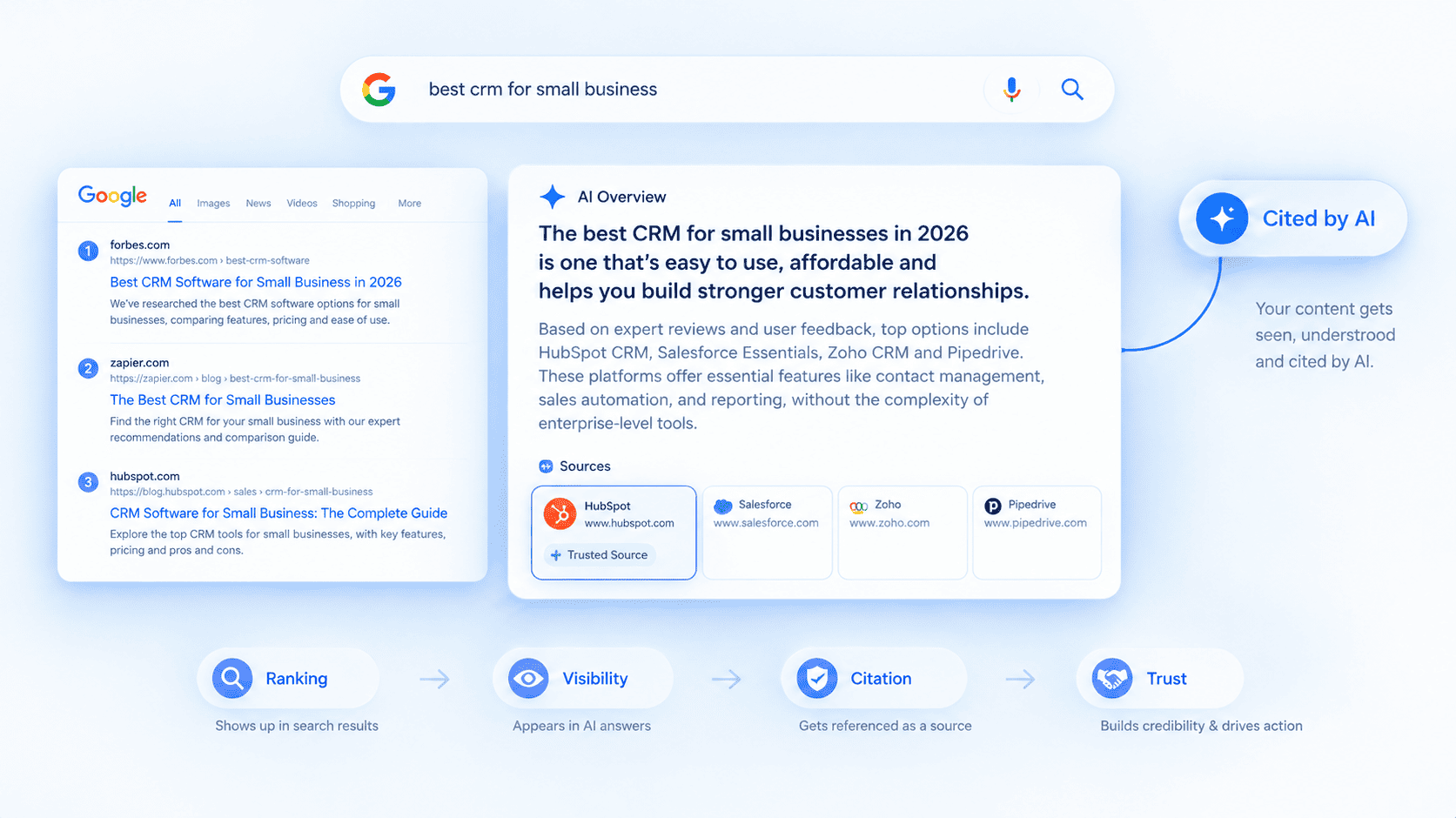
People are searching in longer, more conversational ways, and AI answers are shaping which brands get seen before a website visit happens. SEO now stretches across rankings, citations, branded discovery, third-party proof and the wider research journey.
AI search is changing where SEO creates value. Google rankings remain important because AI experiences still draw from searchable, crawlable web content, while the buyer journey now includes AI Overviews, AI Mode, ChatGPT, Perplexity, Copilot, review sites, social platforms and branded search. A strong page can influence the shortlist even when the user never clicks through immediately.
For small and mid-sized businesses, the practical opportunity is to become easier to understand, easier to verify and easier to reference. That means stronger service pages, clearer answers, original examples, expert proof, case studies, review signals, third-party mentions and content built around the questions buyers actually ask while making a decision.
DiscoverASR, the serviced-residence and extended-stay platform, gives a useful glimpse of where search is heading. Travellers are no longer moving neatly from Google to an online travel agent (OTA) to a hotel website. They are asking ChatGPT where to stay for a month in Singapore, using Gemini to compare neighbourhoods, asking Perplexity which serviced apartments suit families, then returning to Google to check reviews, photos and availability.
During one quarter in 2026, DiscoverASR’s AI-search programme grew its estimated generative-search audience from 7.4 million to 34.6 million, while mentions across ChatGPT, Gemini, Google AI Mode and Perplexity nearly doubled. The brand was showing up earlier in the decision, while the traveller was still figuring out what to consider.
Google’s own data suggests that behaviour is becoming mainstream very quickly. AI Mode has already passed one billion monthly users, and Google says the average AI Mode query is around three times longer than a traditional search. People are also using images and voice more often, while planning and decision-oriented queries are growing particularly fast.
Someone who may have once typed “best accounting firm near me” can now ask which type of firm suits a 120-person company with operations in three countries, what questions to ask before hiring one, and which providers appear strongest for that specific situation. Search is becoming less like a directory and more like an ongoing conversation in which the buyer keeps refining the decision.
This changes what visibility means for a small or mid-sized business. A managed IT provider may appear while a buyer is asking which cybersecurity certifications matter. A staffing company may surface during a comparison of agencies, freelancers and dedicated remote teams. A clinic may enter the journey when someone asks about treatment options, recovery time and price before looking at individual providers.
The source document describes this wider path well: buyers now move across Google results, AI answers, review platforms, Reddit-style discussions, YouTube, LinkedIn, comparison pages and branded search as they build confidence. The website remains central, while more of the decision is being shaped by what the wider web says about the business before the visit happens.
SEO therefore has a larger job in the days ahead. Search engines need to understand the company clearly, AI systems need enough credible material to reference it accurately, and buyers need to keep encountering the same useful evidence as they move between platforms. Service pages, expert articles, case studies, reviews, third-party mentions, original research and clear brand language start reinforcing one another because each gives the next system, and the next buyer, more context.
Google is already adapting its measurement tools around that reality, adding dedicated reporting for generative and multimodal search experiences in Search Console. The next part of the SEO conversation, then, is understanding what happens to rankings when the search result itself begins answering the question.
Tally Education is a useful example because it sits in exactly the kind of market where search behaviour is changing quickly. People researching accounting courses, certifications or career options often begin with fairly broad questions, and many of those questions can now be answered substantially inside Google itself.
During the first half of 2026, Tally Education worked on SEO, Answer Engine Optimization and Generative Engine Optimization together as AI Overviews and conversational search began absorbing more of those early research queries. The programme focused on expanding non-branded discovery while making the site’s content easier to surface in AI-led results, rather than treating traditional rankings and AI visibility as separate exercises.
The commercial reason for doing that becomes clearer when you look at what is happening to clicks. Pew Research Center analysed 68,879 Google searches and found that users clicked a traditional result in 8% of visits when an AI summary appeared, compared with 15% when one did not.
A buyer researching something straightforward may now get enough information from the summary to keep moving without opening several pages. For a company like Tally Education, that means an article explaining a basic accounting concept may create awareness inside the result itself, while a course comparison, fee page or certification guide can still pull the user deeper when the decision becomes more specific.
The same distinction matters in B2B. A cybersecurity company might publish a page explaining what zero-trust architecture means, another comparing different implementation approaches, and a third showing how its own platform works in a regulated industry. All three can rank, yet they play very different commercial roles. The first may increasingly be consumed through an AI-generated answer.
The comparison page can shape which vendors make the shortlist. The product or implementation page has a much better chance of attracting the buyer once the conversation becomes concrete. The source draft captures this wider view well: rankings, citations, branded recall, sales usefulness and movement towards a real conversation are becoming different expressions of the same search journey.
That is also why traffic needs more interpretation than it used to. Ahrefs’ 2026 update on AI Overviews found a substantial reduction in click-through rate for top-ranking pages when an AI Overview was present. The more useful question for an SMB is which searches are losing clicks and which are still carrying commercial intent.
Definitions and simple informational queries are easier for an answer engine to satisfy directly. Pricing, implementation, comparison, local availability, product fit and risk usually need more context. These are the searches where a well-built page can still earn the visit and move the buyer closer to action.
So the practical meaning of ranking is becoming richer. A page can help a business become known during early research, appear as a cited source, reinforce the brand during comparison and eventually bring the buyer onto the site when the question becomes specific enough.
For small and mid-sized businesses, that creates a more useful way to think about SEO investment because the goal is no longer to make every page perform identically. It is to make each important page useful at the moment in the buying journey where it has the most influence.
McAfee offers a useful example of how this starts to work in practice. The cybersecurity company already had the kind of authority most smaller businesses spend years trying to build, yet even a strong brand has to make its expertise legible to newer search systems.
In its work on AI visibility, McAfee focused on improving how its content could be understood and surfaced across AI-led search experiences, alongside the traditional SEO work that already supported organic discovery. The broader pattern across those programmes is revealing: stronger structure, clearer topic relationships and better-connected content can improve visibility in conventional search and increase the likelihood of appearing inside AI-generated answers as well.
AI systems are selective in a different way from a human scanning ten blue links. They have to decide which pieces of information are clear enough to extract, reliable enough to ground an answer and specific enough to be useful. A page that says a cybersecurity provider offers “industry-leading protection” gives an answer engine very little to work with.
A page that explains which threats a product covers, how detection works, what environments it supports, where its limitations sit and what independent evidence exists gives the system something much more concrete. The same principle applies to a 50-person accounting firm, a SaaS company or a specialist manufacturer. AI search benefits from specificity because specificity reduces ambiguity.
Lily Ray’s work is especially relevant here. She is one of the most prominent SEO strategists of the past decade and has spent years studying Google’s quality systems, E-E-A-T and the way authority is established across sensitive and competitive search categories.
In a recent discussion about AI search, Ray argued that lasting visibility continues to come from real expertise, strong E-E-A-T signals and genuinely earned recommendations, particularly as more marketers experiment with automated content and quick GEO tactics. Her point is useful because it gets underneath the latest terminology. A page earns more value when it contains evidence that can be checked and expertise that is difficult to manufacture superficially.
For an SMB, the difference becomes easy to see once you compare the kinds of pages being produced:
| A Typical SEO Page | A Page Built for Search and AI Discovery |
| Broad service description | Clear service scope, use cases and operating detail |
| Generic thought leadership | Expert opinion, original examples and specific judgement |
| Repeated definitions | Definitions connected to a real buyer decision |
| Claims such as “experienced team” | Named proof, case studies, reviews and evidence |
| Keyword-led FAQs | Questions drawn from sales conversations and customer objections |
| Company-only claims | Supporting third-party mentions and credible external references |
The source draft makes the same distinction in its AI-search readiness matrix, particularly around service pages, thought leadership, brand entities and measurement. The important part is the quality of the information underneath the format. Tables, FAQs and answer blocks can make a page easier to interpret, but the value comes from the substance inside them.
A useful way to think about citation, then, is as a test of whether the company’s knowledge can travel. If a founder explains something brilliantly on a sales call, that insight should exist somewhere search engines and AI systems can find it.
If customers repeatedly praise one element of the service, the evidence should appear in case studies and reviews. If the company has data that changes how buyers understand a problem, it deserves to become original research. Pages become more citable, when the business starts publishing the knowledge it already uses to win trust in the real world.
HubSpot is a useful example because it has spent years building one of the strongest organic content engines in B2B software, yet by 2025 and 2026 it was already adapting that machine for a very different kind of discovery journey. The company began tracking how often its brand appeared across ChatGPT, Gemini, Perplexity and other answer engines, then mapped those appearances against the questions buyers were asking at different stages of consideration.
According to HubSpot’s own 2026 account of its AEO programme, the company increased AI citations by 433%, saw qualified leads from AI grow 1,850%, and found that those leads converted at roughly three times the rate of other sources. The interesting part was not simply the increase in citations. HubSpot learned that buyers were encountering the brand across product pages, third-party publishers, Reddit discussions and AI answers long before they reached a conventional conversion page.
That journey is increasingly familiar across categories. Someone researching CRM software might begin with a Google AI Overview, ask ChatGPT to compare HubSpot with Salesforce and ActiveCampaign, read a Reddit thread about implementation pain, check G2 reviews, open a YouTube tutorial, and return a week later through branded search.
A founder looking for an outsourcing partner can follow exactly the same pattern through a completely different set of sources. In both cases, every touchpoint adds another small piece of evidence about the company: what it does, who recommends it, where customers struggle, what people praise, how pricing works and whether the brand appears consistently when the buyer keeps asking harder questions.
The source draft describes that same sideways movement across AI answers, reviews, LinkedIn, YouTube, comparison pages and branded search, which is now a much more realistic picture of how expensive decisions are researched.
HubSpot’s programme is especially interesting because a large part of the work happened outside HubSpot.com. Its team identified publishers that were already being cited frequently in AI answers and worked with those sites to improve the quality and relevance of HubSpot mentions. It also paid close attention to Reddit because the platform kept appearing among the sources answer engines were using for buyer-oriented prompts.
In France and Germany, HubSpot found strong Reddit citation activity with very little brand presence, then built localized community activity around the questions buyers were already discussing. Within a month, its mention rate moved from zero to 33.5% in France and 17.1% in Germany. That is a useful lesson for smaller businesses because AI visibility depends increasingly on the wider web knowing enough about the company to describe it accurately.
Rand Fishkin is especially relevant here because he has spent more than two decades studying how people discover brands through search and the wider web. He co-founded Moz, one of the companies that helped define modern SEO, and now runs SparkToro, where much of his work focuses on audience behaviour and the growing share of discovery that happens without a conventional website visit.
In his 2026 zero-click research with Similarweb, Fishkin found that 68.01% of US Google searches ended without a click during the first four months of the year. His relevance to this discussion is straightforward: he has been tracking the erosion of the old search-to-click model for years, and the latest data shows how quickly that behaviour is accelerating.
ZipRecruiter gives us a useful real-world example of how AI visibility starts to compound when a brand has enough useful material around the questions people are already asking. Between October 2025 and July 2026, the recruitment platform worked on a broader search and citation strategy that extended well beyond its own website.
Over that period, ZipRecruiter’s AI share of voice increased by 72%, while pages influenced by the programme generated 251% more AI citation appearances. The same work also more than doubled the number of campaign-influenced keywords visible in Google, which is important because it shows how closely traditional search visibility and AI visibility can reinforce one another.
The more interesting part is where those citations came from. By July 2026, 83 different pages influenced by the programme had earned at least one AI citation, while more than 400 pages mentioning ZipRecruiter were ranking in Google’s top ten. For a recruitment brand, that surrounding footprint matters enormously.
Employers researching where to advertise a role may encounter the company on an industry page, a comparison article, a hiring guide or an AI-generated shortlist before they reach ZipRecruiter’s own product pages. Job seekers can follow an equally fragmented path through salary questions, career advice, company reviews and application guidance. Each useful appearance adds another layer of familiarity before the commercial decision happens.
That pattern is particularly relevant to SMBs because most do not have the authority or brand recognition of ZipRecruiter. A 70-person cybersecurity firm may have deep expertise that never leaves sales calls. A regional accounting practice may answer the same tax and compliance questions every week but publish only broad service pages.
A specialist software company may have product knowledge scattered across demos, support tickets and implementation documents. AI search creates an opportunity to turn that knowledge into material that can travel. A comparison page can help a buyer shortlist providers. A pricing explainer can answer a commercial question. A case study can show how the service works in practice. A technical guide can establish expertise around a problem the buyer is already researching.
This is where Neil Patel’s perspective becomes useful. Patel is one of the best-known digital marketers of the past two decades, co-founder of NP Digital and the creator behind a large body of SEO and content research used by marketers globally.
His work has consistently focused on connecting search visibility with commercially useful content, and his recent writing on AI search optimization makes much the same argument from a modern SEO perspective: AI systems need clear, authoritative and well-supported information if a brand is going to surface consistently in generated answers.
His relevance here is practical. He has spent years translating shifts in search behaviour into decisions businesses can actually act on, and the AI-search era is making specificity, authority and useful evidence more valuable than sheer publishing volume.
For a small business, the priority can therefore stay fairly simple. The pages closest to real buyer questions deserve the deepest treatment first: service pages, comparisons, pricing and cost explainers, implementation guides, FAQs drawn from sales calls, case studies and expert-led articles. A business does not need hundreds of new pages to become more visible in AI search. It needs a smaller body of pages that contain enough real information to be worth finding, quoting and remembering.
A lot of businesses assume AI search visibility begins with publishing more content. In practice, it often begins with making the most commercially important pages far more useful than they are today. Viggle’s 2026 AI visibility work is a good example. The company already had strong organic reach, with hundreds of thousands of visits and tens of thousands of ranking keywords, but only a tiny number of pages were appearing inside AI answers.
Over the following months, the gains came from tightening page structure, clarifying topic relationships, improving technical foundations and making the content easier for search systems to interpret. By August 2026, the number of pages cited in AI answers had risen sharply, and conventional rankings improved as well. The lesson is useful because the progress did not come from flooding the site with fresh articles. It came from making the pages that already mattered much more legible.
That logic travels well to smaller businesses. A managed IT provider may already have a cybersecurity services page, but the page often says very little about what is actually included, which companies the service suits, how onboarding works, what standards or frameworks are supported, how responsibilities are split between client and provider, and what usually affects pricing.
A buyer wants those answers because they help narrow the decision. An AI system wants the same answers because they make the business easier to describe accurately. Adding another broad article about why cybersecurity matters does not help nearly as much as turning the service page into something detailed enough to support a real evaluation.
The same pattern holds across other categories. An accounting firm can explain which businesses it works with, what monthly bookkeeping includes, how migration is handled, what software it supports and what changes the fee. A B2B software company can show implementation time, integrations, security requirements, support model and the kinds of teams the product fits best.
A specialist manufacturer can publish tolerances, applications, certifications, lead times and technical comparisons. These are not decorative details. They are the details buyers actually use when deciding whether a company belongs on the shortlist, and they are exactly the sort of specifics that make a page more useful in search and more likely to be cited by an answer engine.
A practical way to think about the first round of AI-search work is to look at the pages most closely tied to revenue and ask whether they genuinely help a serious buyer move forward:
| Page Type | What the Buyer Is Looking For | Why It Matters More Now |
| Service or product pages | Scope, fit, proof, process, price logic | These pages help search engines and AI systems understand what the business actually offers |
| Comparison pages | Differences between providers, products or approaches | Buyers increasingly ask AI tools to compare options before they visit a website |
| Pricing and cost guides | What affects cost and what the buyer receives | Pricing context answers one of the most commercially important questions early |
| Case studies | What happened for a real client and how | First-hand evidence gives claims much more credibility |
| Expert guides | How an experienced practitioner thinks through a problem | Distinctive insight makes the content more memorable and more citeable |
| FAQs | Real objections and recurring pre-sales questions | Clear answers help both the buyer and the system interpreting the page |
For most small businesses, this is a far better starting point than inventing a separate GEO programme and treating it like a new marketing fashion. The most valuable raw material usually already exists inside sales calls, proposals, onboarding conversations, support queries and customer objections.
Bringing that knowledge onto the pages buyers already rely on makes the website more useful, gives search systems better material to work with, and gives the business a stronger chance of being remembered when the final shortlist begins to form.
Shopify is a useful example because its AI visibility is being built far beyond Shopify.com. In Semrush’s 2026 analysis of digital PR and AI search, Shopify appeared in more than 45,000 AI mentions, supported by a very large footprint across places buyers already use to make decisions. Semrush found more than 44,500 Shopify mentions on Reddit, over 15,000 on LinkedIn, and hundreds more across G2 and Capterra.
A founder asking ChatGPT which ecommerce platform suits a new business is therefore surrounded by years of accumulated evidence about Shopify before the company’s own website even enters the conversation. Reviews, comparisons, implementation stories, complaints, tutorials and community discussions all contribute to the picture the answer engine assembles.
This is an important development for smaller businesses because a company can no longer define itself entirely through its own copy. A SaaS vendor can describe its product as easy to implement, but buyers will also encounter what customers say on G2, what consultants explain on YouTube, what users complain about on Reddit and how industry publications compare it with alternatives.
An outsourcing business may have an excellent service page explaining its delivery model, yet the wider web becomes much more persuasive when clients, partners and independent publications describe the same strengths in their own language. AI systems are effectively reading that surrounding evidence alongside the company’s own material, which makes consistency across case studies, reviews, interviews, partner pages and expert commentary commercially useful in a way that extends well beyond link building.
The scale of that relationship is beginning to show up in larger datasets. Ahrefs analysed 75,000 brands across ChatGPT, Google AI Mode and AI Overviews and found that branded mentions around the web had a strong correlation with AI visibility, while YouTube mentions produced the strongest correlation in the study at roughly 0.74. That does not mean publishing a video automatically earns an AI recommendation.
It does suggest that brands with a richer public footprint are giving search and answer systems far more material with which to understand who they are, what they do and where they fit. For a smaller company, an expert interview watched by a few thousand relevant people, a detailed customer review, a useful industry podcast or a well-earned mention in a specialist publication can become part of the search asset base rather than sitting in a separate PR bucket.
Seth Godin’s work is useful here because he has spent more than three decades writing about how brands earn attention and trust rather than simply buying exposure. He is the author of books including Permission Marketing, Purple Cow and This Is Marketing, and his influence comes from consistently treating marketing as something built through reputation, distinctiveness and the stories other people choose to carry forward.
His long-running argument that remarkable ideas spread because people find them worth talking about feels unusually relevant to AI search. A brand that customers review, experts discuss, creators explain and publications reference leaves behind a much richer digital record than one that only publishes about itself. In an environment where AI systems are assembling answers from many different sources, that wider record increasingly becomes part of SEO itself.
Men’s Wearhouse is a useful example because it shows how quickly the distinction between SEO and AI search starts to blur in practice. The retailer used Quattr’s AI-led content and internal-linking system across product and editorial pages, and the gains appeared in both places marketers now care about.
Product-page clicks rose 46%, Google AI Mode visibility increased 75%, and top-three ChatGPT citations grew 50%. The same underlying work was helping pages perform in conventional search while also giving newer answer engines clearer paths to understand and surface the content.
That is a much healthier way to think about GEO. A retailer still needs technically sound pages, clear product information, useful category structure, strong internal linking and enough authority for Google to trust the site. AI-led discovery adds another layer because the same content may now be retrieved, summarised, compared or cited inside an answer before the customer reaches the product page.
For a B2B company, the mechanics look different but the logic is similar. A service page that clearly explains scope, implementation, pricing logic and proof can rank for commercial queries, support an AI-generated comparison and help a salesperson answer the same question later in the buying cycle.
In her recent work on AI search visibility, Lily Ray has repeatedly come back to the same underlying principle: durable visibility tends to come from real expertise, credible recommendations and a body of evidence strong enough to survive changes in how search results are presented. This fits the GEO conversation well because it keeps the focus on source quality, brand authority and usefulness rather than treating AI search as a separate layer of tricks.
For an SMB, the distinction between classic SEO and GEO is therefore mostly about widening the questions being asked of each important page:
| Traditional SEO Question | AI Search Question | What the Page Needs |
| Can we rank for this search? | Can we become a useful source inside the answer? | Clear coverage of the buyer’s real question |
| Does Google understand the page? | Can an answer engine extract the important parts accurately? | Strong structure, definitions, examples and evidence |
| Do we have authority around the topic? | Is the brand supported by credible signals elsewhere on the web? | Reviews, case studies, expert mentions, digital PR and consistent brand information |
| Are people clicking? | Are we influencing research before the click as well? | Branded demand, citations, high-intent visits and sales feedback |
| Does the page attract traffic? | Does it help the buyer make a decision? | Commercial depth around price, fit, risk, comparison and proof |
A company with a solid SEO foundation is already much closer to AI-search readiness than the acronym-heavy conversation makes it seem. The next gains usually come from making strong pages more explicit, adding evidence where claims are thin, connecting related content more intelligently and building a wider public footprint around the brand.
GEO becomes useful when it strengthens the same commercial assets the business already depends on and gives those assets a better chance of travelling through Google, ChatGPT, Gemini, Perplexity and the rest of the research journey.
For years, SEO reporting trained businesses to look in the same places every month: rankings, impressions, clicks, sessions and conversions. Those numbers remain useful, but they tell less of the story once a brand starts appearing inside AI-generated answers. Microsoft effectively acknowledged that gap when it launched its AI Performance report in Bing Webmaster Tools in February 2026.
The dashboard shows which pages are being cited across Microsoft Copilot, Bing AI experiences and selected partner surfaces, the grounding queries behind those citations, and how citation activity changes over time. By June, Microsoft had added Intents, Topics, Citation Share and comparison views, which makes the direction of travel fairly clear. Search platforms are starting to measure visibility inside the answer itself.
For a small business, it matters because AI-assisted discovery can influence the buyer several steps before a measurable website session appears. A software company might be cited repeatedly when buyers ask how to compare two approaches, while most of the eventual visits arrive later through branded search.
A professional-services firm might be mentioned in a shortlist generated by an AI assistant, then receive a direct enquiry days later after the prospect has checked reviews, LinkedIn profiles and case studies. Looking only at last-click organic traffic would miss much of that path. The useful question becomes whether the brand is appearing around commercially important questions and whether those appearances are contributing to better-informed, higher-quality conversations.
There is already some evidence that those visits can behave differently once they do arrive. In one 2026 B2B technology programme, Optimist reported a 49-fold increase in revenue attributed to referral traffic from ChatGPT, Perplexity and Claude.
The agency is careful about causality, which is important because AI visibility depends on product adoption, brand strength, existing authority and changing user behaviour as much as any single optimisation tactic. What the case does show is that AI referrals are becoming large enough to deserve their own line in the reporting rather than being buried inside miscellaneous referral traffic.
A sensible reporting view now needs to connect visibility with commercial behaviour rather than create a new vanity dashboard around citations:
| What to Track | What It Helps You Understand |
| AI citations and cited pages | Which parts of the site are actually being used inside generated answers |
| Grounding queries and topics | The kinds of questions and themes the brand is being associated with |
| Citation share | How much presence the site has within the wider set of sources used for a query |
| Branded search growth | Whether more people are coming back later looking specifically for the company |
| AI referral traffic | Visits that can be directly attributed to ChatGPT, Perplexity, Copilot and similar tools |
| High-intent page conversions | Whether AI-influenced visitors move into pricing, comparison, demo or service pages |
| Sales-call mentions | Whether prospects are arriving with knowledge picked up from AI or external research |
| Lead quality and assisted revenue | Whether the visibility is contributing to stronger commercial outcomes |
The final two rows are where the reporting becomes genuinely useful. A rise in citations can be encouraging, but a citation around a broad informational topic has a different commercial value from being referenced when someone asks which provider suits a particular use case.
Microsoft’s decision to classify AI visibility by intent, including commercial, local, research and navigational contexts, is helpful for exactly that reason. SEO teams are beginning to get a clearer view of where a brand appears in the research journey, which makes it possible to connect AI visibility with the questions that actually matter to the business.
Simpplr is a good example of how the work itself is changing. The employee experience platform already had a large body of content and an established SEO programme, yet improving visibility across AI search required much more than adding a few FAQ blocks or changing headings.
In Simpplr’s work with Quattr, the company combined content optimization, internal linking, page-level improvements and AI visibility measurement, eventually tripling its AI citation share while also increasing organic clicks by 113%. The useful lesson is that the gains came from several disciplines working together around the same pages. Search, content, technical structure and measurement all had to reinforce one another.
This is increasingly what modern SEO looks like inside a business. The person leading it needs to understand what buyers are asking, where existing pages are thin, which claims need evidence, what sales teams hear repeatedly, how competitors are being described, and which pages deserve deeper treatment.
A writer can turn that knowledge into something useful, while technical SEO makes sure the site can be discovered and interpreted properly. Analytics then shows whether the work is changing visibility, citations, branded demand or conversions. The individual skills are familiar. The difference is how closely they now need to work together.
Aleyda Solís has become one of the clearest voices on that shift. She is an internationally recognised SEO consultant, founder of Orainti and creator of Crawling Mondays, with years of experience advising global companies on technical SEO and international search. Her recent AI Search Optimization framework treats AI visibility as a connected discipline spanning research, content, technical readiness, authority and measurement.
That framing is useful because it reflects what teams are discovering in practice. Someone still has to decide which questions matter commercially, which sources are credible, which claims need corroboration and where the brand is missing from the wider conversation.
For any small business, the marketing team does not need to become large. It does need to cover the right jobs:
| Capability | What It Now Needs to Do |
| SEO | Find commercial search demand, improve crawlability, structure pages and connect related topics |
| Content | Turn expertise, customer questions and real evidence into useful pages |
| Analytics | Track rankings, citations, branded demand, AI referrals and lead quality |
| Digital PR | Build credible third-party mentions, expert commentary and external proof |
| Sales input | Feed recurring objections, comparison questions and buyer language back into content |
| CRO and design | Make high-intent pages easier to understand and act on |
A company can assemble those capabilities in different ways. One experienced marketing lead may coordinate specialist freelancers. A small in-house team may use an external SEO expert and dedicated content support. A growing company may build a remote team around SEO, content, analytics and design rather than hiring each discipline locally at once.
The structure matters less than continuity. AI search rewards a body of work that becomes clearer and more credible over time, which makes sustained execution far more valuable than a short burst of optimization around a new acronym.
Gabriel Marketing Group, a B2B technology PR agency, is a useful example because its problem was not a lack of expertise or content. The company already had years of technology-sector experience, client work and industry knowledge. What changed was the need to make that authority visible across the places AI systems were drawing from. Over 120 days, Gabriel Marketing Group’s AI visibility programme increased mentions in AI-generated answers by 830% and its citation rate across seven major AI models by more than seventeen times.
The campaign also produced three qualified leads that the company attributed directly to AI-led discovery. Those numbers come from the platform provider behind the programme, so they should be read as a company case study rather than an independent benchmark, but the underlying lesson is useful. The work connected the firm’s website, PR footprint, subject expertise and wider brand presence instead of treating AI visibility as a content-format exercise.
That is a useful test for smaller companies as well. Imagine a cybersecurity consultancy whose website calls the business a “digital resilience partner”, LinkedIn describes it as a managed security provider, review platforms place it under IT consulting, and its best case studies use completely different terminology again. A human buyer can usually work through the inconsistency. An answer engine has to assemble those fragments into a confident description of the company.
The clearer the service categories, locations, expertise, people, proof and customer language are across the web, the easier it becomes for the brand to appear accurately when someone asks a specific question. AI-search readiness therefore reaches into parts of marketing that SEO teams once treated as adjacent work, including PR, reviews, executive visibility, customer evidence and brand consistency.
The difference becomes easier to see as a simple readiness check:
| Area | What Good AI-Search Readiness Looks Like | Why It Matters |
| Service pages | Clear scope, audience, process, pricing logic, use cases and proof | Gives AI systems enough context to describe the offer accurately |
| Expert content | Named expertise, first-hand examples, original observations and useful sourcing | Creates material that adds something beyond a generic summary |
| Brand identity | Consistent company, service, location and category descriptions across the web | Reduces ambiguity around who the company is and what it does |
| Customer proof | Detailed case studies, reviews, testimonials and measurable outcomes | Gives buyers and answer engines independent signals of credibility |
| Third-party presence | Relevant press, partner pages, podcasts, industry mentions and community discussions | Builds an evidence trail beyond the company’s own claims |
| Measurement | Rankings, citations, branded search, AI referrals, high-intent visits and lead quality | Shows whether visibility is reaching commercially useful questions |
The table also explains why the companies making progress in AI search often look strong in more than one marketing discipline. Search provides discoverability. Editorial content gives the company something substantive to say. PR and third-party mentions create external confirmation. Reviews add customer language. Sales supplies the questions buyers genuinely care about.
Analytics shows which of those signals are beginning to influence discovery and demand. Once those pieces reinforce one another, being cited becomes a natural extension of being well understood across the web, which is a much more durable position for an SMB than trying to engineer a handful of pages specifically for an AI crawler.
For years, SEO gave businesses a relatively contained job. Build useful pages, make them technically accessible, earn authority, rank for the right searches and turn some of that traffic into leads. AI search is stretching that job across a much wider research environment.
A buyer may now encounter the company in a Google AI Overview, ask ChatGPT for alternatives, see the same brand mentioned in a Reddit thread, watch an expert interview on YouTube, read a comparison page and then return through branded search several days later. Each appearance contributes to the same commercial outcome because the buyer is gradually deciding whether the company deserves a place on the shortlist.
The quality of the company’s public evidence is increasingly important. A clear service page helps Google understand the offer. A detailed case study gives an answer engine something concrete to reference. Reviews supply language from real customers. Expert commentary shows how the company thinks.
Industry mentions and partner pages strengthen the picture outside the company’s own domain. When all of those signals describe the business consistently, search systems have an easier time connecting the dots and buyers encounter a brand that feels coherent wherever their research takes them.
For small and mid-sized businesses, that should make the path forward feel more manageable rather than more complicated. The biggest gains are likely to come from improving the assets closest to revenue, publishing expertise that genuinely helps buyers make decisions, and building enough third-party proof for the brand to carry weight outside its own website.
AI-search tools and citation dashboards can help measure progress, but the underlying work remains deeply commercial. The business needs to explain what it does, who it is for, how it works, what customers can expect and why anyone should trust the answer.
SEO in 2026 is therefore becoming a broader discipline of discoverability. Rankings remain part of it. Citations add another layer. Branded search, reviews, expert visibility, AI referrals and assisted demand add still more.
The businesses that handle this well will be the ones whose expertise is easy to find, whose claims are easy to verify and whose brand keeps appearing with enough consistency that both people and machines know where it fits. Ths is the real shift from ranking to being cited, and it gives SEO a much larger role in how buyers discover and evaluate a company before the first conversation ever begins.
Generative Engine Optimization, or GEO, is the work of making a business easier for AI systems to understand, reference and cite when people ask questions through tools such as ChatGPT, Gemini, Perplexity or Google AI Mode. For a small business, that usually means improving the same assets that already matter in good SEO: clear service pages, useful comparisons, expert-led content, case studies, reviews, strong internal linking and consistent information about what the company does.
The biggest mistake is treating GEO like an entirely separate campaign. A small company usually gets more value from making its existing website and wider digital presence clearer and more credible. If the service pages explain the offer properly, case studies show real outcomes, reviews reinforce the claims, and third-party mentions describe the business consistently, AI systems have much stronger material to work with.
Yes, because AI search still depends heavily on discoverable, crawlable and trustworthy web content. Google, Bing and other search platforms continue to use search indexes, page quality signals and broader authority signals when deciding which information should appear in generated answers. Strong SEO therefore remains the foundation for being visible across both traditional search and AI-led discovery.
The commercial value of SEO is also becoming broader. A page may help a business rank, appear as a cited source, strengthen branded recall, support a later direct visit or help a buyer validate something they already encountered elsewhere. That makes rankings and traffic important, while also adding new forms of influence that traditional SEO reports were never designed to capture.
The best starting point is to publish information that is specific enough to be genuinely useful. A strong service page should explain scope, fit, process, pricing logic and proof. A comparison page should help someone understand meaningful differences between options. An expert article should contribute judgement, examples or evidence that adds something to the existing conversation instead of simply repeating common definitions.
The wider web matters as well. Reviews, industry mentions, partner pages, expert interviews, case studies and customer evidence all help reinforce how a company is understood. AI systems often draw from multiple sources, so a brand has a better chance of being cited accurately when its own website and third-party presence tell a consistent story.
FAQs can be very useful when they reflect questions real buyers actually ask. Pricing, implementation, timelines, risk, service scope, fit, ownership and comparisons are usually stronger topics than questions added only because they contain a target keyword. Good FAQs remove uncertainty and help someone make a decision faster.
They also work well because they create clear, self-contained answers that search and AI systems can interpret easily. The value still comes from the quality of the answer rather than the format itself. A vague two-line response adds little, while a thoughtful explanation built around a genuine customer concern can become useful across search, sales and AI discovery.
Schema can help search systems understand what different elements on a page represent. Organization details, products, articles, breadcrumbs, reviews and other structured information can all become easier to interpret when the markup is accurate and properly implemented. For larger sites in particular, that extra clarity can help search engines understand relationships between pages and entities.
Its role is supportive rather than central. Clear writing, strong page structure, crawlability, internal linking, evidence and authority matter much more. Schema works best when it helps machines interpret a page that is already useful, detailed and trustworthy.
Content that helps a buyer make a decision tends to carry the most value. Comparison pages, pricing explainers, service pages, case studies, original research, expert commentary, technical guides and well-developed FAQs all give search and AI systems more useful material than broad educational pieces that simply cover common definitions.
The common thread is depth and specificity. A page becomes more valuable when it contains real examples, practitioner insight, evidence, trade-offs, customer questions and practical detail. That gives both the reader and the answer engine something concrete to work with and makes the content harder to replace with a generic summary.
Start by looking at where the brand actually appears. Track citations in AI answers, which pages are being referenced, the topics or questions those citations are attached to, branded search growth, AI referral traffic and whether people are landing on more commercially important pages after encountering the brand elsewhere.
Then connect those visibility signals to business outcomes. Sales teams can record when prospects mention ChatGPT, AI Overviews or other research tools. Marketing can compare lead quality, assisted conversions and branded demand over time. The goal is to understand whether AI visibility is helping the right people discover and evaluate the business, rather than simply collecting citation counts.
Most businesses that depend on search-led research should adapt their existing SEO and content work for AI discovery, but the level of investment should match the category. A local clinic may benefit most from clearer service pages, reviews, location information and medically careful FAQs. A B2B software company may need comparison pages, implementation guides, case studies and stronger third-party coverage.
For many SMBs, GEO works best as an extension of SEO, content, PR and brand building. The business usually does not need a standalone department or a completely separate publishing programme. It needs its strongest digital assets to work harder across a wider discovery environment.
Yes. AI can be extremely useful for research, analysis, outlining, summarisation and production support. What determines the value of the finished piece is the expertise and judgement added afterwards. Original examples, customer knowledge, internal data, credible sourcing and strong editorial thinking are what make a page distinctive.
The strongest content therefore uses AI as leverage around real expertise. A marketer can produce faster with AI, but the final piece still needs someone who understands the buyer, the subject and the commercial context well enough to make the article worth reading and worth referencing.
Begin with the pages closest to revenue. Review the main service or product pages, pricing information, comparison pages, case studies and recurring sales questions. Check whether each one clearly explains what the business does, who it is for, how the offer works, what evidence supports the claims and what the buyer should understand next.
From there, strengthen the wider evidence around the company. Encourage meaningful reviews, build relevant partner and industry mentions, publish expert commentary and make sure the brand is described consistently across different platforms. Once the website and wider digital footprint reinforce each other, AI search visibility becomes part of a stronger overall discovery system rather than a separate marketing exercise.
Oct 02, 2026 / 34 min read

Sep 30, 2026 / 28 min read

Sep 29, 2026 / 27 min read