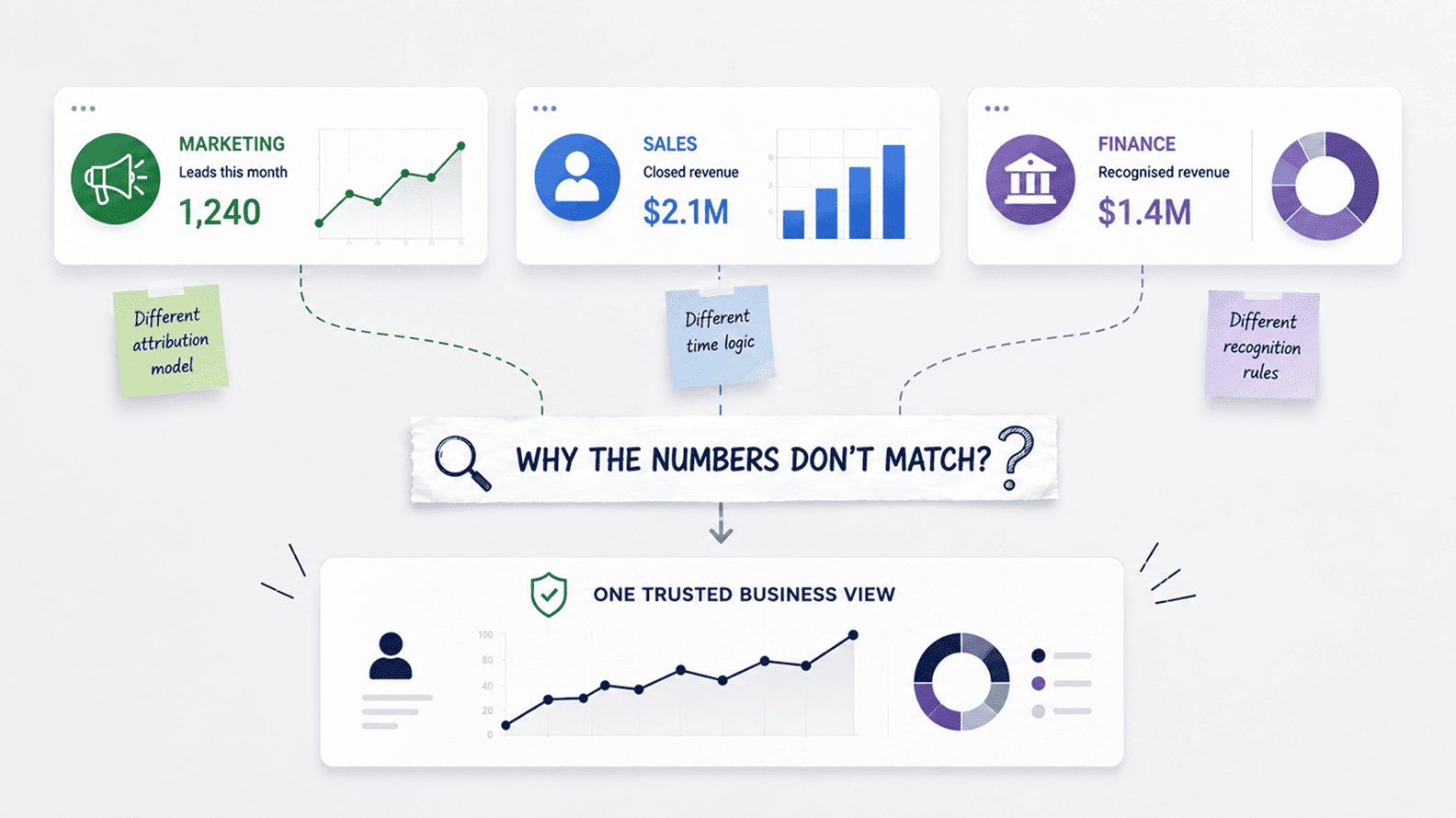
Why Marketing, Sales, And Finance Reports Do Not Match
Aug 04, 2026 / 27 min read
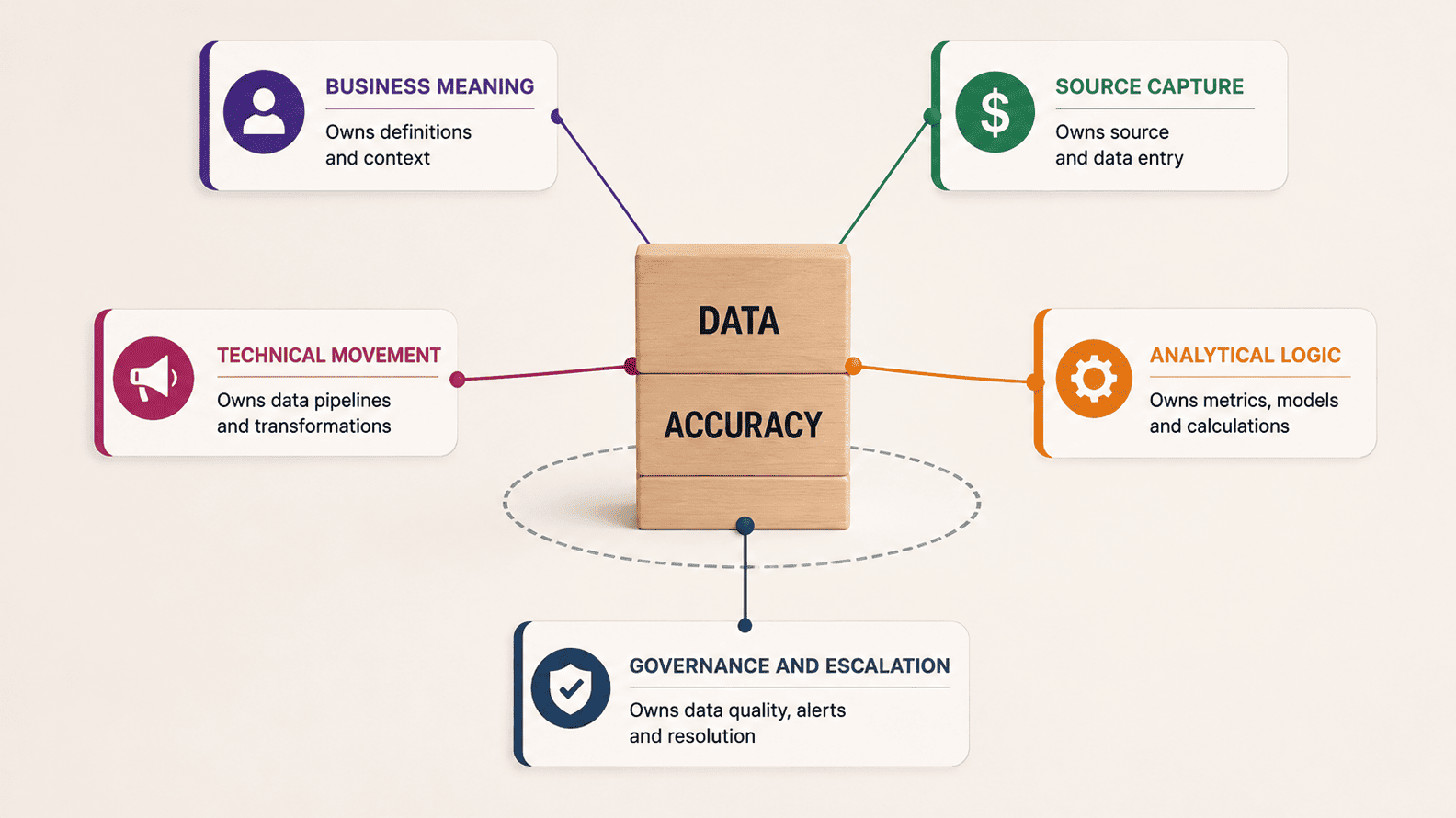
Data accuracy is an operating model that decides who defines truth, who protects it, and who fixes it when the business starts making decisions on the wrong number. A practical guide for leaders, operations teams, finance teams, analysts, BI teams, and data specialists who need clear accountability for the numbers the business uses to make decisions.
Data accuracy should not sit with one team by default because errors rarely enter the business from one place. A wrong number can begin as a skipped CRM field, a vague finance adjustment, a duplicated customer record, a broken product event, a manual spreadsheet upload, a stale pipeline, a dashboard formula, or an AI assistant pulling from the wrong source. The company needs shared responsibility, but shared responsibility only works when accountability is named.
The cleanest model is domain-based ownership supported by technical controls. Business teams own the meaning of their data. Sales owns the commercial meaning of pipeline. Finance owns the meaning of revenue, margin, collections, and close logic. Product owns usage events and adoption definitions.
Marketing owns campaign taxonomy and attribution rules. Data teams own the path from source to decision: pipelines, transformations, testing, lineage, metric modeling, semantic layers, and reporting logic. Stewards keep the daily discipline alive. Executives make the model enforceable when teams disagree.
The biggest mistake is treating accuracy as a dashboard problem because the dashboard is where the error becomes visible. A dashboard may reveal that customer count is inflated or that revenue does not match finance, but the failure may have happened earlier in the business process.
Strong companies treat data accuracy as an operating model. They decide who defines the truth, who protects it, who fixes it, and who has the authority to resolve disputes when the same number carries different meanings across teams.
Data accuracy ownership is the operating model that assigns accountability for whether business data correctly represents the real-world process, event, customer, transaction, metric, or decision it is meant to describe. It includes business definition ownership, source-system responsibility, technical reliability, metric governance, validation, stewardship, and executive escalation.
The UK Post Office Horizon scandal is an extreme example of what can happen when system-generated data is treated as truth without enough accountability around the people, processes, and technology behind it. Hundreds of postmasters had convictions quashed in 2024 after years of disputes linked to faulty accounting data from the Horizon system, and the government described the episode as one of the greatest miscarriages of justice in British history.
Most companies will never face anything that severe, but the lesson travels: when data is trusted because it comes from a system, rather than because responsibility around that system is clear, bad numbers can gain dangerous authority.
Inside ordinary businesses, the damage is usually quieter. Sales says the pipeline dashboard is wrong because committed deals are missing. Finance says the revenue number cannot be used because it does not match the closed books. Marketing says attribution is undercounting paid campaigns. Operations says utilization is inflated because training time has been treated as productive work.
Product says the active-user metric is misleading because it counts passive events. The analyst checks the SQL, the warehouse, the BI model, the CRM extract, and the dashboard filters, only to find that the deeper issue was never purely technical. The company had never made accuracy ownership visible.
That is why data accuracy becomes political before it becomes technical. Revenue affects bonuses and board reporting. Pipeline affects hiring. Churn affects investor confidence. Utilization affects staffing. Inventory affects cash flow. Customer count affects strategy. Once a number carries money, status, accountability, or risk, every team has a reason to care about how it is defined.
The work, then, is not simply to ask whether a value is present in a database. The real work is to decide which team owns the business meaning, which system is authoritative, which checks prove the number is safe, and who resolves the dispute when two reasonable interpretations exist.
A mature data culture does not fix this by telling everyone to “trust the dashboard.” It builds an ownership model around the dashboard before the dashboard becomes the courtroom. The model should show who owns the source process, who owns the definition, who owns the transformation, who owns the dashboard logic, which checks run automatically, who reviews exceptions, and who has the final say when the business cannot agree.
IBM’s data quality dimensions are useful here because accuracy is only one part of the picture; completeness, consistency, timeliness, validity, and uniqueness all affect whether a number is fit for a decision. A customer record can be factually correct but duplicated, complete but too late, valid in one system but inconsistent with another. Ownership matters because every failure mode points to a different fix.
It is tempting to say the data team owns data accuracy because analysts, engineers, and BI developers are closest to the reports. That answer is convenient, but it is usually incomplete. The data team often does not create the original customer record, approve the invoice, decide what counts as a qualified lead, define whether an opportunity is committed, or know whether a manually updated status field reflects what actually happened in the business.
They can test for missing values, duplicate IDs, strange row-count changes, schema drift, and broken refreshes, but they cannot always decide whether a customer marked as “active” is commercially active, operationally active, or merely present in the system.
The reverse mistake is just as common. Business teams sometimes push accuracy back to IT because the data sits inside tools and databases. But if sales teams skip mandatory CRM fields, if support agents use three different reason codes for the same complaint, if marketing keeps changing campaign naming conventions, or if finance changes a close rule without updating reporting definitions, the weakness did not begin inside the warehouse.
It began where business behaviour, process design, and data capture met each other. Gartner’s data governance guidance is useful here because it frames governance around decision rights and accountability, which is exactly what companies need when accuracy becomes a business-risk issue rather than a reporting complaint.
The better model is shared responsibility with named accountability. Shared responsibility means every team that creates, moves, transforms, defines, approves, or consumes data has a role in keeping it accurate. Named accountability means a specific business owner or role has authority over a domain, metric, source process, or escalation path. Without shared responsibility, the data team becomes the clean-up crew for everyone else’s process gaps. Without named accountability, every accuracy discussion ends with polite agreement and no real decision.
| Layer Of Accuracy | What It Means | Primary Owner | What Breaks When Ownership Is Unclear |
| Business Meaning | What a field, record, or metric is supposed to represent in the real business. | Domain owner or metric owner. | Teams argue over definitions after dashboards have already reached leadership. |
| Source Capture | How data is entered, generated, approved, changed, or corrected in operational systems. | Process owner or system owner. | Bad values enter clean pipelines and begin to look official. |
| Technical Movement | How data travels through APIs, pipelines, warehouses, models, refresh jobs, and integrations. | Data engineering or platform team. | Freshness issues, duplication, schema drift, and broken joins create hidden errors. |
| Analytical Logic | How source data becomes metrics, cohorts, segments, dashboards, forecasts, or leadership reports. | Analytics, BI, or analytics engineering team. | Different reports calculate the same KPI differently and users lose trust. |
| Governance And Escalation | How standards, exceptions, ownership disputes, and cross-functional conflicts are resolved. | Data governance council, CDAO, or executive sponsor. | Accuracy becomes a personality debate instead of an operating process. |
This distinction keeps the company honest. A data engineer may be responsible for fixing a broken pipeline, but they should not be accountable for deciding whether an account qualifies as active. A finance owner may be accountable for the definition of net revenue, but they still need analytics and engineering teams to implement it reliably.
A sales operations leader may own pipeline-stage rules, while a CRM admin and BI developer handle configuration and reporting. Accuracy improves when the company stops asking one team to own the whole chain and starts making every link in the chain visible.
The data team usually gets blamed first because accuracy problems become visible in the place the data team helped build: the report. A dashboard shows that customer count is inflated, revenue does not match finance, or pipeline has moved sharply overnight, and the natural reaction is to assume the dashboard is wrong.
That reaction is understandable, but it confuses the place where the problem appeared with the place where the problem began. A smoke alarm does not own the fire, and a dashboard does not always own the bad business process it is exposing.
Experienced analysts see this pattern all the time. A stakeholder challenges a KPI, the analyst checks the SQL, and the query is technically fine. Then the real issue appears upstream. A sales stage was updated manually without a clear rule. A CRM import created duplicate accounts. A campaign source was overwritten by a new automation.
A support team changed reason-code labels without telling analytics. A finance adjustment was made after close but not reflected in the metric definition. The dashboard may need better explanation, but the root cause sits in the source process, business rule, or ownership gap.
This is where data teams do have a serious role. They should own technical reliability, testing, documentation, lineage, transformation logic, and reporting consistency. Great Expectations Data Docs are useful because they turn expectations and validation results into human-readable documentation, which gives teams evidence of what was checked instead of relying on memory.
Similarly, tools that track freshness, schema changes, anomalies, and downstream impact can help teams catch failures before users discover them in a meeting. These controls matter, but they work properly only when the business has already defined what “correct” means for the domain.
The line matters because data teams can verify whether a field is missing, duplicated, stale, invalid, or transformed incorrectly. They cannot always decide whether a customer should be considered active, whether a lead is genuinely qualified, whether a sales opportunity deserves committed status, or whether an adjustment belongs in the current reporting period.
When companies treat analysts as the owners of all accuracy, they turn the team that detects problems into the team expected to fix every upstream behaviour. That is how analytics becomes a repair shop instead of a decision function.
The strongest ownership principle is also the most practical one: the team that understands the business meaning of a domain should own the definition of accuracy for that domain. Finance should own margin, collections, invoice status, close logic, and finance-grade revenue definitions. Sales or revenue operations should own opportunity stages, pipeline categories, forecast confidence, and sales-qualified lead rules.
Marketing should own campaign taxonomy, channel definitions, attribution windows, and qualified demand logic. Product should own usage events, feature adoption, activation, and retention signals. Operations should own the process data that affects capacity, fulfilment, staffing, service quality, and delivery performance.
This does not mean every department gets to invent private definitions whenever a number does not suit the meeting. It means the business function closest to the real-world process must approve what the data is supposed to represent, then accept responsibility when weak process discipline damages that data. If sales wants the pipeline to be trusted, sales cannot allow stage movement to depend on rep judgment with no documented rule.
If marketing wants campaign ROI to be trusted, campaign naming, source capture, and attribution windows cannot change casually. If a product wants adoption metrics to influence roadmap decisions, event definitions cannot live only in a developer’s memory or a tracking plan nobody maintains.
This is where domain ownership becomes useful. In its writing on data mesh, McKinsey describes business teams as owning their data and being responsible for its quality, accessibility, and security. The point is not that every company needs a full data mesh architecture. The point is that business meaning usually lives closest to the domain, and accuracy improves when the people who understand the process also carry accountability for the data created by that process.
The data team still matters deeply here, but its role becomes sharper. Instead of guessing whether an account is active, whether a claim is approved, whether a lead is qualified, or whether a utilization record should include training time, the data team can implement and test the definition the business has approved.
That is how accuracy moves from personal interpretation to operating discipline. The business defines what the number should mean, and the data team makes sure that meaning survives the journey into models, dashboards, reports, and AI systems.
Once the business has defined what a field, record, or metric is supposed to mean, the data team has a different kind of accountability: it has to protect that meaning as the data moves. A customer’s status may begin inside the CRM, pass through an API, land in a warehouse, get joined with billing data, be transformed into a customer-health model, appear in a dashboard, and then be used inside an AI assistant or leadership deck.
At every handoff, context can leak. A field can change type, a source table can arrive late, a join can duplicate records, a filter can exclude the wrong segment, or an old dashboard can keep using logic that the business has already replaced.
That is where the data team’s ownership becomes serious. It should know whether the source refreshed, whether a schema changed, whether a transformation introduced duplicates, whether late-arriving records changed last week’s totals, whether a downstream dashboard is using the certified metric, and whether a leadership number can be traced back to an approved source.
OpenLineage describes itself as an open standard for collecting lineage metadata from running jobs, which is useful because lineage is not just a technical diagram. It is how a team can answer the practical question that comes up after every accuracy dispute: where did this number come from, and what happened to it along the way?
The best data teams also challenge definitions before weak logic becomes official reporting. If the business asks for “new customers,” the analyst should ask whether that means first paid invoice, first signed contract, first fulfilled order, first login, first active subscription, or first account created in the CRM.
If the metric is churn, the team should clarify whether the business means cancellation request, service end date, payment failure, account inactivity, or non-renewal. These questions can sound irritating in the moment, especially when leadership wants a quick dashboard, but they prevent the much larger irritation of a number being challenged after it has already shaped a decision.
| Data Team Responsibility | What It Protects | What Can Go Wrong Without It |
| Pipeline Reliability | Whether data arrives on time, completely, and from the right source. | Dashboards refresh but show stale, missing, or partial data. |
| Transformation Logic | How raw records become modeled tables, metrics, cohorts, and reporting views. | Valid source data becomes misleading because joins, filters, or grain are wrong. |
| Testing And Validation | Freshness, completeness, duplicates, validity, schema changes, and unusual movement. | Accuracy problems reach users before anyone has checked whether the number is safe. |
| Lineage And Documentation | Where a number came from, what changed, and which reports depend on it. | Teams cannot explain why a metric moved or which dashboards are affected by a source change. |
| Semantic And BI Modeling | Approved metric logic, definitions, caveats, and dashboard consistency. | Every report rebuilds the same KPI differently and users stop trusting the reporting layer. |
| Incident Response | How data issues are detected, triaged, communicated, fixed, and prevented. | Accuracy problems become informal firefighting instead of a controlled operating process. |
The important boundary is that data teams protect the journey, not every business truth inside the journey. They can make sure the approved utilization rule is implemented correctly, tested, documented, and reused across dashboards.
They should not be left alone to decide whether training time belongs in utilization, whether suspended customers count as active, or whether a finance adjustment belongs in this month or last month. When business meaning and technical reliability are separated clearly, accuracy stops depending on heroic analysts and starts becoming part of the company’s operating rhythm.
Many companies jump from “the business owns the meaning” to “the data team will build it,” and then wonder why accuracy still breaks in daily work. The missing layer is stewardship. A data owner may approve the definition of a critical metric, and the data team may implement that definition in the warehouse or BI model, but someone still has to keep the definition alive when systems change, teams create exceptions, users misuse fields, or old habits return. That is where a data steward becomes useful.
A steward is usually the practical guardian of a domain’s data rules. In finance, that may mean making sure a margin definition is documented, updated after policy changes, and reflected in the reporting model. In marketing, it may mean keeping campaign naming rules clean enough that attribution does not collapse into “Other.”
In customer operations, it may mean watching duplicate-account patterns, checking whether customer-status values still reflect the real lifecycle, and coordinating fixes when support, billing, and sales use the same account differently. Atlan’s discussion of data owners and stewards makes this distinction clearly: the owner carries authority and accountability, while the steward handles much of the operating discipline that keeps governance usable.
This role matters because definitions rarely fail only at the moment they are written. They fail three months later, when a field is added without a definition, a team invents a new status value, a reporting exception becomes a habit, or a process change never reaches the analytics model.
A steward notices those small cracks before they become leadership-level arguments. The steward does not replace the domain owner, and they do not replace the data team. They sit between the two, making sure the business rule, system behaviour, documentation, and reporting logic keep speaking to each other.
For mid-sized companies, stewardship does not need to become a large governance department. It can begin with named people inside finance, sales operations, marketing operations, customer operations, product analytics, HR, or delivery operations who are already close to the data and the process.
The important point is to make the role explicit. If nobody is responsible for maintaining valid values, documenting exceptions, reviewing changes, and coordinating fixes, data ownership becomes a title on paper while accuracy still depends on analysts cleaning up the consequences later.
Once ownership is split across business teams, data teams, stewards, and leadership, the next risk is that the model becomes verbally clear but operationally vague. Everyone agrees that accuracy matters, but nobody knows who should approve a definition, who should investigate an issue, who should be consulted before a metric changes, or who needs to be told when a number has been restated. This is where a simple RACI model helps. It is not glamorous, but it prevents the slow damage caused by unclear authority.
The point is not to create a governance chart for every column in every system. That would kill momentum. The point is to protect the data that the company actually uses to make decisions: revenue, margin, pipeline, customer count, utilization, churn, active usage, inventory, campaign attribution, support SLA, employee capacity, supplier performance, or any other number that regularly appears in leadership reviews.
For those areas, the company needs to know who is responsible for the work, who is accountable for the business meaning, who must be consulted because the metric crosses functions, and who must be informed when the logic changes.
| Data Area | Responsible | Accountable | Consulted | Informed |
| Revenue Metric | Analytics engineer, finance analyst, BI owner | Finance leader or revenue owner | Sales operations, data engineering, tax or accounting where relevant | CEO, leadership team, department heads |
| Pipeline Stages | Sales operations, CRM admin, analytics | VP Sales or Revenue Operations leader | Finance, marketing, BI team | Sales managers, leadership |
| Campaign Attribution | Marketing operations, analytics | Marketing owner or growth leader | Sales operations, data engineering, BI team | CMO, growth team, sales leadership |
| Customer Master Data | Customer operations, MDM team, data engineering | Customer domain owner | Finance, support, product, sales operations | Customer-facing teams, leadership |
| Product Usage Events | Product analytics, data engineering | Product owner or product analytics lead | Engineering, customer success, sales operations | Product, support, customer success |
| Utilization Or Capacity | Operations team, delivery operations, analytics | Operations or delivery leader | Finance, HR, project managers, BI team | Leadership, staffing teams, department heads |
A RACI model works because it separates effort from authority. The responsible team may investigate the issue, clean the data, fix the pipeline, update the report, or prepare the analysis. The accountable owner decides what the accepted business rule is and carries responsibility for the consequence of poor quality.
Consulted teams bring context because most critical metrics cross functional lines. Informed teams do not need to approve every change, but they need to know when a definition, source, or historical trend has shifted.
The biggest advantage is speed during disputes. If customer count suddenly changes, the team should not spend three meetings deciding whether sales, support, product, finance, or analytics owns the answer.
The ownership model should already say who decides what a customer is, who checks the source records, who validates the transformation, who updates the dashboard, and who tells leadership whether historical numbers need to be restated. Accuracy improves when the argument has a route, not when every team joins the same call and hopes clarity appears.
A company will struggle to assign ownership if every complaint gets reduced to the same sentence: “the data is wrong.” That phrase is too blunt for the amount of damage it causes. Sometimes the number is wrong because the source record was entered badly. Sometimes it is wrong because the data arrived late.
Sometimes the value is technically valid, but the business definition is weak. Sometimes two dashboards disagree because they are using different date fields, different filters, or different grains. The fix depends on the failure mode, which means the owner also changes.
This is why accuracy conversations need better diagnosis before they need more meetings. If finance has a different number after close, the first question should be about the authoritative system and reporting calendar. If marketing attribution is off, the issue may sit in campaign taxonomy, UTM discipline, channel grouping, or attribution-window logic.
If customer count is inflated, the problem may be duplicate accounts, weak master data, inactive customers, or unclear rules for parent-child relationships. If an AI assistant gives an unreliable answer, the issue may not be the model alone. It may be stale data, weak retrieval rules, poor permissions, or missing business context.
| What People Say | What May Actually Be Wrong | Likely Owner | Best First Question |
| “The dashboard is wrong.” | Metric logic does not match the approved business definition. | Metric owner plus analytics team. | Which definition is approved, and where is it documented? |
| “The numbers changed overnight.” | Pipeline refresh, late-arriving data, schema change, or transformation change. | Data engineering or platform team. | Did the source, schedule, schema, or transformation change? |
| “Finance has a different number.” | Close adjustment, reporting calendar, revenue rule, or authoritative system differs. | Finance owner. | Which number is official after close, and what changed during reconciliation? |
| “Sales says records are missing.” | Source entry process, CRM permissions, sync failure, or duplicate handling. | Sales operations or CRM system owner. | Where should the record have been created first, and who controls that process? |
| “Marketing attribution is off.” | Campaign naming, UTM capture, channel grouping, attribution window, or source mapping differs. | Marketing operations plus analytics. | Which attribution rule is approved for this decision? |
| “Customer count is inflated.” | Duplicate accounts, inactive customers, weak master data, or unclear customer grain. | Customer domain owner. | What is the unique customer entity: user, account, payer, legal entity, or parent company? |
| “AI output is unreliable.” | The AI retrieved stale, incomplete, poorly governed, or wrongly scoped enterprise data. | AI product owner plus data governance. | Which data sources is the AI allowed to trust, and which definitions must it use? |
This kind of table helps because it stops the company from treating every data issue as a BI defect. A stale refresh needs a different fix from a disputed definition. A duplicate customer record needs a different owner from a late finance adjustment.
A weak campaign taxonomy cannot be solved only by rewriting a dashboard formula. Once teams can name the type of accuracy problem, the conversation becomes calmer and more useful because the work can move to the right owner instead of bouncing around the data team by default.
Data accuracy improves when senior leaders stop treating it as a back-office hygiene issue and start treating it as decision infrastructure. This does not mean the CEO should approve field definitions or review dashboard logic. It means leadership must make it clear that trusted data is part of how the company runs, not something analysts are expected to repair quietly before every major review.
Without that sponsorship, ownership remains polite in theory and weak in practice. Definitions wait for approval, business teams delay process fixes, dashboards multiply, and every department keeps a private spreadsheet because the official version does not fully match its needs.
The reason executive ownership matters is simple: many accuracy problems cross departmental boundaries. Finance may want one revenue treatment, sales may want a commercial momentum view, operations may need staffing visibility, and leadership may want a stable number for planning. None of these teams is necessarily wrong, but someone has to decide which number is official for which decision.
If nobody has the authority to settle that, the company keeps debating definitions long after the dashboard has been built. The cost is not only analytical confusion. It is slower planning, weaker accountability, and less confidence in the operating rhythm.
A workable model has five layers, and each layer has to do a different job:
| Ownership Layer | What It Should Do | Why It Matters |
| Domain Owners | Define the business meaning of critical data in areas such as revenue, customer, product, sales, finance, inventory, workforce, operations, or marketing. | Accuracy begins with the people who understand the real-world process behind the data. |
| Data Stewards | Maintain definitions, valid values, exceptions, documentation, quality routines, and coordination between business and data teams. | Approved rules decay unless someone keeps them alive in daily work. |
| Data Engineers And Platform Teams | Protect pipelines, schemas, refreshes, access controls, lineage, technical monitoring, and incident response. | Even a correct definition becomes risky if the data moves badly or arrives late. |
| Analytics And BI Teams | Protect metric modeling, semantic layers, dashboard logic, documentation, validation, and interpretation for users. | The business needs consistent logic from source data to reporting and decision-making. |
| Executives | Sponsor governance, resolve cross-functional conflicts, fund quality work, and make ownership part of management discipline. | Accountability fails when senior leaders do not enforce it when trade-offs appear. |
This model works because it connects meaning, movement, interpretation, and authority. A data catalog, semantic layer, observability tool, or BI platform can show where data came from, which dashboard uses it, and whether a pipeline failed.
It cannot decide whether an active customer should mean a paying account, a recently logged-in user, or an account showing meaningful product usage. That decision belongs to the business, and the discipline to enforce it belongs to leadership. Without that layer of authority, accuracy becomes dependent on helpful individuals rather than a repeatable way of working.
The real test of ownership is not whether the company has a governance slide with names on it. The test is how the business behaves when data is created, changed, questioned, corrected, and reused. If a field can be added to a core system without a definition, if a KPI can be reworked inside a presentation without updating the official metric, or if a dashboard can influence a leadership meeting without showing source, freshness, and caveats, the ownership model is still too shallow. It may exist on paper, but it has not reached the operating habits of the company.
Good ownership shows up in small, repeatable behaviours. A sales operations team does not add a new opportunity stage casually because it knows pipeline reporting, forecasting, and compensation may be affected. A marketing operations team does not rename channels mid-quarter without checking how attribution dashboards will read the change.
Product teams do not ship a new event name without asking whether it changes activation, adoption, or retention reporting. Finance does not update a margin treatment without telling analytics which historical reports need restatement or explanation. These are not big governance ceremonies. They are the daily habits that keep numbers from drifting quietly.
A practical accuracy culture usually includes a few non-negotiables:
This is where stronger data cultures separate themselves from weaker ones. In weaker cultures, accuracy depends on heroic analysts who remember every exception, every old field, every fragile dashboard, and every rule that was agreed in a meeting six months ago. In stronger cultures, that memory is built into systems, definitions, review rituals, stewardship, and accountability.
The analyst should not be the only person who knows why last month’s customer count excludes inactive accounts, why utilization treats training differently from billable time, or why the margin dashboard changed after finance closed. That knowledge should belong to the company, not to whoever happens to remember the SQL.
For years, inaccurate data mostly damaged dashboards, reports, spreadsheets, and board packs. That was already expensive enough, but at least the error usually had a visible surface. Someone opened a dashboard, spotted a strange number, asked the analyst, and the investigation began.
AI changes that rhythm because the same weak data can now travel through copilots, customer-support assistants, sales summaries, workflow agents, internal search tools, and automated decision support. A bad dashboard may mislead one meeting. A bad enterprise data source connected to an AI assistant can mislead many users quietly, repeatedly, and with more confidence than the data deserves.
This is why ownership cannot stop at the BI layer anymore. If an AI assistant answers “which customers are at risk?” it may pull from customer health scores, product usage, support tickets, renewal dates, billing status, CRM notes, and sales activity.
Each of those domains needs a clear owner, and the AI system needs ownership too: who approves the sources, who controls retrieval, who checks permissions, who evaluates answer quality, who monitors incidents, and who decides whether the assistant is allowed to answer certain questions at all.
The NIST AI Risk Management Framework is useful here because it treats trustworthy AI as something organizations have to design, evaluate, use, and govern across the system lifecycle, not as a model-only concern.
The practical point is that AI does not make governance optional. It makes weak governance travel faster. If product usage events are poorly defined, a customer-risk assistant may exaggerate renewal danger. If CRM notes are stale, a sales copilot may brief a rep with outdated account context.
If finance data has not closed, an executive summary may present a provisional number as final. If permissions are loose, an assistant may expose sensitive customer, revenue, or employee data to the wrong audience. These are not only AI problems. They are data ownership problems showing up through a new interface.
A company building AI on internal data therefore needs two layers of ownership working together. The first is domain ownership for the data itself: customer, revenue, product usage, support, sales, finance, operations, and employee data must have accountable owners.
The second is product ownership for the AI experience: the team responsible for the assistant must define what sources it can trust, what answers it can produce, how outputs are evaluated, how errors are reported, and when a human reviewer is required. AI can make the business faster, but only if the company knows who owns the truth it is allowed to use.
A useful test for metric ownership is simple: the owner should be the person or function that understands the real-world event behind the number and has the authority to improve the process that creates it. If a person can explain the dashboard but cannot change the upstream behaviour that makes the number unreliable, they may be responsible for analysis or reporting, but they are probably not the accountable owner.
That distinction matters because many companies accidentally assign ownership to whoever is most helpful, most technical, or most available. Over time, analysts become the unofficial owners of definitions they did not create and processes they cannot control.
The owner of a metric should be able to answer three questions clearly:
If the answer is weak, ownership is probably sitting in the wrong place. A BI developer may build the revenue dashboard, but finance should usually own the approved revenue definition. A data engineer may create a customer table, but customer operations or a customer-domain leader should own the rules for customer identity.
A marketing analyst may build the attribution report, but marketing leadership should own the attribution logic used for budget decisions. A product analyst may model activation, but product leadership should approve which event actually proves meaningful adoption.
The right owner has business authority, not just system access. A CRM admin may control fields and workflows, but the sales or revenue operations leader should own the commercial meaning of pipeline stages. A data engineer may know how a product event flows into the warehouse, but the product owner should know whether that event represents real usage or background noise.
A finance analyst may help reconcile margin, but the finance leader should approve the rule that decides which cost categories are included. Ownership should sit with the function that can change the behaviour causing the accuracy issue, not merely with the team that can explain the issue after it appears.
A focused first pass is usually enough. Companies do not need to assign perfect ownership to every field before improving accuracy. Start with the 10 to 20 metrics that leadership actually uses: revenue, margin, pipeline, customer count, churn, utilization, inventory, cash collection, active usage, fulfilment rate, support SLA, or whatever carries weight in the business.
For each one, document the source, definition, grain, filters, refresh cadence, caveats, current owner, and escalation route. Review that ownership every quarter because systems, incentives, business models, and reporting needs change. This keeps governance practical rather than theatrical, and it puts accountability where the business already feels the pain.
The clean answer is that business teams own meaning, data teams own technical reliability, stewards keep the rules alive, and executives own the accountability model. That is useful, but the sharper answer is that data accuracy belongs to the operating system of the company. It sits in how teams define work, capture events, approve changes, model metrics, publish dashboards, resolve disputes, and learn from mistakes.
A company that wants accurate data cannot depend only on better tools or smarter analysts. Tools can detect missing values, failed pipelines, duplicate records, schema changes, stale dashboards, and unusual metric movement. Analysts can investigate contradictions, challenge definitions, and explain what changed. But neither tools nor analysts can permanently fix a business that allows every department to carry its own private version of reality.
Accuracy improves when the people closest to the business define what truth means, the people closest to the data stack protect that truth as it moves, and leaders make ownership part of how the company is managed.
This is also why accuracy should be tied to the decisions that matter most. A company does not need a massive governance programme before it can improve. It can begin with the numbers that already carry risk: revenue, margin, pipeline, churn, customer count, utilization, cash collection, inventory, product usage, support SLA, or any metric that appears in leadership reviews.
For each one, the company should know the definition, source, owner, steward, technical path, validation checks, dashboard, escalation route, and review rhythm. That practical discipline does more for trust than a large policy document nobody uses.
The difference between a company that has dashboards and a company that has trust is not visual polish. It is accountability underneath the number. When accuracy ownership is clear, fewer meetings begin with “which number is right?” and more meetings can move straight into what the number means.
That is the real purpose of data accuracy: not perfect records for their own sake, but decisions that are less fragile because the company knows who owns the truth, who protects it, and who fixes it when it breaks.
Ultimate accountability should sit with the business domain owner, supported by the data team. If the data describes revenue, margin, collections, or close logic, finance needs to own the meaning. If it describes pipeline, sales stages, forecast confidence, or sales-qualified leads, sales or revenue operations should own the meaning.
If it describes product usage, activation, retention, or feature adoption, product should own the event logic. The data team can make these definitions reliable, testable, and usable, but the business must approve what the number is supposed to represent.
The cleanest model is shared work with named accountability. Business teams own meaning, data teams own movement and modeling, stewards maintain daily discipline, governance teams define standards, and leadership enforces the model when teams disagree. When companies push all of this onto analytics or IT, accuracy becomes a clean-up burden rather than a business responsibility.
It belongs to both, but in different ways. IT and data teams usually own the technical systems that store, move, transform, secure, and monitor data. They should make sure pipelines refresh properly, schemas are handled safely, access rules are enforced, transformations are tested, and downstream dashboards do not break quietly. Even accurate source data can become misleading if it is duplicated by a join, refreshed late, transformed wrongly, or shown through an outdated report.
Business teams own the real-world meaning behind the data. They know whether a sales stage reflects genuine commercial progress, whether a customer status is meaningful, whether a finance adjustment belongs in the current period, and whether an operations field is being used properly in daily work.
When business teams avoid this responsibility, technical teams are forced to guess business logic, which is one of the easiest ways to produce dashboards that look clean but mislead the people using them.
A data owner is the person or role accountable for the business meaning, quality expectations, usage rules, and dispute resolution around a data domain, dataset, or important metric. Ownership is not the same as system administration. A CRM admin may control the tool, but a revenue operations leader may own pipeline definitions. A BI developer may build the dashboard, but finance may own the definition of margin or recognized revenue.
A good data owner does not need to write SQL, but they do need to understand the business process that creates the data and the decisions the data supports. They should be able to approve definitions, resolve edge cases, prioritize fixes, and accept accountability when data quality affects business decisions. Without a real owner, responsibility usually falls to analysts who can explain the number but cannot fix the process that made it unreliable.
A data owner carries authority. A data steward carries much of the operating discipline that keeps ownership useful in daily work. The owner may approve what counts as an active customer, a qualified lead, a fulfilled order, or a valid utilization record. The steward documents that definition, checks whether systems and teams are following it, coordinates exceptions, works with analytics on reporting updates, and notices when definitions begin to drift.
In smaller companies, one person may play both roles. In larger companies, separating them helps because ownership requires authority while stewardship requires attention to detail and regular follow-through. The steward is often the person who spots that a field is being used inconsistently, that a new source value has appeared, that a process change will break downstream reporting, or that a dashboard needs updating before users start questioning it.
Aug 04, 2026 / 27 min read
Aug 04, 2026 / 22 min read
Jul 31, 2026 / 24 min read