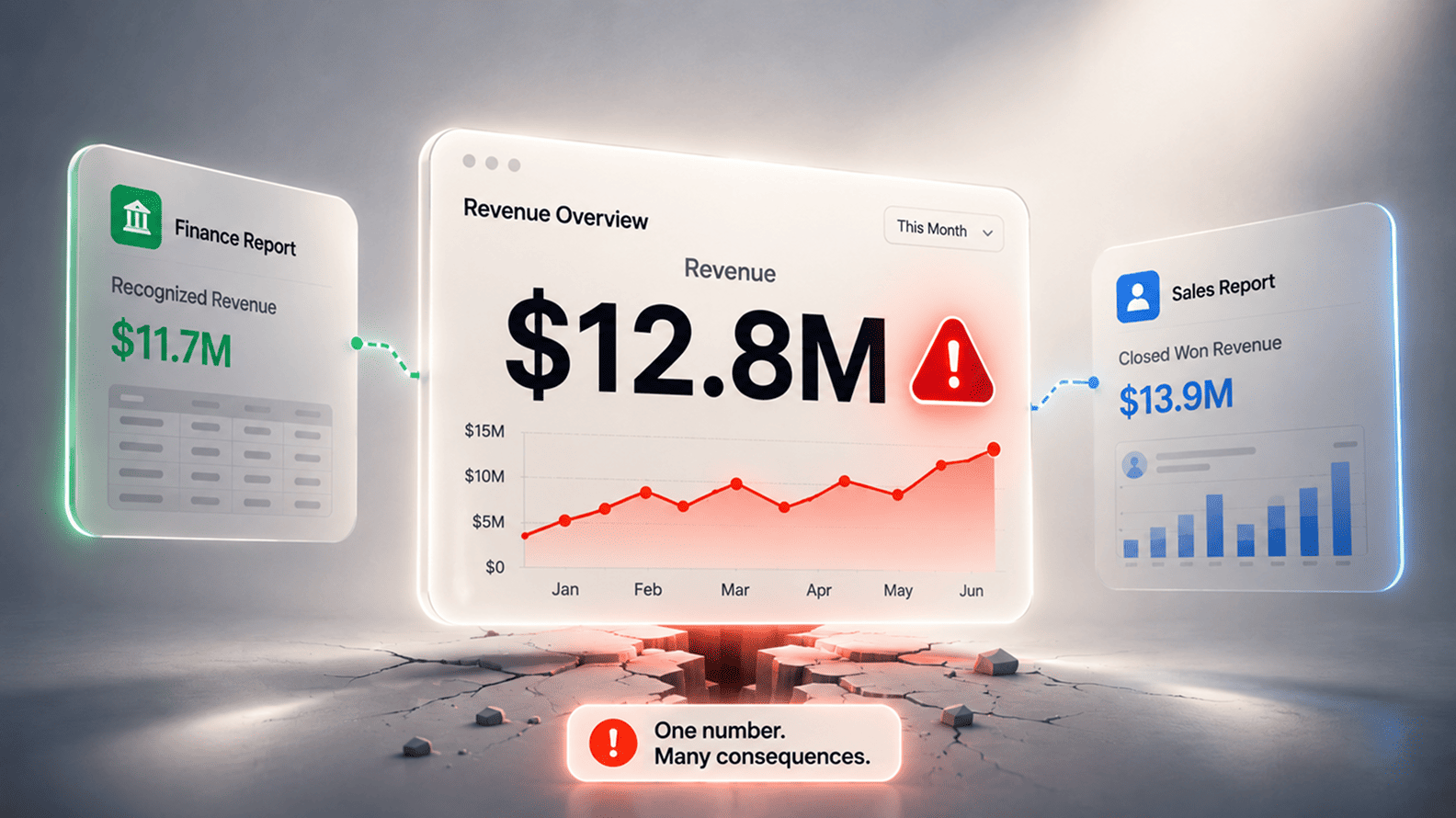
What Happens When A Dashboard Shows The Wrong Revenue
Aug 04, 2026 / 22 min read
August 4, 2026 / 27 min read / by Team VE
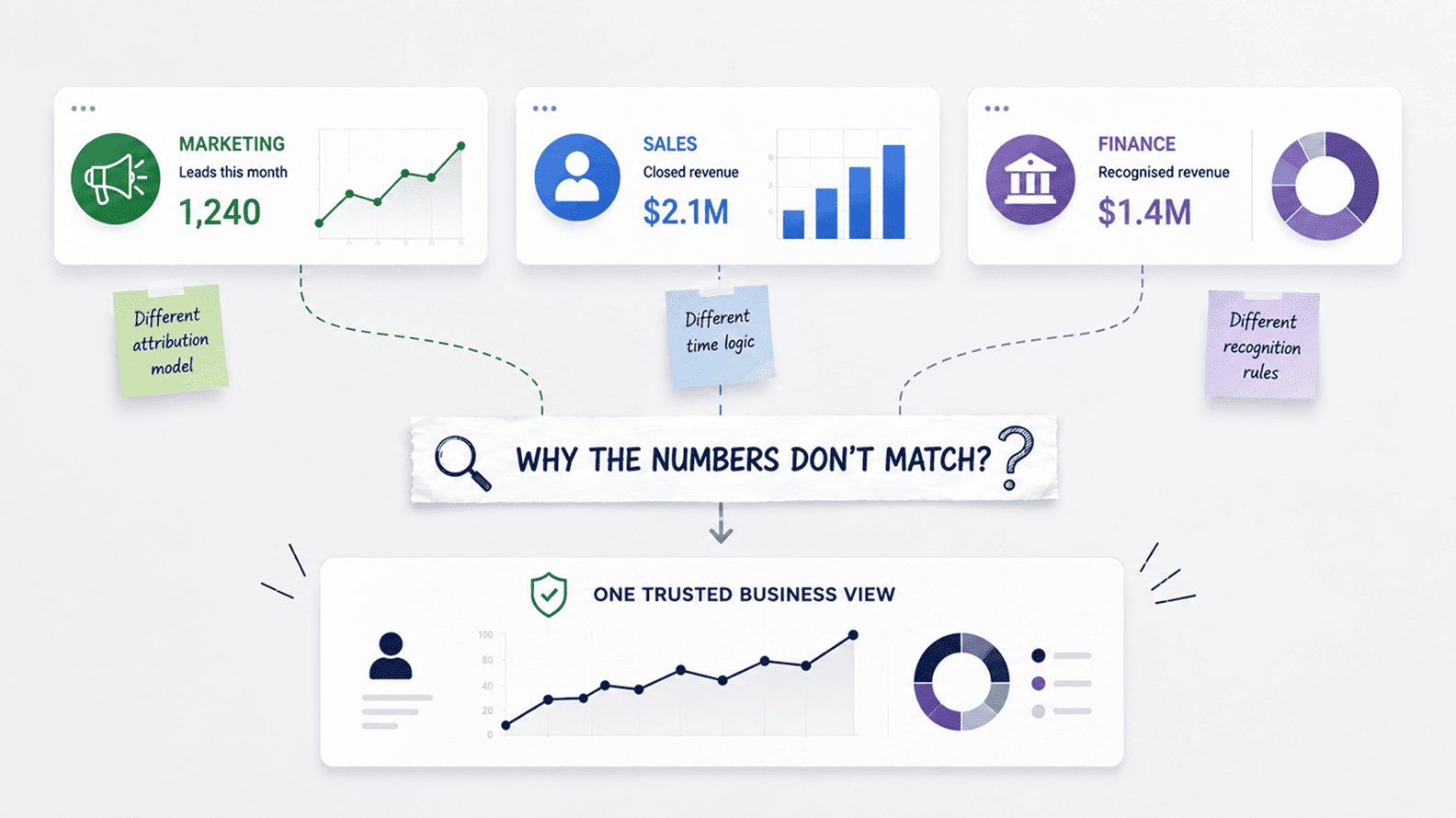
A practical guide to why the same revenue story looks different across campaign dashboards, CRM reports, accounting files, and leadership reviews, especially inside small and mid-sized businesses.
Marketing, sales, and finance reports usually do not match because each team is looking at a different moment in the same commercial journey. Marketing often starts with campaign response and attribution. Sales moves the conversation toward qualification, opportunity value, stage, probability, and forecast confidence.
Finance looks at invoices, cash, margin, refunds, recognition, period close, and auditability. The same customer can therefore appear as a lead in one report, a weak opportunity in another, and no revenue at all in the finance view. The reports may all be useful, yet still fail the company if their differences are not named clearly.
This problem is especially common in small and mid-sized businesses because the reporting stack grows in pieces. A company may have ads in one platform, forms in another, CRM data in HubSpot or Salesforce, invoices in QuickBooks, payments in Stripe, ecommerce sales in Shopify, and board numbers in Excel. At first, people manage the gaps through memory and manual checks.
Later, as volume rises and leaders need faster decisions, those gaps become arguments. The real fix is not one magical dashboard. It is a shared reporting language around lead, pipeline, revenue, margin, date logic, source ownership, attribution, and finance treatment, so every team knows which report is meant to answer which question.
A mismatch between marketing, sales, and finance reports happens when different teams report on the same business outcome using different sources, dates, definitions, filters, or stages of the customer journey. Marketing may report campaign-sourced leads based on the first conversion.
Sales may report accepted opportunities based on CRM stage and expected close date. Finance may report revenue based on invoice date, cash received, refunds, deferred revenue, or recognized revenue. The mismatch becomes a real business problem when teams treat these different views as if one of them must be wrong, instead of understanding what each view is designed to explain.
In a small or mid-sized company, this often begins innocently. The founder looks at Shopify sales, the marketing manager looks at ad platform revenue, the sales head looks at CRM pipeline, and the accountant looks at QuickBooks or Stripe.
Each system is doing a different job. The trouble starts when these numbers enter the same meeting without context. The business is then no longer comparing performance. It is comparing definitions.
A disagreement between marketing, sales, and finance often begins with a perfectly ordinary question: how are we doing? Marketing may answer by looking at leads, conversion rate, campaign-sourced pipeline, or channel ROI. Sales may answer from the CRM, where the focus is qualified opportunities, forecast category, stage movement, close probability, and account ownership.
Finance may answer from the accounting system, where the story is shaped by invoices, collections, refunds, taxes, recognition, margin, and period close. Everyone is looking at the same business, but each team is standing at a different point in the journey from attention to cash.
That is why the reports can disagree without anyone being careless. A webinar may look successful to marketing because it created 180 leads. Sales may see only 22 as worth pursuing because the rest are students, vendors, existing customers, poor-fit geographies, or early-stage researchers.
Finance may see no revenue at all that month because none of those opportunities has been invoiced or recognized. The tension does not come from dishonesty. It comes from the fact that one business event has many reporting lives before it becomes money the company can count.
HubSpot’s explanation of funnel stages is useful because it treats lead, marketing-qualified lead, and sales-qualified lead as separate moments rather than interchangeable labels. In HubSpot’s guide to defining sales and marketing funnel stages, the important point is not the terminology itself. It is the discipline of making the handoff visible, so the business does not mistake early interest for sales readiness or sales readiness for revenue.
Small and mid-sized businesses feel this more sharply because the same person may have once held all three views in their head. The founder knew which leads were serious, the sales manager knew which deals were real, and the accountant knew which invoices had actually turned into cash.
As the company grows, that informal memory breaks down. New team members read the label on the report, not the history behind it. A number that used to be understood through context now needs to be understood through definition.
| Team | What It Is Really Asking | Why Its Report May Not Match |
| Marketing | Which activity created interest or influenced demand? | It may count early response, attribution, influenced pipeline, or platform revenue before sales or finance accepts the outcome. |
| Sales | Which leads can be worked and which opportunities can close? | It may use qualification, stage, probability, sales judgement, and expected close date rather than campaign response. |
| Finance | Which money can be invoiced, collected, recognized, and defended? | It may use accounting periods, invoices, refunds, credits, margin, cash timing, and recognition rules. |
In many small and mid-sized businesses, the reporting problem is not born in a grand data strategy. It is born in a stack that grows one practical decision at a time. The company needed invoices, so it adopted accounting software. It needed payments, so Stripe or another gateway entered the flow. It needed ecommerce, so Shopify became the order record.
It needed lead capture and sales tracking, so HubSpot, Salesforce, or another CRM arrived. Later, someone added Looker Studio, Power BI, Tableau, or a spreadsheet-based dashboard because leadership wanted visibility. Each decision made sense on its own. Together, they created a reporting system where each tool tells the truth from its own angle.
Shopify is a useful example because it openly explains why merchants may see differences across analytics, sales, finance, export, and payout views. Its guidance on sales discrepancies in Shopify Analytics points to timing and reporting logic as normal causes of different numbers, while the Shopify Payments documentation explains that payout reconciliation includes transactions, fees, and payouts, and that finance reports are based on orders and sales activity rather than payout timing.
For an ecommerce SMB, that distinction is not academic. The founder may ask why sales are high but the bank deposit looks lower, and the answer may involve refunds, fees, payout timing, taxes, chargebacks, or orders paid through another gateway.
The same pattern appears in subscriptions and services businesses. Stripe’s support note on why revenue numbers may not match what a business expected to see explains that revenue recognition follows ASC 606 logic and can recognize revenue based on the service period rather than the moment payment arrives.
That difference matters for a SaaS company that sells an annual plan. Sales may celebrate the full contract value in the CRM, cash may arrive upfront, and finance may recognize the revenue over the subscription period. If all three numbers are called revenue in the same review, the argument is already built in.
This is why smaller companies often feel the pain before they have the language for it. They are not always large enough to have RevOps, data governance, finance systems, and BI ownership clearly separated. The same person may run campaigns, export leads, update the CRM, prepare the investor note, and ask the accountant why the number is different.
The solution has to respect that reality. SMBs do not need enterprise theatre around reporting. They need a small set of shared definitions and a clear understanding of which system answers which question.
| Business Question | Likely Source | What It Can Answer Well | Where It Can Mislead |
| How many people responded to marketing? | Ad platform, website forms, email platform, CRM. | Campaign response, channel interest, cost per lead, early demand. | It may include duplicates, low-intent leads, test forms, poor-fit contacts, or leads that sales later rejects. |
| How much real opportunity do we have? | CRM and sales forecast. | Qualified pipeline, stage movement, owner accountability, likely close timing. | It may rely on stale stages, optimistic close dates, weak next steps, or sales judgement not visible to finance. |
| How much money did we make? | Accounting, billing, payment, and finance reports. | Invoiced revenue, cash, recognized revenue, margin, refunds, credits, period close. | It may lag behind sales activity or exclude commercial momentum that has not become finance-ready yet. |
Marketing is naturally drawn toward influence because its work happens before the contract. A search campaign, webinar, email sequence, content download, referral page, or remarketing touch may all help create the conditions for a sale.
If marketing only receives credit for the final form submission before sales takes over, a large part of its work can disappear from the report. That is why marketing teams often care about first touch, last touch, multi-touch influence, campaign-sourced leads, and campaign-influenced pipeline.
Finance is looking for a different kind of proof. It does not usually care whether a customer first saw a LinkedIn ad, attended a webinar, or read three blog posts before speaking to sales. Finance wants to know whether a contract was signed, an invoice was raised, payment was received, refunds were issued, revenue can be recognized, and margin can be reported.
The finance report has to survive a stricter standard because it is used for cash planning, tax, accounting, board reporting, lender conversations, and sometimes investor updates.
Salesforce makes this alignment point in a practical way in its discussion of sales and marketing alignment, where the emphasis is on shared goals, communication, connected data, and a more unified revenue operations view. The important lesson is that marketing and sales alignment cannot stop at campaign meetings.
If finance is absent from the definitions, the business may still end up with marketing celebrating influence, sales defending pipeline, and finance asking why neither number ties cleanly to the revenue plan.
A small B2B services firm may see this during a monthly review. Marketing reports that paid search produced 70 leads at a healthy cost per lead. Sales says only 12 became serious conversations because many were price shoppers or outside the target market. Finance says only three produced invoices, and one invoice was discounted heavily.
All three observations matter. The mistake is allowing one report to pretend it explains the whole journey. Marketing influence, sales acceptance, and finance value are connected, but they are not the same event.
Date logic is one of the simplest reasons reports do not match, and one of the easiest to overlook. Marketing may report a lead in the month it was created. Sales may report an opportunity in the month it moved to qualified status. Finance may report revenue in the month the invoice was issued, paid, or recognized.
A customer acquired through a March campaign may become an April opportunity, a May invoice, and June recognized revenue. Nothing is wrong with the journey. The reports only look inconsistent because each team has placed the same customer into a different month.
This becomes painful in smaller companies because owners and managers often expect one clean monthly number. They ask whether May was good, and each system answers from a different calendar. The ad dashboard may say May performed well because the leads arrived in May.
The CRM may say June looks better because those leads became opportunities in June. QuickBooks may show the revenue later because invoices or payments landed after the sales event. The difference can feel like a reporting error when it is really a timing chain.
QuickBooks is a useful example because its own guidance on cash and accrual reporting methods explains that reports can be viewed differently depending on whether income is shown when billed or when payment is received.
For a growing business, that means a sales number and a finance number can both be reasonable while still sitting in different months. This is why reports should name the date they use, rather than hiding it behind a broad label like monthly revenue or monthly performance.
| Metric | Possible Date Behind The Report | How The Mismatch Appears |
| Lead | Form submission date, campaign touch date, CRM created date, MQL date. | Marketing sees demand in one month while sales sees qualification later. |
| Pipeline | Opportunity created date, sales accepted date, stage-change date, expected close date. | Sales and marketing disagree about when opportunity value was created. |
| Revenue | Close date, invoice date, payment date, service period, recognition date. | Sales celebrates a deal before finance records revenue in the reporting period. |
| Customer | Contract start, first invoice, first payment, onboarding completion, first product usage. | Teams disagree on when a customer is truly active. |
Pipeline creates conflict because it sits between optimism and accountability. Marketing wants to show that its work is creating a commercial movement. Sales wants to show which opportunities are real enough to pursue and forecast. Finance wants to know how much of that future value is credible enough to influence planning. A single pipeline number cannot carry all of those jobs unless the business is very clear about which version is being discussed.
A good example is a mid-sized software company selling annual contracts. Marketing runs a webinar and sees a strong registration list from target accounts. Sales accepts only some of those accounts because the rest are too junior, too early, or outside the ideal customer profile. A few accepted opportunities enter the CRM with optimistic close dates because the quarter is under pressure.
Finance later discounts part of the pipeline because procurement timing, implementation risk, and renewal history make the forecast less reliable. The same campaign has created interest, opportunity, and possible future revenue, but each report is applying a different level of seriousness to the number.
This is where many businesses make the mistake of asking which pipeline report is correct. The better question is what each pipeline report is for. Marketing-influenced pipelines can help judge whether demand programmes are reaching the right accounts.
Sales forecast pipeline can help managers inspect deal movement and risk. A finance-reviewed pipeline can help leadership understand what may realistically support the plan. The reports only become a problem when they all appear under one loose heading in the same management pack.
| Pipeline Version | Useful For | Risk If It Is Mislabelled |
| Marketing-influenced pipeline | Understanding whether campaigns and content are touching opportunities. | Marketing impact may look stronger than sales or finance believes is commercially reliable. |
| Sales-accepted pipeline | Tracking opportunities sales agrees are worth working. | Early or weak opportunities may still inflate the forecast if stage hygiene is poor. |
| Forecast pipeline | Reviewing close probability, timing, owner judgement, and quarter risk. | Finance may challenge the number if evidence, dates, or stage movement are weak. |
| Finance-reviewed pipeline | Planning revenue, cash, capacity, and board expectations. | Marketing and sales may feel the view ignores useful earlier momentum. |
Marketing and sales teams sometimes read finance caution as resistance. The campaign created demand, the sales team opened opportunities, the customer verbally agreed, and the CRM shows a strong quarter.
Finance then asks about invoice timing, payment terms, refunds, discounts, implementation obligations, revenue recognition, tax, and margin. From the outside, that can feel like finance is slowing down the story. In reality, finance is often protecting the version of the number that the company may have to stand behind later.
This is especially important in SMBs that are moving from founder-led reporting to more formal management discipline. Early on, the company may run on bookings, bank balance, and a few spreadsheets. As the business grows, the same loose habits create real strain.
A large annual contract cannot always be treated like immediate revenue. A high order month may not mean the same thing as strong cash if refunds, fees, delayed payouts, or unpaid invoices sit behind it. A profitable-looking campaign may look weaker after sales effort, discounts, failed onboarding, and support costs are included.
For a subscription business, a finance report may look cautious because it separates booked contract value from recognized revenue. For an ecommerce company, a finance report may appear lower because it has absorbed refunds, payment fees, duties, and payout timing.
For an agency, finance may care less about the headline deal value and more about how much work must be delivered before the revenue is earned. These are not minor accounting details. They change how the business plans hiring, cash, delivery capacity, and growth.
The relationship improves when finance is brought into metric definitions early. Marketing can still keep influence and campaign-performance views. Sales can still keep stage and forecast views. Finance can still maintain reporting discipline. The shared benefit is that everyone understands how those numbers connect, and where each one stops being the right number for the next decision.
Attribution is another reason marketing and finance rarely see the same story. A campaign may introduce a prospect to the company months before the deal closes. Another campaign may bring the prospect back. A sales referral may move the opportunity forward.
A discount may close it. Finance may only see the invoice. Marketing may see a chain of influence across channels and weeks. Sales may remember the one conversation that changed the deal. Each view contains something real, but none is complete on its own.
A small business does not need an elaborate attribution model to feel this problem. A local training company may run Google Ads, email old leads, receive referrals, and close deals through sales calls. If the CRM only records the final source, marketing may lose credit for early nurture.
If the ad platform claims revenue from anyone who clicked an ad before buying, marketing may overstate its commercial effect. If finance only sees invoices by month, it may miss which activities created future demand. The reports disagree because each system has a different memory of the customer journey.
The practical answer is to make attribution humble. Marketing can report sourced demand, influenced demand, and campaign-assisted opportunity, but it should avoid presenting platform credit as if it were the same as finance revenue. Sales should add feedback on lead quality, not only lead acceptance.
Finance should help define which revenue view can be used for ROI conversations. When those lines are visible, the business can discuss marketing performance without turning every review into a fight over credit.
| Attribution View | What It Helps Explain | Where It Can Overreach |
| First touch | Which source introduced the prospect. | It can ignore the later work that made the deal real. |
| Last touch | Which activity happened closest to conversion. | It can erase early education, brand, nurture, and sales effort. |
| Multi-touch influence | Which campaigns helped across the journey. | It can become too generous if every touch receives credit without context. |
| Finance revenue | Which value can be reported, recognized, or planned against. | It may be too late-stage to explain which marketing activity created demand. |
The most expensive mistake is treating every mismatch as a hunt for the one true report. Sometimes there is a data error, and the company should fix it. A duplicate customer, broken sync, missing refund, wrong currency, stale CRM stage, or bad campaign ID can absolutely damage reporting.
But often the deeper issue is that different reports are answering different questions. Marketing wants to know what created interest. Sales wants to know what can close. Finance wants to know what can be reported. Those questions deserve connection, not collapse.
This is where small and mid-sized companies can make real progress without building an enterprise data office. They can begin with a few high-pressure numbers and agree on the version that belongs in each meeting. The marketing review can use campaign-sourced and campaign-influenced measures.
The sales forecast can use a sales-accepted and forecast pipeline. The finance review can use invoiced, collected, recognized, and margin-adjusted numbers. The leadership meeting can show the bridge between them, so the team sees how early demand becomes an accepted pipeline and how accepted pipeline becomes finance-recognized value.
A simple bridge is often more valuable than a more advanced dashboard. It gives leaders a way to read the journey rather than argue over the destination. If marketing generated 500 leads, sales accepted 80, 25 became opportunities, 10 closed, and finance recognized revenue from 6 within the reporting period, the story becomes clearer. The question moves from which report is wrong to where the business is losing quality, timing, or value.
| Reporting Layer | Better Metric Language | Best Meeting For It |
| Marketing | Campaign leads, MQLs, influenced opportunities, cost per qualified lead. | Campaign performance and demand-quality reviews. |
| Sales | Sales-accepted leads, qualified opportunities, forecast pipeline, closed-won bookings. | Pipeline, forecast, and sales execution reviews. |
| Finance | Invoiced revenue, collected cash, recognized revenue, gross margin, net revenue. | Month-end close, cash planning, board reporting, budget reviews. |
| Leadership | Lead-to-revenue bridge, pipeline-to-revenue bridge, margin-adjusted growth. | Cross-functional performance and planning reviews. |
The best SMB reporting rhythm is usually lighter than people imagine. It does not require every metric to be governed like a public-company disclosure. It does require the handful of business-critical numbers to be named carefully and reviewed consistently.
Revenue, pipeline, qualified lead, churn, CAC, margin, cash, and conversion deserve more discipline than one-off campaign cuts or exploratory team reports. These are the numbers that shape hiring, pricing, budgets, targets, and confidence.
A healthy rhythm starts with the leadership team agreeing that reports can differ when the questions differ. That single idea removes a lot of noise. From there, the business can decide which system owns each major question. The CRM may own opportunity and forecast views. The accounting system may own revenue and cash views.
The marketing platform may own early campaign performance. The BI layer may show the bridge across them. The job of the dashboard is not to pretend all systems are the same. It is to make the relationship between them understandable.
For a small business, this could be as simple as a monthly revenue bridge that moves from leads to accepted pipeline to closed-won bookings to invoices to cash collected. For a mid-sized business, it may become a more structured RevOps model with owners across marketing, sales, finance, and customer success.
The level of sophistication can grow with the company. The core discipline should start early because once every team has built its own reporting habit, changing the language becomes much harder.
| Reporting Habit | Why It Helps |
| Name the version of every major metric. | People stop using broad labels like revenue, lead, and pipeline as if they answer every question. |
| Show the bridge between teams. | Leadership sees where interest becomes a qualified pipeline and where pipeline becomes finance value. |
| Separate operating views from finance views. | Marketing and sales keep useful momentum signals while finance protects reporting discipline. |
| Review definitions when the business changes. | New pricing, channels, regions, products, or payment terms do not quietly break old reports. |
| Retire old dashboards and spreadsheets. | Teams stop carrying outdated definitions into new reviews. |
AI can make analytics feel faster, but it cannot repair unclear business meaning on its own. If marketing, sales, and finance already disagree about revenue, pipeline, source, customer status, or conversion, an AI assistant may only make the confusion more fluent.
It can summarize the CRM pipeline, pull marketing performance into a narrative, or answer a finance question from the wrong revenue view with impressive confidence. That is a useful speed only if the definitions underneath are already controlled.
This matters because many SMBs are now tempted to skip the hard reporting work and move straight to AI dashboards, copilots, and automated summaries. The promise is attractive. Ask a question and get an answer. The risk is that the answer inherits whatever mess already exists in the systems.
If Shopify sales, Stripe payouts, QuickBooks revenue, CRM bookings, and ad-platform conversions all mean different things, AI needs context before it can explain the difference. Otherwise, the company has simply replaced one confusing dashboard with a faster confusing answer.
The smart use of AI is to sit on top of cleaner metric language, not to substitute for it. Once the business has named the major versions of lead, pipeline, revenue, margin, and cash, AI can help users ask better questions and move faster through reconciliation.
Before that, the priority is still basic business clarity. The company has to know what its own numbers mean before it asks software to explain them.
Marketing, sales, and finance reports do not match because they are not always meant to match line by line. They describe different moments in a journey that starts with attention and ends, much later, in reliable financial value. Marketing sees the first signs of interest.
Sales sees the work of turning that interest into opportunity. Finance sees what can be invoiced, collected, recognized, and trusted for planning. The problem begins when a business places those views beside each other without explaining the distance between them.
For small and mid-sized companies, this is one of the most important reporting lessons to learn early. Growth makes the gap wider. More leads, more channels, more products, more payment methods, more discounts, more refunds, more salespeople, and more reporting tools all create more room for numbers to separate.
The answer is not a bigger spreadsheet or another dashboard with more charts. The answer is a clearer operating language for the numbers that matter most.
A good reporting system does not erase the difference between marketing, sales, and finance. It makes those differences useful. It lets marketing talk honestly about demand, sales talk honestly about opportunity, and finance talk honestly about revenue and cash.
Leadership then gets something better than a forced single number. It gets a bridge across the business, showing where value is created, where it is delayed, where it is lost, and where the company needs to act.
That is when reports stop competing with one another and start strengthening one another. The business no longer wastes the first half of every review asking whose number is right. It can move into a better conversation, which is what the numbers are revealing and what should happen next.
They usually do not match because each team is counting a different point in the customer journey. Marketing may count the first campaign response, sales may count the qualified opportunity, and finance may count invoiced, collected, or recognized revenue. The numbers can all be useful, but they should not be treated as the same metric. The fix begins by naming which question each report is answering.
No. Sometimes the mismatch is caused by duplicate records, broken integrations, missing refunds, stale CRM stages, wrong currency, or bad source tracking. Many times, however, the reports differ because the business has not separated campaign activity, sales qualification, bookings, invoices, cash, and recognized revenue clearly enough. A mismatch should be investigated, but it should not automatically be treated as a mistake.
Marketing revenue often includes attribution or influence. It may show revenue connected to a campaign, channel, landing page, email, webinar, or ad click. Finance revenue is usually stricter because it depends on invoices, payments, credits, refunds, recognition, tax, and accounting periods. Marketing is trying to understand what created demand. Finance is trying to protect the number the business can report and plan against.
Sales pipeline is often built around opportunities, stage movement, probability, expected close date, and sales judgement. Finance forecasts usually apply more caution because they must consider timing, payment terms, historical conversion, risk, margin, and whether revenue will fall into the right period. A CRM pipeline can be commercially useful while still being too optimistic for finance planning.
SMBs often build their reporting stack gradually. Ads, forms, CRM, payments, ecommerce, accounting, and spreadsheets may all be added at different times by different people. Early on, the founder or senior team fills the gaps through memory. As the company grows, that memory no longer scales, and the same labels begin to mean different things across tools and departments.
It depends on the question. The CRM may be the source of truth for opportunity stage and sales ownership. The accounting system may be the source of truth for invoices, cash, and recognized revenue. The marketing platform may be useful for campaign response and early attribution. A good dashboard should show how these systems connect rather than pretending one tool can answer every question equally well.
Start with the few metrics that cause the most arguments, such as lead, pipeline, revenue, margin, conversion, churn, CAC, and cash. Define the main versions, decide which system owns each one, agree which meeting uses which view, and create a simple bridge from marketing activity to sales opportunity to finance value. Most companies do not need a huge governance programme to begin. They need clearer language around the numbers that carry pressure.
They should share a common view of the journey, but they do not need one flat dashboard for every purpose. Marketing still needs campaign and demand views. Sales still needs pipeline and forecast views. Finance still needs revenue, cash, margin, and close views. The leadership dashboard should connect those views and make the differences clear enough that teams stop arguing over labels.
Attribution should be treated as useful but limited. First-touch, last-touch, and influenced revenue can each explain part of the journey, but none should be presented as the complete truth. Marketing should show how activity contributed to demand and pipeline, sales should add lead-quality feedback, and finance should define which revenue can be used for ROI and planning conversations.
AI can help summarize, query, and reconcile reporting faster, but it cannot fix unclear definitions by itself. If the company has not defined lead, pipeline, revenue, cash, margin, source, and date logic, AI may simply produce confident answers from confusing inputs. AI becomes useful when it sits on top of shared metric language, trusted sources, and clear ownership.
Aug 04, 2026 / 22 min read
Jul 31, 2026 / 24 min read
Jul 31, 2026 / 25 min read