Why Marketing, Sales, And Finance Reports Do Not Match
Aug 04, 2026 / 27 min read
July 31, 2026 / 23 min read / by Team VE
A practical business guide to where AI helps analytics move faster, where it creates new risk, and why weak data becomes more visible instead of magically repaired.
AI changes business analytics by making data easier to question, summarize, compare, and explain. It lets leaders ask for a revenue bridge in plain English, helps analysts move faster through messy tables, turns dashboards into more conversational tools, and can surface patterns that would take longer to find manually.
The shift is real, but it does not make bad data good. If customer records are duplicated, campaign sources are unreliable, revenue definitions are loose, or product events are incomplete, AI may only make the weak answer arrive faster and sound more confident.
The companies that benefit most from AI analytics will be the ones that connect it to trusted sources, governed metric definitions, clear ownership, and human review.
AI can reduce the distance between a business question and a useful answer, but it still needs the business to explain what the number means, which source has authority, what should be excluded, and where judgement is needed. In that sense, AI does not replace data discipline. It raises the cost of ignoring it.
AI in business analytics refers to the use of machine learning, generative AI, natural language interfaces, automated insight detection, forecasting, anomaly detection, and AI-assisted data preparation to help companies analyze business performance more quickly.
In practice, this can mean asking a dashboard a question in plain English, getting a first explanation of why churn moved, using AI to summarize sales patterns, finding outliers in finance data, or creating a first draft of a report from structured and unstructured information.
Bad data means the inputs behind that work are inaccurate, incomplete, duplicated, late, inconsistent, poorly defined, or missing business context. AI can help detect some of those issues, but it cannot decide on its own what a qualified lead should mean, whether revenue should be booked or recognized, which customer record is authoritative, or whether a sudden change is a real business signal or a source-system problem.
The appeal of AI in analytics is easy to understand. A leader can ask why a pipeline moved, an analyst can get help finding anomalies, a marketer can summarize campaign performance faster, and a finance team can turn a messy variance explanation into a cleaner first draft.
Work that once required several exports, formulas, chart checks, and explanation notes can begin inside a more conversational interface. That is a meaningful change because analytics has often been slowed down by the gap between the person who owns the decision and the person who knows how to pull the data.
The problem is that speed can create a false feeling of certainty. If the CRM has duplicate accounts, if campaign attribution is loose, if refunds are missing from revenue, or if churn is being read differently by finance and customer success, the AI layer does not make the answer trustworthy simply by explaining it well.
It may produce a cleaner paragraph, a sharper chart title, or a more confident recommendation, while the weak assumption underneath remains untouched.
This is the difference companies need to understand early. AI improves the interface around analytics before it improves the substance of the data. It can make reports easier to query, findings easier to summarize, and patterns easier to inspect. The foundation still comes from source quality, metric definitions, ownership, lineage, permissions, and the business judgement that decides what the number is allowed to mean.
| What AI Changes | What It Still Cannot Fix Alone |
| People can ask questions in natural language | The company still needs agreed definitions for revenue, churn, pipeline, margin, and customer activity |
| Analysts can explore patterns and outliers faster | The business still has to separate real signals from source errors, timing delays, or reporting changes |
| Reports and dashboards can become easier to explain | The explanation still depends on whether the underlying records are accurate and complete |
| Forecasts can be generated more quickly | The model still needs reliable historical data and a clear view of what changed in the business |
| AI can help draft summaries and recommendations | Humans still need to approve decisions that affect customers, money, staffing, or risk |
The better way to describe AI in analytics is not as a magic repair layer. It is an acceleration layer. It makes good analytical systems more usable, but it also exposes weak ones because more people can now ask more questions of the same messy data.
Traditional analytics has always had a bottleneck. A business user has the question, while an analyst often has the access, the SQL, the dashboard skill, or the patience to reconcile the data. AI changes that relationship by letting more people ask follow-up questions directly.
A head of sales can ask which region pulled down the forecast. A marketing manager can ask whether paid leads are converted into real opportunities. A customer success lead can ask which accounts look healthy on the surface but have declining usage underneath.
That sounds empowering, and it can be. Morgan Stanley gives a useful enterprise example because its AI work was built around controlled access to internal knowledge, not an open-ended guessing machine. In the official OpenAI case study on Morgan Stanley’s AI assistant, the firm says more than 98 percent of advisor teams actively use the assistant, which can answer questions from a corpus of 100,000 documents.
The important part for analytics teams is not only the adoption number. It is the discipline behind it. Morgan Stanley describes evaluation, retrieval tuning, daily testing, and human review as part of how the system earns trust.
That is the model business analytics should learn from. Natural language access is powerful only when the answer is grounded in the right material. If the AI assistant reads the wrong dashboard, pulls from an old spreadsheet, ignores a finance definition, or treats a draft metric as official, the business user receives a fluent answer from weak evidence.
The interface becomes easier, but the governance burden becomes heavier because the old friction of asking an analyst no longer protects the company from asking the wrong question too quickly.
The advantage belongs to companies that make it easy for AI to know which source is trusted, which metric is approved, which dashboard is certified, and which caveats matter. Without that, natural language analytics may simply give every team a faster way to retrieve its own version of the truth.
One reason AI changes the risk profile of analytics is that it can make uncertainty sound finished. A messy spreadsheet at least looks messy. A dashboard with missing fields may show its gaps. A human analyst may hesitate and say that the data needs checking. AI, especially when used as a conversational layer, can take incomplete or stale information and turn it into a clean answer that feels more settled than it should.
The Air Canada chatbot case is not a business analytics case, but it is a useful warning for any company planning to put AI between users and business information. In the Air Canada chatbot ruling covered by The Guardian, a passenger relied on incorrect information about bereavement fares provided by the airline’s chatbot, and the tribunal ordered Air Canada to compensate him.
The broader lesson is clear for internal analytics as well. When an AI system speaks with the company’s voice, users do not experience it as a draft, a maybe, or a rough interpretation. They experience it as an answer.
Inside analytics, the same risk appears when an AI assistant explains margin movement using a product category that finance has stopped using, summarizes churn from customer records that still contain duplicates, or recommends a sales action from CRM notes that have not been updated after the last customer call.
The output may read beautifully, but the business is now further away from the problem because the weak data has been polished into a persuasive explanation.
This is why AI analytics needs visible uncertainty. Users should know when the answer comes from provisional data, which report or table it used, whether the metric is certified, and whether the source has known gaps. A human analyst often gives that context naturally because the analyst knows where the data is fragile. An AI tool has to be designed to carry that context into the answer instead of hiding it behind smooth language.
AI is especially attractive in forecasting because every business wants to see around the corner. Sales teams want better pipeline forecasts, finance wants more reliable cash and revenue projections, marketing wants to know which campaigns will mature into real demand, and operations wants earlier warning of pressure. AI can help with all of this, but prediction is only as strong as the relationship between the signal and the reality it is supposed to represent.
Google Flu Trends remains one of the cleanest cautionary examples because it was built on a powerful idea. Search behaviour could help estimate flu activity faster than traditional reporting. The promise was real, but later analysis showed how easily a model can drift when its proxy signal moves away from the real-world outcome.
A comparative epidemiological study found that Google Flu Trends overestimated the 2012 to 2013 influenza season by two to three times compared with traditional influenza-like illness surveillance systems.
The business version of this problem is everywhere. Website visits can look like demand even when the visitors are poor-fit. Product logins can look like engagement even when users are not using the features that predict renewal. Pipeline value can look healthy even when close dates are slipping and next steps are weak.
Support ticket volume can look stable even when a few strategic accounts are becoming increasingly unhappy. The AI model may see a pattern, but the business has to know whether the pattern is connected to a decision that matters.
This does not make forecasting useless. It makes grounding essential. Forecasts need comparison against closed outcomes, finance reality, customer behaviour, and operational knowledge. When the business changes, the forecast has to be challenged. A model trained on last year’s funnel may struggle after pricing changes.
A churn model built around old product usage may weaken after a major feature redesign. A demand model built on campaign data may misread the market after a channel mix shift. AI can improve the forecast, but only when the company keeps bringing the model back to reality.
The weaker story about AI analytics is that analysts will simply be replaced by tools that answer every question automatically. The more realistic story is that analysts will spend less time on some mechanical work and more time on the work that decides whether the answer deserves trust.
They will still need to understand source systems, metric definitions, business context, exceptions, data quality, privacy, and the difference between a number that is interesting and a number that should change a decision.
In many teams, AI will take the first pass. It may draft SQL, summarize a trend, flag an anomaly, create a chart, suggest a segment, or turn notes into a reporting narrative. That can be valuable because analysts often lose time moving between small pieces of work.
The risk is letting the first pass become the final answer simply because it looks polished. The analyst’s value shifts toward inspection: checking whether the source is right, whether the definition matches the meeting, whether the outlier is real, and whether the explanation fits what the business knows.
The best analysts will therefore become more editorial in the way they handle data. They will decide what belongs in the story, what should be caveated, what should be challenged, and what should be kept out because it is not reliable enough. They will also become more useful to business teams because AI can reduce the waiting time between question and first draft, leaving more room for the harder conversation about meaning, action, and trade-offs.
That is why companies should avoid treating AI analytics as a way to bypass analytical judgement. It is better understood as a way to make that judgement more visible. When routine exploration becomes faster, the quality of interpretation matters more.
A conversational analytics tool feels simple because the user can ask a question in normal language. Underneath, however, the system needs a disciplined map of the business.
It needs to know where revenue lives, which customer table is trusted, how refunds are treated, whether pipeline is forecast pipeline or marketing-influenced pipeline, how churn is defined, and which dashboard is official for a leadership review. Without that map, the conversation becomes easier while the answer becomes riskier.
The UK Information Commissioner’s Office makes a useful distinction in its guidance on accuracy and statistical accuracy in AI. The guidance explains that data protection accuracy and statistical accuracy are related but different, and that organizations need to consider whether AI inferences may be wrong or based on inaccurate data.
For business analytics, the same idea matters even outside regulated personal data. A model can be statistically impressive and still produce a commercially weak answer if the source data, definition, or decision context is wrong.
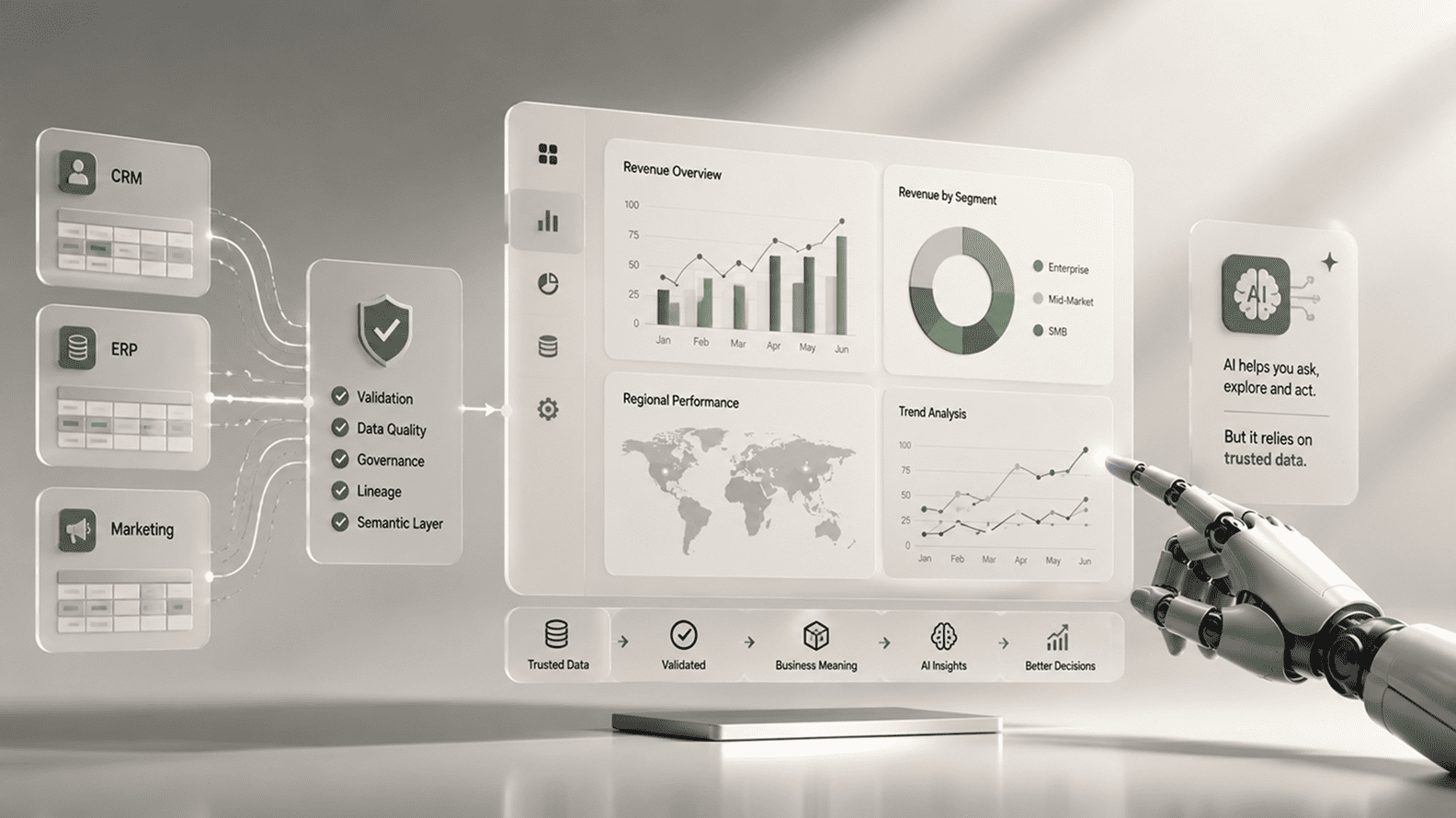
This is where AI readiness becomes less glamorous than the demo. The company needs certified data sources, clear metric names, record ownership, data lineage, permissions, refresh status, and documentation that business users can understand. It also needs a way to handle uncertainty.
If a number is provisional, the AI answer should say so. If a metric has several approved versions, the assistant should ask which version the user means or show the distinction clearly. If the data is stale, the answer should not pretend to be current.
A good AI analytics layer behaves like a careful analyst. It answers quickly, but it also shows where the answer came from, what it excluded, what could be wrong, and when a person should review the result before it is used. That is the difference between a useful interface and a confident shortcut.
AI can improve many parts of analytics, especially the parts where teams spend time searching, summarizing, classifying, comparing, or preparing first drafts. It can help an analyst notice that a region is moving differently from the rest of the business, help a manager understand a dashboard without waiting for a walkthrough, and help a finance team draft a variance explanation before the close review. Used well, it gives people a faster starting point.
The danger is expecting the tool to own decisions the business has never properly made. AI cannot decide whether a trial user should count as active, whether a stalled deal should remain in forecast, whether a refund should be included in net revenue, or whether a large account should be treated as a single customer or several buying centres. Those are business choices, and analytics become stronger when those choices are made openly.
| AI Can Help With | The Business Still Owns |
| Finding anomalies in sales, finance, product, or customer data | Deciding whether the anomaly is a true business event or a data issue |
| Summarizing why a metric moved | Confirming the definition, source, and exclusions behind the movement |
| Drafting first-pass explanations for reports | Approving the explanation before it reaches leadership or customers |
| Creating segments and patterns | Deciding which segments matter commercially and which are noise |
| Speeding up dashboard questions | Naming the official metric and deciding which version belongs in each meeting |
| Suggesting forecasts or recommendations | Judging whether the prediction fits current business conditions |
This division of responsibility keeps AI useful without making it reckless. The tool can carry more of the mechanical burden, but the company still has to protect the meaning of the numbers. That means metric owners, data owners, analysts, and business leaders all remain part of the system. AI may change how quickly a question can be answered. It does not remove the need to know whether the answer should be trusted.
One unexpected effect of AI analytics is that it can expose data problems that were easier to ignore when fewer people were asking questions. A leadership dashboard may be opened by a small group once a week. A conversational analytics tool can be queried by sales, marketing, finance, product, support, operations, and leadership throughout the day. That wider use quickly reveals where the company’s data language is weak.
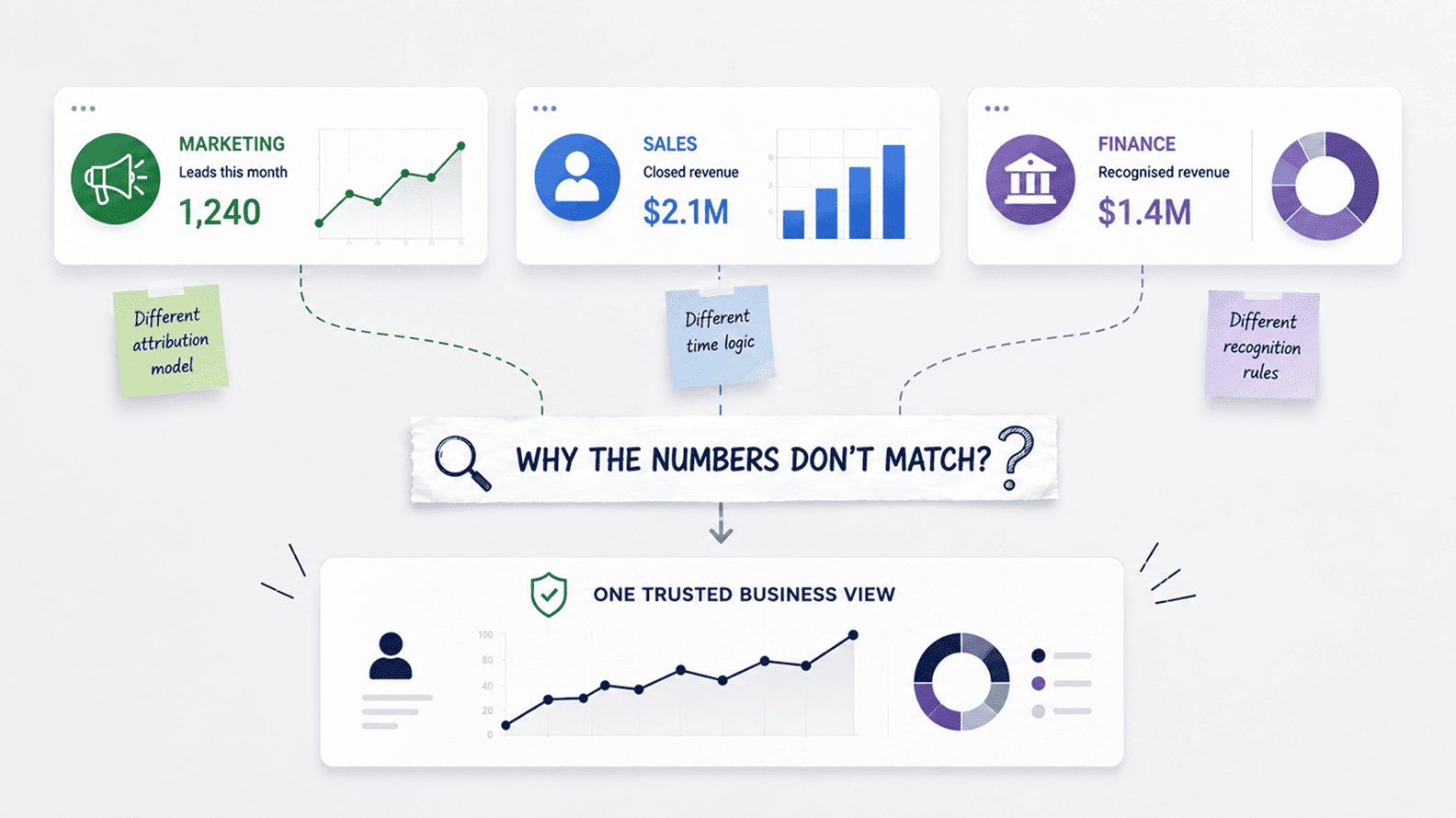
A user asks for customer churn and discovers three different churn definitions. Someone asks for margin by product and finds that product categories changed halfway through the year. A marketing manager asks which campaigns created the best opportunities and learns that source tracking is incomplete.
A sales leader asks why forecast moved and finds that close dates were updated inconsistently. AI did not create these problems. It made them harder to hide because the questions became easier to ask.
This is why data quality work should not be framed as a blocker to AI. It is part of the AI programme itself. Every important AI analytics use case should reveal a practical cleanup list: which metrics need owners, which sources need certification, which fields need stronger capture, which definitions need clearer names, and which reports should be retired because they no longer match the business.
The goal is not to clean the entire company before using AI. The goal is to improve the data around the decisions where AI will actually be used.
That approach also makes the work more manageable. Instead of launching a giant data-quality programme in the abstract, the company can begin with the areas where AI will touch real decisions: revenue, pipeline, churn, margin, customer health, utilization, campaign performance, inventory, cash, or support risk. AI becomes the forcing function that helps the business finally fix the data issues it has been working around for years.
AI is changing business analytics because it changes how people reach the numbers. The old analytics experience often depended on dashboards, scheduled reports, analyst queues, spreadsheet work, and formal review cycles. The new experience is becoming more conversational, faster, and more widely available.
A business user can ask more questions, an analyst can move faster through exploration, and a leadership team can expect explanations to arrive closer to the moment of decision.
That is a major shift, but it does not make weak data less weak. If anything, it makes weak data more expensive because the answer now travels faster and sounds more complete. A bad dashboard can be ignored. A bad spreadsheet may stay inside one team.
A bad AI-generated explanation can move into meetings, messages, customer actions, forecasts, and executive decisions before anyone has checked whether the underlying data deserves that confidence.
The strongest companies will not treat AI as a layer that sits above analytics and magically fixes what is underneath. They will treat it as a new interface on top of a business language that still has to be governed. Metrics need names. Sources need owners. Definitions need version history. Dashboards need certification. Forecasts need ground truth. AI outputs need review when they affect money, customers, people, or risk.
The promise is still enormous. AI can make analytics more accessible, more responsive, and more useful in the daily rhythm of business. It can help teams move from question to first answer much faster than before. The companies that get the most from it will be the ones that understand the trade-off clearly: AI can accelerate the route to insight, but the insight is only as strong as the data, definitions, and judgement it is built on.
AI changes business analytics by making it easier to ask questions, summarize results, spot patterns, draft explanations, and explore data without waiting for a traditional report every time. It turns analytics into something more conversational and responsive. A manager can ask why revenue moved, an analyst can test a segment faster, and a business team can get a first explanation before a formal review.
The important point is that AI changes the speed and interface of analytics before it changes the quality of the underlying data. If the data is trusted, AI can make good analysis easier to use. If the data is weak, AI can make weak analysis spread faster.
AI can help detect some data problems, such as unusual values, missing fields, duplicate patterns, inconsistent labels, or sudden changes in source behaviour. It can also help clean, classify, and standardize some records when the rules are clear.
It cannot automatically decide the business meaning behind the data. It cannot know by itself whether revenue should mean bookings, billings, collections, or recognized revenue in a specific meeting. It cannot decide whether a customer should be counted at account level, user level, parent level, or billing-entity level. Those choices still need business ownership.
Bad data becomes more risky with AI because the output can sound confident even when the input is weak. A messy spreadsheet may make people cautious. A clean AI summary may make people believe the answer is ready to use. That is dangerous when the source data is incomplete, stale, duplicated, or based on unclear definitions.
The risk grows when AI answers are used in meetings, forecasts, customer actions, or leadership communication. The company needs to know where the answer came from, which data was used, what was excluded, and whether a human should review it before action is taken.
AI is most useful at the start of analytics work where speed and exploration matter. It can help summarize dashboards, draft SQL, find anomalies, explain movement, generate first-pass charts, classify text, group records, and produce a first narrative for a report.
These are useful accelerators, but they still need review. A first-pass explanation is not the same as a finance-ready answer. A suggested anomaly is not automatically a business issue. A generated chart still needs a user who understands the metric, the source, and the decision.
Companies should start with the data problems closest to important decisions. Revenue, pipeline, churn, customer health, margin, utilization, campaign performance, inventory, cash, and support risk usually matter more than low-use fields that rarely affect action.
The useful questions are simple. Which source is trusted? Which metric definition is official? Which fields are often missing? Where do duplicates distort the answer? Which dashboards are certified? Who owns the number when two teams disagree? Fixing those areas gives AI a stronger foundation without turning readiness into an endless cleanup project.
AI reduces some of the mechanical work around analytics, but it increases the importance of judgement. Analysts may spend less time producing the first version of a query, chart, summary, or variance note. They will spend more time checking whether the answer is right, whether the source is trusted, whether the definition fits the decision, and whether the explanation is commercially sensible.
The analyst becomes less of a report factory and more of a quality gate, interpreter, and business partner. AI can help produce a first answer faster. The analyst helps decide whether that answer is good enough to use.
Forecasts fail when the signals used by the model no longer reflect the real business. A demand model may be trained on old campaign behaviour. A churn model may rely on usage events that no longer predict renewal risk. A sales forecast may treat pipeline value as healthy even when close dates and next steps are weak.
AI can improve forecasting, but forecasts still need ground truth. The business has to compare predictions with actual outcomes, update models when conditions change, and challenge patterns that look statistically strong but commercially weak.
Traditional BI usually depends on structured dashboards, scheduled reports, filters, and predefined views. AI analytics adds a more flexible layer where users can ask questions, request summaries, explore patterns, and receive draft explanations in natural language.
The two should work together. BI provides trusted structure. AI makes that structure easier to use. If the BI layer has weak definitions, old dashboards, and unreliable sources, AI will inherit those weaknesses. If the BI layer is governed well, AI can make it more accessible and useful.
AI can support executive reporting, but it should not be allowed to invent or quietly reinterpret the numbers. Executive reporting needs stable definitions, trusted sources, clear owners, and visible change history because leaders use those numbers for budgets, forecasts, hiring, incentives, and strategy.
AI is useful for drafting commentary, surfacing drivers, and helping leaders ask follow-up questions. The final numbers and explanations still need review when the decision carries financial, operational, or reputational weight.
Start with one or two high-value use cases where the data and decision are already reasonably understood. A good starting point may be campaign performance summaries, sales pipeline explanations, customer-health reviews, finance variance drafts, support-volume analysis, or product-usage summaries.
The first pilot should test more than the AI output. It should test whether the data source is trusted, whether users understand the metric, whether the answer reduces work, and whether people would actually use it again. That gives the company a practical path into AI analytics without pretending that the tool will fix every data problem on day one.
Aug 04, 2026 / 27 min read
Aug 04, 2026 / 22 min read
Jul 31, 2026 / 24 min read