How to Build Content That Buyers and AI Tools Actually Reference
Sep 22, 2026 / 38 min read
September 23, 2026 / 30 min read / by Team VE
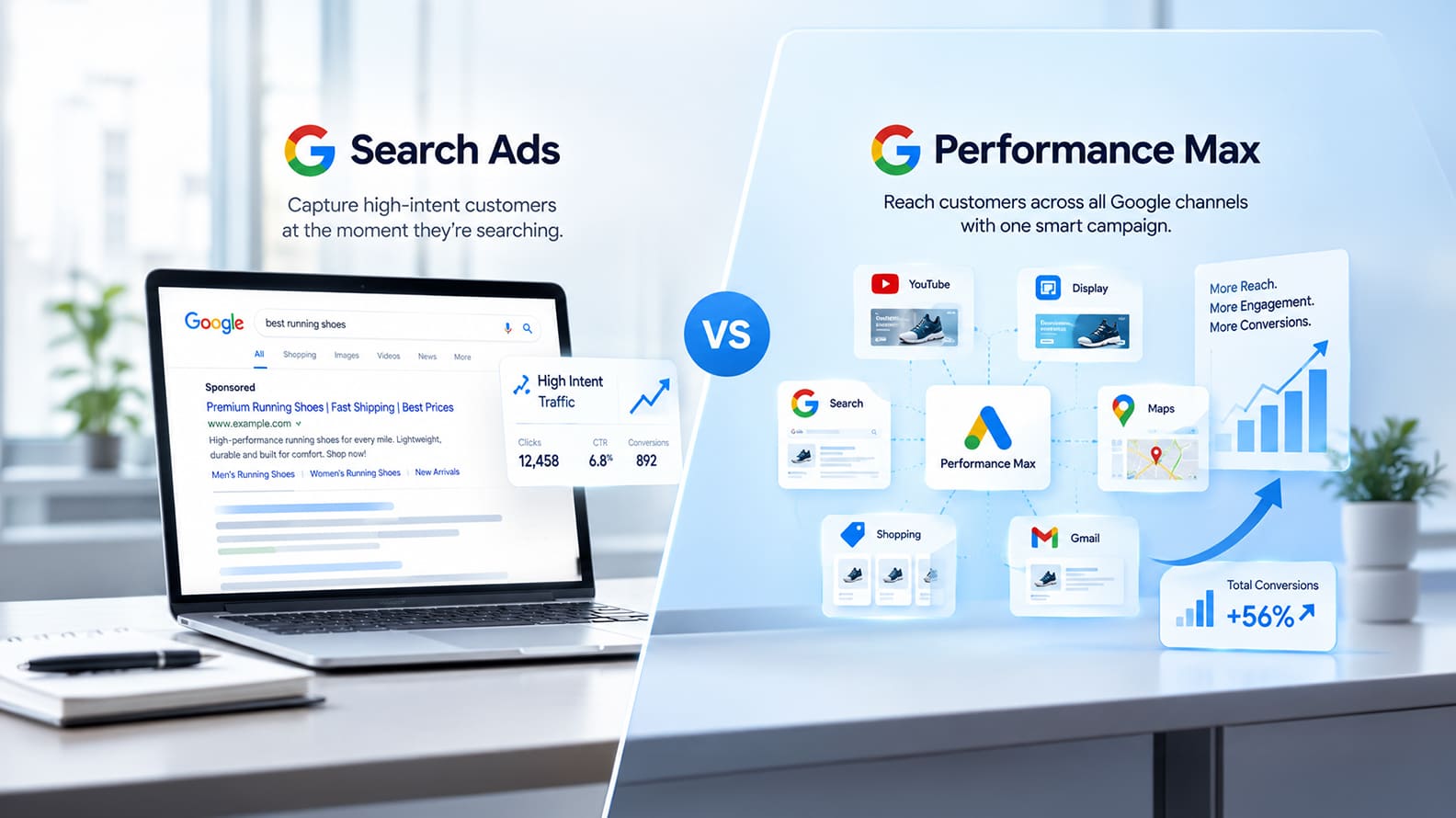
A practical guide to choosing between control and discovery in Google Ads, with a sharper focus on lead quality, ecommerce economics, automation, measurement and the data that increasingly determines performance.
Search and Performance Max are built for different jobs. Search gives a business the clearest view of explicit demand because campaigns begin with the language people use when they are actively looking for a product, service or provider.
Performance Max uses Google AI to work across Search, Shopping, YouTube, Display, Discover, Gmail and Maps, which gives it more room to find additional conversions when the advertiser can provide reliable conversion data, strong assets, useful landing pages and clear commercial goals.
For most lead-generation SMBs, Search remains the cleaner place to prove intent and economics before asking automation to explore more broadly. Ecommerce can justify a larger Performance Max role earlier because product feeds, purchase values, inventory and repeat-purchase behaviour give the system richer signals.
In both cases, campaign choice is increasingly a measurement decision. The account needs to know what a valuable lead or sale looks like, how much it is worth, and whether reported conversions are creating incremental revenue instead of simply producing an attractive dashboard.
Google Ads now makes automation feel almost effortless. A single Performance Max campaign can reach buyers across Search, Shopping, YouTube, Display, Discover, Gmail and Maps, while Search campaigns themselves are becoming more automated through AI Max, broader matching and dynamic landing-page selection.
The platform can do more of the mechanical work than it could a few years ago. The commercial question has become harder at the same time because a small business still has to decide which signals deserve to be amplified.
Google’s own definition is useful here. Performance Max is described as a goal-based campaign type designed to complement keyword-based Search campaigns, not as a universal replacement for them. Search begins with known demand.
Performance Max begins with a conversion goal and a wider inventory set, then uses signals from the website, feeds, assets, audiences and conversion history to decide where opportunity may exist. Those starting points create very different management problems.
A local physiotherapy clinic with a £2,000 monthly budget may value knowing exactly which searches generate booked consultations. A consumer brand selling hundreds of products may care more about allowing the system to match products, audiences and creative across several surfaces.
A B2B software company could sit between the two, with high-value Search terms at the bottom of the funnel and a longer research journey that gives Performance Max room to assist with remarketing and broader consideration once lead quality is measurable.
The platform can optimize only against the objective it receives. A clinic that counts every phone click as success, an agency that counts every form completion equally, or a SaaS company that never sends qualified pipeline back into Google Ads leaves the system guessing about business value. Automation works fastest when the advertiser has already done the uncomfortable work of defining success in commercial terms.
| Question | Search Gives You | Performance Max Gives You |
| Where does intent come from? | Search queries and keyword structure you can inspect directly | AI-led discovery across multiple Google surfaces |
| How much control is visible? | More direct control over queries, ads and landing-page structure | Broader automation with search themes, exclusions, URL controls and asset groups |
| What data matters most? | Search terms, conversions, landing-page performance and query economics | Conversion quality, first-party data, assets, feeds, audience signals and goal accuracy |
| Where does it usually fit first? | Proving known demand and high-intent economics | Expanding reach once the account can identify valuable outcomes |
| Main commercial risk | Paying too much for known intent or allowing match expansion to drift | Scaling low-quality signals or harvesting easy conversions without enough incrementality |
The enduring advantage of Search is linguistic. Someone types what they want, and the advertiser can inspect the relationship between the query, the ad, the landing page and the conversion. An immigration law firm can distinguish “immigration lawyer consultation” from “immigration law course”.
A commercial cleaning company can see the difference between “office cleaning contract” and “cleaning jobs”. A specialist engineering supplier can separate a product query from an educational search by a student. For a small budget, those distinctions are the economics of the campaign.
Search itself is moving deeper into AI. Google says AI Max for Search can expand matching using broad match and keywordless technology while also using text customization and Final URL expansion.
Google reports that advertisers activating AI Max typically see 14% more conversions or conversion value at a similar CPA or ROAS, with higher typical uplift among campaigns that previously relied mainly on exact and phrase match. Those are Google-reported averages, so they are best treated as platform benchmarks rather than guaranteed results for an individual account.
The important consequence is that Search now offers more discovery without giving up the campaign structure entirely. Advertisers can still see search terms, keyword contribution, landing pages and AI Max-specific matches in reporting.
Google’s current reporting also lets teams inspect the search term together with the headline and landing page that served. Search remains the better diagnostic instrument when a business needs to understand what people are asking for and whether the page answering that demand is working.
A lead-generation company still needs discipline around match expansion. Query intent can deteriorate quickly when the market is broad or ambiguous. A financial adviser may value searches around retirement planning while having little interest in school assignments about pensions.
A B2B staffing company may want to “hire a Salesforce developer” and have no use for “Salesforce developer salary”. Search campaigns give the team a relatively clear place to find that waste and improve the account.
For a company still learning paid acquisition, the first strategic question remains simple: when buyers actively ask for what we sell, can we convert that intent at an acceptable cost? Search is usually the cleanest campaign type for answering it.
Performance Max is built around a broader proposition. Google says the campaign can access its full ad inventory from one campaign and use AI across bidding, targeting, creative and attribution. The value comes from allowing the system to search for conversion opportunities across places an advertiser would struggle to coordinate manually.
Google also reports that advertisers adopting Performance Max beyond retail see an average 27% increase in conversions or conversion value at a similar CPA or ROAS, even when they already use broad match and Smart Bidding in Search. Again, the figure is a Google benchmark, not an independent guarantee.
A good Performance Max account therefore looks less like a clever campaign setup and more like a well-instrumented business. Conversion goals need to reflect value. Landing pages need to be specific.
Creative assets need to represent the offer properly across different contexts. Audience signals and search themes should add information the system cannot easily infer. Product feeds, where relevant, need accurate titles, images, prices, availability and category information.
Google has added considerably more steering than early Performance Max users had. Current Performance Max search controls include search themes, negative keywords, brand exclusions, Final URL expansion and URL controls.
Search themes can provide up to 50 signals per asset group, while negative keywords and brand exclusions create firmer boundaries. Final URL expansion can send a user to a more relevant page based on query intent, and URL exclusions can prevent the system from landing visitors on content that should never receive paid traffic.
Those controls make Performance Max easier to manage, but they also change what good management looks like. The job is no longer endless manual bid adjustments. It is deciding which conversions matter, which URLs are safe, which asset groups represent distinct commercial propositions, how branded traffic should be handled, and whether the incremental conversions are genuinely valuable. Strategy has moved into the inputs and the measurement architecture.
| Input | Why It Matters in Performance Max | What Weak Input Looks Like |
| Conversion goals | Tells the system what outcome to pursue | Every form, call or micro-action counted as equal |
| Landing pages | Provides commercial context and conversion paths | Generic homepages, thin service pages, irrelevant blog URLs |
| Creative assets | Allows the campaign to work across visual and text inventory | Repeated generic headlines, weak images, no useful video |
| First-party data | Helps steer toward higher-value audiences and outcomes | No customer lists, CRM feedback or qualified-lead signal |
| Feeds | Gives retail campaigns structured product information | Poor titles, wrong availability, weak images, bad categorization |
| Controls | Keeps automation inside commercial boundaries | No exclusions, uncontrolled URL expansion, unclear brand strategy |
Lead generation is where Performance Max deserves the most sceptical management because the conversion event is often far removed from revenue. An ecommerce purchase usually creates an immediate value signal.
A B2B enquiry can spend four months moving through qualification, discovery, proposal and procurement before anybody knows what it was worth. A raw form fill is therefore a weak proxy for success when one lead can be worth £50 and another £50,000.
Google’s own lead-generation guidance makes the same point. Its Performance Max best-practice documentation for lead generation says AI is only as good as the inputs it receives and emphasizes high-quality data, valuable conversion actions and strong creatives.
Google now recommends enhanced conversions for leads as the upgraded path for importing offline outcomes, and its setup guidance specifically identifies “Qualified lead” or “Converted lead” as best-practice conversion goals.
Consider a home renovation company. Performance Max may produce 80 enquiries at a cost per lead that looks excellent. Sales may later discover that many are outside the service area, several want minor repairs, some have unrealistic budgets, and only a handful become site visits.
Search could produce fewer enquiries at a higher cost while concentrating on queries such as “loft conversion company” or “kitchen renovation quote”. The cheaper lead source is not automatically the better commercial source.
Google has also changed the technical plumbing in 2026. Enhanced conversions for leads now uses a unified measurement setup and Google recommends Data Manager for current and future offline uploads.
First-party data such as hashed email addresses can help connect later CRM outcomes back to the ad interaction. The practical value is substantial because bidding can learn from qualified or converted leads instead of treating every initial submission as equally valuable.
Retail is a more natural environment for Performance Max because the feedback loop is richer. A Merchant Center feed tells Google what the product is, how much it costs, whether it is available, and what image represents it. Purchases carry value. Customer lists and remarketing behavior add history. Inventory and product-level performance can be analyzed much faster than a six-month B2B sales cycle.
Google continues to position Performance Max as the cross-channel option for retailers even as Shopping itself becomes more automated. In April 2026, Google launched AI Max for Shopping to help standard Shopping campaigns respond to conversational queries using Merchant Center data, text customization and Final URL expansion.
Google explicitly described Performance Max as the cross-channel choice, which is an important distinction. Retailers now have more automation inside Shopping and more cross-network expansion through Performance Max.
The danger in ecommerce is blended efficiency. Performance Max can capture branded searches, returning visitors, remarketing demand, high-margin products, low-margin products and new customers inside a single reported result.
A headline ROAS can therefore look excellent while incremental customer acquisition is weak. Brands need to separate new customer growth, repeat purchases, contribution margin, discounting and product-level economics from the platform’s aggregate return.
The platform has become more transparent here as well. Google expanded Performance Max product-level reporting across eligible networks in June 2026, giving merchants a fuller view of product performance beyond the Search network. More reporting helps, but the commercial question remains the same: which products and customers create profitable growth after shipping, returns, discounts and margin are included?
Feed quality is frequently the quiet differentiator. A specialist furniture merchant with accurate material, size, style and availability data gives the system far more useful context than a store with vague titles and inconsistent attributes. Images matter. Product pages matter.
Price competitiveness matters. Margin segmentation matters. In a Performance Max account, much of the highest-value optimization may happen in the Merchant Center and on the website rather than inside the campaign screen.
| Retail Signal | What the Campaign Can Learn | What the Business Still Needs to Judge |
| Product feed | Which items and attributes match shopper intent | Margin, inventory priority and merchandising strategy |
| Purchase value | Which conversions are worth more | Profit after returns, discounts, shipping and fees |
| Customer lists | Patterns among existing or valuable customers | Whether growth is truly incremental |
| Product-level reporting | Which items consume and return spend | Whether budget should follow revenue or contribution margin |
| New customer goals | How to weight acquisition toward new buyers | Lifetime value and acceptable first-order economics |
Search and Performance Max are often discussed as opposing philosophies when they are better understood as different information systems. Search gives the advertiser a clearer view of the demand it intentionally entered. Performance Max gives the platform more freedom to explore.
A business that knows exactly which intent it wants to buy may value the former. A business with mature tracking and enough commercial signal may gain more from allowing the system to find additional demand.
A new accounting practice is a good illustration. Early campaigns can focus on terms around bookkeeping, payroll, tax preparation, or fractional finance in a defined geography. The owner can see which services generate calls and which searches attract irrelevant students, jobseekers or DIY traffic.
Once the firm has reliable conversion rates, qualified lead definitions and strong pages for its profitable services, Performance Max can be tested as an expansion layer with clear search themes, URL controls, and exclusions.
A direct-to-consumer skincare brand starts from a different place. Product feeds, customer lists, images, videos, purchase values and repeat purchase behavior already give Google a richer signal set. Performance Max may deserve a larger early role because it can combine product discovery and conversion across more surfaces.
Brand Search, category Search, Shopping controls and lifecycle marketing still need separate attention because a campaign that efficiently harvests existing demand can look healthier than the underlying customer-acquisition engine.
B2B services usually sit closer to the accounting example than the ecommerce brand. Bottom-funnel Search terms are easier to interpret, and lead quality can vary dramatically. Performance Max becomes more credible when CRM stages, offline conversions, useful case studies, and service-specific pages are mature enough to tell the platform what the business actually values.
Google provides Performance Max uplift experiments specifically to measure the incremental conversion or conversion-value lift from adding Performance Max alongside other campaign types. That is a better question than asking which campaign “wins” in a blended report. Incrementality asks whether the extra automation created value the account would not otherwise have captured.
Performance Max earned much of its early reputation for opacity because advertisers had fewer controls and fewer ways to see where spend was going. The product in 2026 is materially different. Search themes, campaign-level negative keywords, brand exclusions, Final URL controls, placement tools and richer reporting give teams more ways to steer and diagnose performance.
Current Google brand-exclusion guidance allows advertisers to keep Performance Max away from specific brand searches, including their own brand where separate campaign economics are important. Campaign-level negative keywords can block unsuitable Search and Shopping queries. Final URL expansion controls can prevent the system from sending paid traffic to non-commercial areas such as support or policy pages.
These tools matter because a business rarely wants maximum automation in every direction. A multi-location clinic may allow broad discovery while restricting URLs to bookable services and locations. A SaaS company may exclude careers, documentation and free-resource pages.
An ecommerce brand may keep branded searches in a separate Search campaign to preserve a cleaner view of acquisition economics. Better controls turn automation into a design problem instead of a binary on-off decision.
The management standard should therefore be higher than “let the algorithm learn”. A specialist should be able to explain which signals the system is receiving, which controls are active, what changed after a budget movement, how landing pages are being selected, whether brand traffic is influencing the result, and how raw conversions compare with revenue. Automation can reduce manual work. It does not reduce accountability.
Small businesses do not need an elaborate account architecture for the sake of complexity. They need enough separation to understand intent, economics and expansion. The right structure depends on the business model, but a few recurring patterns are useful because each gives Search and Performance Max a defined commercial job.
| Business Type | Search Role | Performance Max Role | Other Layer to Protect |
| Local lead generation | High-intent service and location searches | Expansion after call and booking quality are measurable | Local pages, reviews, call tracking and remarketing |
| B2B services | Bottom-funnel service, competitor and category intent | Broader discovery and remarketing after CRM quality signals mature | Case studies, service pages, offline conversions |
| Ecommerce | Brand and priority category intent where control matters | Cross-channel product discovery and conversion | Feed quality, Shopping controls, lifecycle and margin reporting |
| Multi-location business | High-value service and local intent | Cross-channel reach with location and conversion signals | Location exclusions, store goals, reviews and landing pages |
| New advertiser | Primary learning environment | Small controlled test after tracking is reliable | Analytics, conversion setup and commercial landing pages |
For lead generation, a sensible early account often gives Search the majority of acquisition responsibility. The campaign can concentrate on the services, locations and queries with the clearest intent. Performance Max can begin as a measured expansion test once the CRM can distinguish a raw enquiry from a qualified opportunity. Remarketing then keeps known visitors in the consideration set without asking acquisition campaigns to do every job.
Retail accounts can shift faster toward Performance Max because product data makes the system more informative earlier. Brand Search may still need protection, especially when the company wants a clean view of incremental acquisition.
High-margin categories can deserve their own structure. Products with limited inventory or weak economics should not receive the same freedom as the hero lines. The account architecture should reflect the business model, not just the campaign menu.
One principle should stay consistent across both: budget movement needs evidence. If Performance Max receives more spend, the business should know whether qualified pipeline, incremental revenue or profitable new-customer growth improved.
If Search receives more spend, the team should know which queries and services are absorbing it and whether marginal cost remains acceptable. Campaign architecture is useful because it makes those answers easier to see.
As campaigns automate, measurement becomes the part competitors cannot simply switch on. Two businesses can use the same bidding strategy, the same campaign type and even the same AI features. The advertiser with better conversion data, better CRM discipline and a clearer definition of customer value gives the system a more accurate target.
Google’s 2026 conversion documentation reflects that shift. Enhanced conversions for leads combines online identifiers with later offline outcomes so Google Ads can attribute qualified and converted leads back to earlier interactions more accurately. The system still needs the business to decide which sales stages matter and to maintain the data flow. A platform can optimize toward “converted lead” only after the company defines and records one consistently.
Ecommerce has a similar challenge with value. Revenue is convenient, profit is more useful. A campaign can hit a strong ROAS while leaning into low-margin products or existing customers who would probably have purchased anyway. Retailers with uneven margins need contribution data, new-customer economics and return behaviour alongside the ad-platform result. Otherwise the algorithm is optimizing a simplified version of the business.
| Platform Metric | Better Business Check | Why It Matters |
| Cost per lead | Cost per qualified lead and cost per customer | Raw lead volume can hide poor fit |
| Conversion volume | Pipeline, revenue and incrementality | More conversions may simply mean easier conversions |
| ROAS | Contribution margin and new-customer economics | Revenue can hide discounts, returns and low margin |
| Search volume captured | Commercial quality of the queries | Reach without intent can drain a small budget |
| Asset performance | Message quality and downstream conversion | Engagement does not guarantee customer value |
| Campaign growth | Capacity to fulfil and sell the extra demand | Media can outgrow the sales or operations team |
A small company can build a meaningful advantage here because the feedback loop is often shorter. The owner may know within a day that a batch of enquiries is poor. A salesperson can tag which calls became real opportunities. An ecommerce operator can see which products are being returned. Feeding that knowledge back into campaign decisions is more valuable than trying to outsmart Google’s bidding system manually.
Automation has reduced some of the manual work that once defined paid search. Daily bid adjustments, exhaustive keyword expansion and repetitive creative variations matter less when Smart Bidding, AI Max and Performance Max can perform much of that work at scale. The specialist has not become less important. The role has moved closer to commercial systems design.
A strong PPC operator now needs to understand conversion architecture, CRM stages, landing-page intent, product feeds, audience signals, creative quality, exclusions, brand strategy and budget incrementality. They also need enough financial judgment to challenge a campaign that looks efficient inside Google Ads but creates weak pipelines or unprofitable orders. Platform fluency is still necessary, but the highest-value decisions increasingly happen around the platform.
This is particularly important for small businesses because wasted learning is expensive. A large advertiser can absorb several months of poor experimentation. A smaller company may have one salesperson, one key geography and a limited budget. The campaign needs to fit lead-handling capacity, average order value, service margin and operational constraints. Fifty extra low-quality leads can create more damage than benefit if they consume the sales team’s week.
A modern account does not need constant intervention, but it does need a regular commercial review. Weekly checks are useful for protecting intent, detecting broken measurement and catching sudden quality problems. Monthly reviews should step back and ask whether the campaign mix is producing profitable growth, whether the data feeding automation is improving, and whether the budget deserves to move.
| Check | Search | Performance Max | Business Reason |
| Search quality | Review actual queries, match expansion and negatives | Review search-term insights, themes and exclusions | Protect intent and budget |
| Conversion truth | Compare forms and calls with qualified outcomes | Import qualified or converted leads and values | Stop automation optimizing for junk |
| Landing-page fit | Match high-intent queries to precise pages | Review Final URL behaviour and URL controls | Protect relevance and conversion |
| Creative | Refresh messaging and assets when response weakens | Maintain images, video, headlines and asset groups | Give automation better material |
| Budget | Move toward profitable query groups and services | Scale after quality and incrementality improve | Avoid rewarding blended averages |
| Sales or revenue feedback | Review closed-loop results | Compare platform growth with pipeline or profit | Keep media tied to commercial outcomes |
The review should get more analytical as automation increases. A report made up of impressions, clicks, conversions and average CPA is too thin for a 2026 Google Ads account. Leadership should be able to see what the campaign is finding, which conversion stage is being optimized, how lead or order quality is changing, what the landing pages are doing and why the next budget movement is justified.
Search remains the clearest instrument for buying explicit demand. Performance Max is the broader expansion system. Their value changes with the maturity of the advertiser. A business still discovering which queries generate profitable customers benefits from Search’s visibility into intent. A business with dependable conversion data, strong assets and enough commercial signal can give Performance Max more freedom to explore.
Lead generation makes the measurement requirement especially important because the platform sees an inquiry long before the business knows whether it was good. Qualified and converted lead data closes that gap. Ecommerce gets a richer starting point through product feeds and purchase values, while profitability, customer mix and incrementality still need to be judged outside a blended ROAS.
Google is steadily making both campaign types more automated and more controllable at the same time. AI Max is bringing keywordless expansion and dynamic assets deeper into Search. Performance Max now has stronger search themes, negative keywords, brand controls, URL controls and reporting. The strategic advantage therefore comes from how well a business defines value, supplies useful signals and interprets the result.
The most effective account does not need Search to defeat Performance Max or Performance Max to replace Search. It needs Search to capture and explain known intent, Performance Max to expand into worthwhile demand, and measurement to decide whether the expansion creates real commercial value. Once those jobs are clear, automation becomes easier to trust because the business knows what it is asking the machine to optimize.
Performance Max is stronger when the advertiser wants Google to explore across multiple channels and already has reliable conversion goals, strong assets and enough commercial data to guide that exploration. It can reach customers through Search, Shopping, YouTube, Display, Discover, Gmail and Maps from one campaign, which gives it a broader opportunity set than a standard Search campaign.
Search remains stronger when the business needs a clearer view of intent, query economics and landing-page performance. Many SMBs benefit from using Search to establish what profitable demand looks like, then adding Performance Max as an expansion layer. The useful comparison is therefore the job each campaign is performing and the incremental business value it creates.
Search is usually the cleaner starting point for a lead-generation SMB because the business can see which searches generate calls, forms and qualified conversations. That visibility is particularly important when budget is limited, service areas are narrow or the difference between a good and bad lead is large. Search gives the team a more interpretable learning environment while the offer and landing pages are still being refined.
Performance Max becomes more attractive after conversion quality is measurable. Once the company can identify qualified or converted leads, import CRM outcomes, control landing pages and provide strong creative assets, automation has much better information to work with. A small test can then measure whether broader reach adds genuinely incremental pipeline.
Yes. Any campaign can waste money, and Performance Max can do it quickly when the underlying signals are poor. Broad conversion goals, weak tracking, irrelevant landing pages, thin assets and no lead-quality feedback can encourage the system to find the easiest available conversion instead of the most valuable customer. The dashboard may still look efficient while sales sees little commercial improvement.
Current Performance Max controls make that risk easier to manage. Advertisers can use negative keywords, brand exclusions, search themes, URL exclusions and Final URL settings to establish boundaries. The larger safeguard is measurement. Qualified leads, revenue, contribution margin and incrementality should sit beside CPA or ROAS before the budget is increased.
Performance Max works best when Google receives a rich and accurate picture of value. Ecommerce often fits that description because Merchant Center feeds, product prices, purchase values, customer lists and repeat-purchase behaviour provide structured signals. Multi-location and high-volume lead-generation businesses can also benefit when calls, bookings and qualified leads are tracked consistently.
Strong creative and landing pages matter because Performance Max serves across several environments. The campaign may need text, images, video and a relevant destination for different moments in the journey. A well-built asset and measurement environment gives automation room to discover while the advertiser retains enough commercial control to understand the result.
For most SMB accounts, Search still has a valuable role. High-intent service terms, branded searches, competitor queries and important category searches may deserve separate structure because the business wants cleaner reporting or greater control. Google also designs Performance Max to complement keyword-based Search, and exact-match Search keywords can receive priority when the query is identical and the campaign is eligible.
Keeping Search alongside Performance Max can also improve learning. Search-term data shows how buyers describe the problem, while Performance Max can test beyond the demand the advertiser has already mapped. The account becomes stronger when those two sources of information are reviewed together instead of being managed as isolated channels.
It can be, although B2B needs stronger conversion measurement because the sale often happens long after the ad click. A demo request or contact form is only an early stage in the process. Student enquiries, vendors, small companies outside the target segment and low-budget prospects can all make a campaign look productive while producing little pipeline.
B2B advertisers should connect Google Ads with CRM stages wherever possible and optimize toward qualified or converted leads. Search often remains the better place to capture bottom-funnel demand first. Performance Max becomes more useful as the business develops reliable offline conversion imports, service-specific pages, credible content and enough first-party data to guide wider discovery.
There is no reliable universal percentage. The appropriate amount depends on cost per click, margin, sales capacity, conversion volume, the maturity of Search campaigns and how much uncertainty the business can tolerate. A lead-generation SMB may protect the majority of budget around proven Search demand while giving Performance Max a controlled test budget. A retailer with strong product data may give Performance Max a larger share sooner.
The budget should increase when business outcomes improve, not simply because platform conversion volume rises. Qualified leads, closed revenue, contribution margin, new-customer growth and incrementality are better scaling signals than a cheaper blended CPA alone. The campaign needs enough budget to learn, while the company still needs enough control to survive a poor test.
Performance Max can use headlines, descriptions, images, videos, logos and landing pages, with product feeds adding another layer for retail. The assets should represent the real buying context. A clinic needs credible service and location proof. A B2B provider needs clear pages around services, process and evidence. A retailer needs accurate product information and strong imagery.
Quantity helps only when the material is useful. Repeating the same generic claim across several headlines does not create meaningful variety. Asset groups should align with distinct products, services or customer needs, and the pages they use should answer the commercial questions those audiences are likely to have.
Start with conversion truth. Lead-generation businesses should separate raw enquiries from qualified leads, opportunities and customers. Ecommerce companies should look beyond reported ROAS to contribution margin, new-customer mix, returns and product-level economics. Both should examine whether Performance Max is adding conversions that would not have happened through existing Search, branded demand or remarketing alone.
Google provides experiments for advertisers with enough volume to measure uplift from adding Performance Max to an existing campaign mix. Even without a formal experiment, the management principle is the same. Compare platform performance with CRM or commerce outcomes and increase spend only when the business can explain where the additional value is coming from.
Automation has changed the specialist’s work more than it has removed the need for one. Google can now automate bidding, targeting expansion, creative combinations and landing-page selection at a scale no human team could manage manually. Someone still needs to decide what counts as a valuable conversion, which URLs and brands are appropriate, how the account should be structured and whether reported growth is commercially useful.
The strongest PPC specialists increasingly operate across analytics, CRM, creative, feeds, landing pages and financial performance. Their advantage is judgment. They can connect a platform signal to what sales, finance and operations are seeing, then decide whether the machine needs more freedom, better data or tighter boundaries.
Sep 22, 2026 / 38 min read

Sep 21, 2026 / 34 min read

Sep 20, 2026 / 39 min read