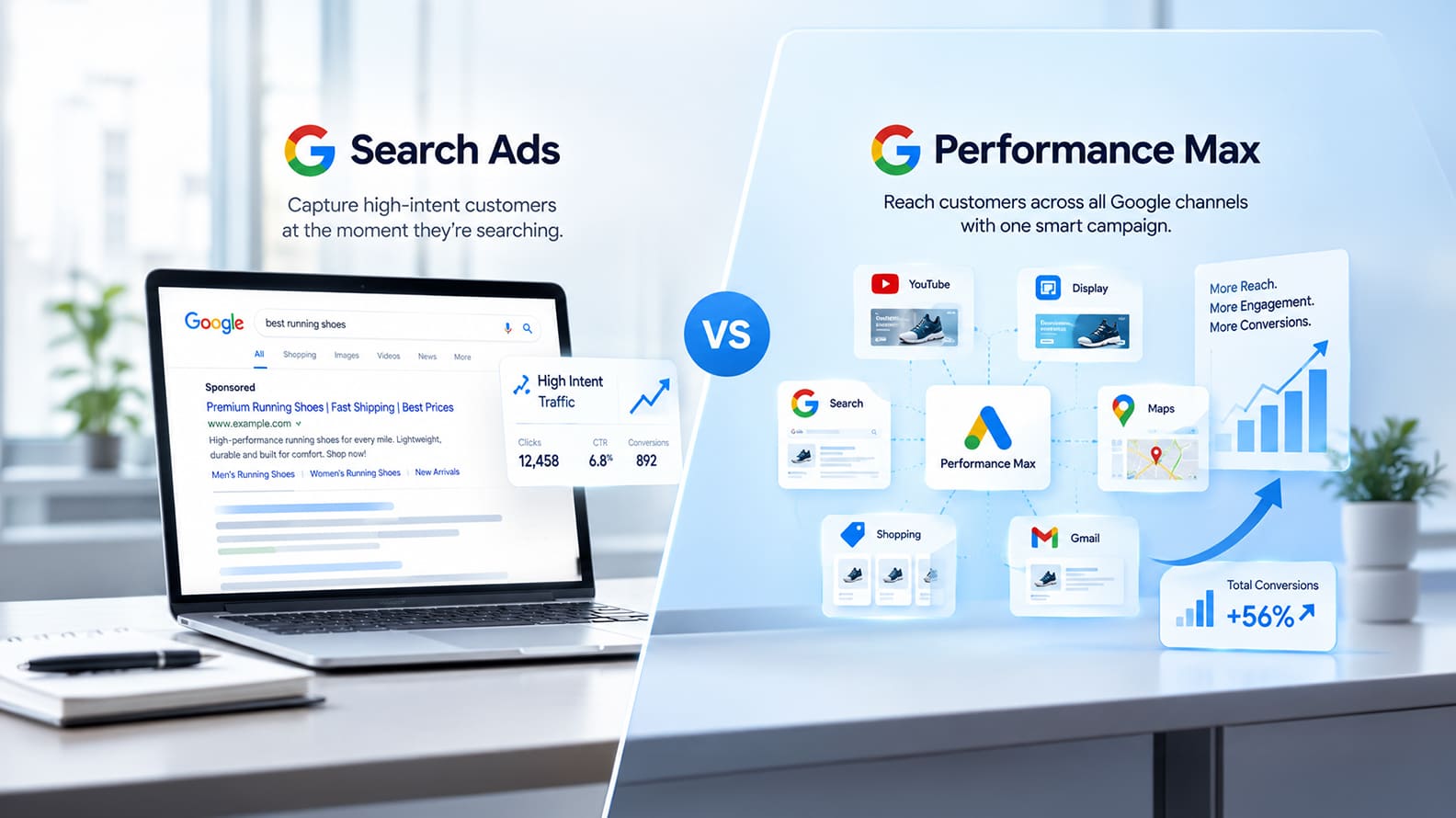
Performance Max vs Search Campaigns: What Should Businesses Use and When?
Sep 23, 2026 / 30 min read
September 21, 2026 / 34 min read / by Team VE
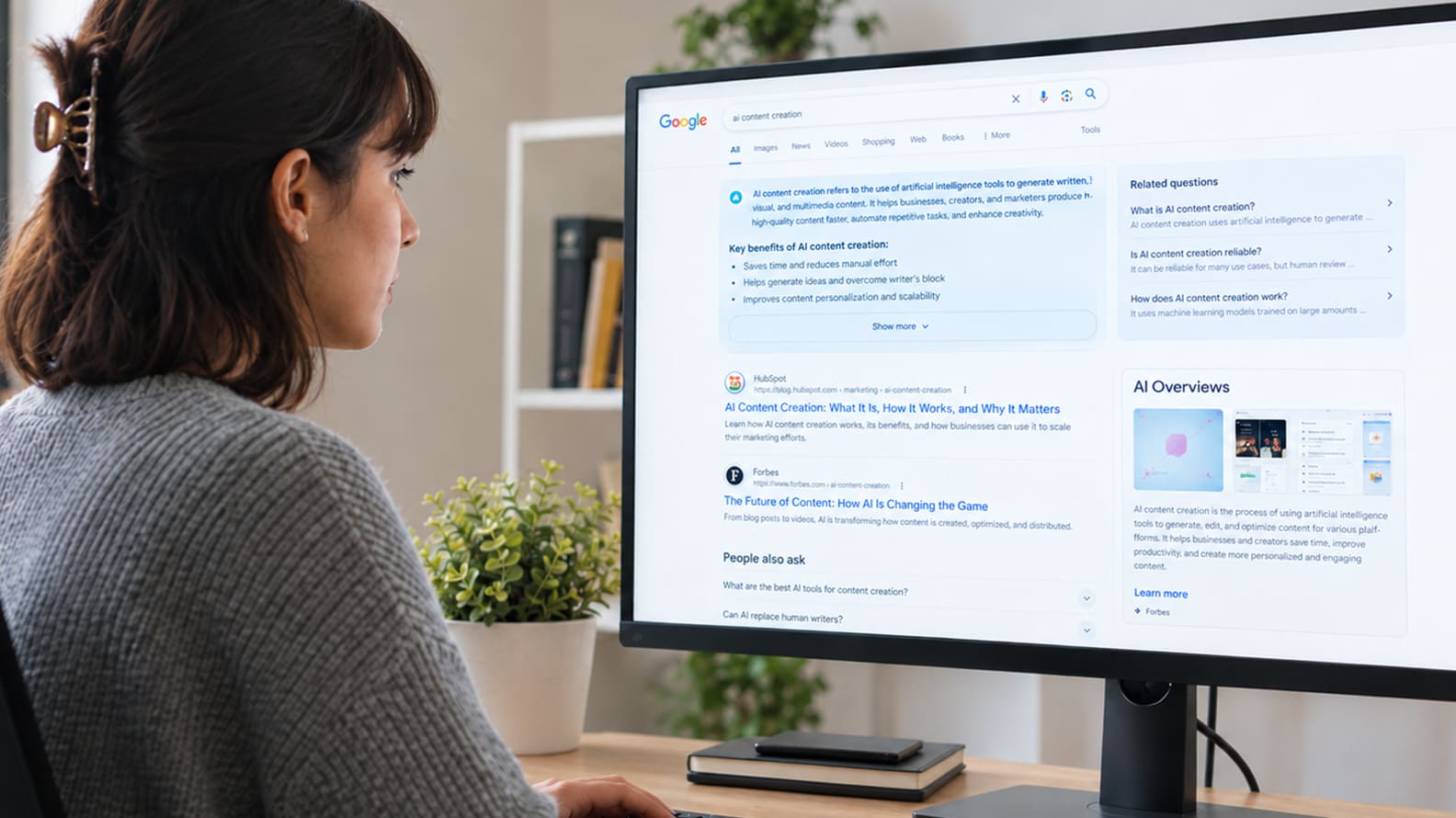
AI Overviews are changing which searches still produce a visit, where organic attention is being absorbed, and what a commercially useful SEO result now looks like.
Google AI Overviews are changing click behaviour most sharply on searches that can be answered inside the results page. Informational queries remain the most exposed, although AI Overviews are also moving into commercial research. For an SEO team, the useful question is no longer whether traffic is up or down in aggregate. It is which pages are losing clicks, what role those pages play in the buying journey, and whether the visits that remain are becoming more commercially valuable.
The strongest response is to concentrate effort on pages that buyers still need to visit. Pricing explainers, comparisons, service pages, original research, case studies, calculators, local proof and expert-led guides have more room to earn attention because they help someone evaluate, choose or act. Reporting needs the same upgrade. Rankings, impressions and sessions still belong on the dashboard, alongside citation visibility, branded demand, returning visitors, assisted conversions, lead quality and sales feedback.
Knix is a useful place to begin because it competes in a category crowded with companies far larger than itself. H&M, Uniqlo and Victoria’s Secret all sell period underwear, yet in a 2026 analysis of 20 buying-stage searches across ChatGPT and Google AI Mode, Knix appeared only twice between them.
A shopper can now ask which period underwear works best for heavy flow, travel, teenagers or overnight use and receive a shortlist before opening a single product page. By the time the click happens, part of the research has already taken place inside the search or answer experience.
The same behaviour is moving into much less glamorous categories. A finance director looking for risk-management software can ask Google for the differences between enterprise platforms, refine the question around compliance, ask for implementation considerations and only then open a vendor site.
A homeowner can get a concise answer about gutter-cleaning frequency and save the click for the moment they need a local price. Search is becoming more useful before the website visit, which means the visit itself increasingly arrives later in the decision.
User behaviour is catching up quickly. Pew Research Center’s analysis of 68,879 Google searches found that people clicked a traditional result in 8% of visits when an AI summary appeared, compared with 15% when it did not. Only 1% of visits with an AI summary produced a click on one of the cited sources. By February 2026, 60% of US adults told Pew that they read AI summaries at the top of search results. The behaviour is no longer confined to early adopters or SEO experiments.
For an SEO team, that changes the value of the page before it changes the value of SEO. A page may help a brand enter the shortlist, establish a benchmark or frame a decision even when the user does not visit immediately. The harder question is whether the site has enough depth to earn the later click when the buyer moves from learning to evaluating. That is where the next generation of organic performance is starting to separate itself from the old traffic model.
There is also a subtle change in the quality of the visit. When Google handles more of the orientation work, the people who do click are often arriving with a narrower question. They have already learned the basic definition, seen a shortlist or understood the broad trade-offs. The website inherits a more demanding visitor.
That visitor wants evidence, specifics and a reason to believe the company can solve the problem in front of them. For smaller businesses, this can be an advantage because a focused service page or a strong case study can compete on usefulness even when the brand cannot compete on sheer publishing volume.
France gave SEO teams a rare clean before-and-after moment in July 2026. Google launched AI Overviews there on July 22, allowing Ahrefs to compare 963 domains across the 28 days before launch and the nine days after. Among sites with heavy AI Overview exposure, median click-through rate fell 23.1%.
The control group, whose queries were rarely exposed, moved slightly upward over the same period. The result is useful because it isolates the search-result change more clearly than markets where AI Overviews arrived gradually alongside algorithm updates and seasonal shifts.
Look a little closer and the exposure is far from uniform. Ahrefs’ wider 2026 dataset found AI Overviews on roughly one in five tracked keywords overall, while 99.9% of those appearances were attached to informational intent. Questions, longer queries and medical research triggered them much more often than shopping or local searches.
A page answering a self-contained question such as what a marketing funnel is sits in a very different environment from a page helping a buyer compare three providers, check local availability or decide which product to purchase.
The boundary is moving, though. Semrush’s analysis of more than 600,000 US keywords found that AI Overview appearances on commercial-intent searches grew 71% over six months, while Google Ads and AI Overviews appeared together roughly twice as often as they had a year earlier.
Finance saw the largest jump in commercial queries triggering an AI Overview. The comfortable assumption that AI summaries belong only to harmless top-of-funnel research is already becoming dated.
Site-wide traffic is a poor place to begin the diagnosis. An accounting firm losing visits to a glossary article on accrual accounting may barely notice commercially. The same firm losing click-through rate on a page comparing outsourced bookkeeping models deserves attention because the buyer is already weighing an approach. Page type, intent and proximity to revenue tell a much richer story than the headline traffic number.
The practical risk is portfolio imbalance. Many content programmes still carry hundreds of pages built for questions that can now be answered in a few lines, while the pages closest to revenue remain thin. A software company may have forty articles explaining broad industry terminology and only one weak integration page.
A professional-services firm may publish weekly thought leadership but leave pricing logic, timelines and engagement models vague. AI Overviews make that imbalance more expensive because the easy educational traffic is exactly where Google can absorb more of the journey.
One of the stranger features of the AI Overview era is that a ranking report can look reassuring while the business underneath it is receiving fewer visits. Seer Interactive tracked 53 brands across 5.47 million queries and 2.43 billion organic impressions from January 2025 into early 2026.
On queries where an AI Overview appeared and the tracked brand was not cited, organic click-through rate declined by 67% over 2025. The blue link could remain visible while the attention around it was being absorbed by a richer result above.
Citation changed the economics inside the same result. Throughout 2025, Seer found that brands cited inside an AI Overview earned roughly two to five times the organic click-through rate of brands that appeared on the page without being cited. The cited result still did not behave like the old ten-blue-links page, but it occupied a more useful position in the user’s research. Visibility and traffic had started to separate into different layers of the same outcome.
The data also produced an encouraging clue. Searches without AI Overviews became more valuable over the year, with organic click-through rates rising on those queries as lower-engagement answer searches migrated into AI-led results.
It suggests that some of the traffic being removed was always less likely to continue into a meaningful website session. For an SEO team, the task becomes identifying the queries that still contain a genuine reason to click and protecting the pages that serve them well.
A monthly report should therefore resist the temptation to celebrate position three in isolation. If the query now carries an AI Overview, shopping unit, video carousel, Reddit discussion and paid ads above the organic result, the commercial meaning of position three has changed. Search Console data by query and page, combined with SERP observation, can reveal whether the ranking is still producing the attention the business expects from it.
Neil Patel has reached a similar conclusion from a performance-marketing angle. Patel, co-founder of NP Digital and one of the most widely followed practitioners in search and digital acquisition, has been tracking how AI Overviews change the relationship between rankings and traffic.
In NP Digital’s 2026 analysis of AI Overview expansion, informational and educational searches carried the heaviest click-through pressure, while branded searches were the notable exception. His useful contribution to this debate is the commercial framing: search teams should stop forecasting clicks from ranking position as if the result page were unchanged and start modelling how intent, brand strength and SERP composition affect the traffic a position can realistically produce.
Google’s AI search systems are also changing what a single query represents. In classic keyword research, a marketer could look at one phrase, estimate volume, study the current ranking pages and build a piece around that intent. AI Mode and AI Overviews can go much further.
Google’s official documentation on AI features in Search explains that the systems can use query fan-out, issuing multiple related searches across subtopics and data sources before assembling an answer. One question can therefore trigger a much wider research process behind the scenes.
Imagine a founder asking whether to outsource SEO or hire in-house. The visible query sounds simple, but the useful answer may depend on company size, budget, sales cycle, technical complexity, reporting expectations, content capacity and how quickly the business needs results.
A page that only repeats the headline comparison is easy to summarise. A page that understands the questions underneath the question has much more room to become a source, earn the visit and influence the final choice.
Google’s newer optimization guide for generative AI search makes an important point here. Site owners are not being encouraged to create a separate page for every fan-out variation. Google explicitly warns against manufacturing large numbers of pages simply to capture those related prompts.
For an experienced SEO team, the better response is editorial depth: cover the decision properly, connect supporting pages intelligently and make the site useful enough that several related questions can resolve into the same trusted body of content.
Good content architecture now matters more than keyword count. A managed IT provider may have one strong pricing guide, supported by service pages, security case studies, local pages and implementation FAQs.
A SaaS company may have one detailed migration guide connected to integrations, pricing and customer stories. The site begins to resemble the way a buyer actually researches the decision, which is increasingly close to the way AI search is assembling its answers.
Home Depot provides a useful illustration of what that richer page ecosystem looks like. In a 2026 review of ecommerce visibility across ChatGPT, Google AI Mode, Perplexity and Gemini, Home Depot led its category in AI share of voice ahead of rivals including Lowe’s and Amazon for a broad range of home-improvement questions.
Its advantage is not a single clever AI tactic. The company has years of product detail, project guidance, buying advice, video, local inventory information and category expertise available across the web. A shopper can get an answer from an AI surface, then still have plenty of reasons to visit when the question becomes specific to a project or purchase.
BrightEdge found a similar division when it studied ecommerce queries in late 2025. AI Overviews appeared much more often during research and evaluation than at the point of purchase. Traditional search continued to play a larger role close to the sale.
That movement explains why a generic article on how to choose a drill is easier to summarize than a product comparison that includes torque, battery compatibility, warranty, stock and local pickup. As the buyer’s decision becomes more concrete, the need for source depth grows.
The same principle works for B2B services. A short explanation of SOC 2 can be consumed inside Google. A serious buyer comparing managed security providers still wants implementation detail, certifications, response models, customer evidence and clarity on who owns what when an incident happens.
An immigration client may accept a summary of a visa category, then visit a law firm’s page when timelines, documentation, risk and personal circumstances enter the picture. The best commercial pages give the reader a reason to continue because the decision itself needs more than a summary.
That should change where editorial effort goes. Pricing guides, calculators, service comparisons, original data, local pages, implementation guides, case studies and expert interviews deserve disproportionate attention because they carry information the buyer can use.
A broad educational article can still introduce the topic and support internal discovery, but its job should be clear. Search traffic is becoming harder to justify when the page adds nothing that the result page can already explain in a few paragraphs.
The opportunity is to design pages around the moment when curiosity turns into evaluation. A buyer who has already read an AI summary does not need another 1,500 words of background.
They may need the calculator that shows likely cost, the comparison table that exposes trade-offs, the implementation timeline that removes uncertainty, or the case study that proves the company has handled a similar problem. The click becomes more valuable when the page gives the buyer something they could not finish inside the results page.
The list is deliberately commercial. AI Overviews raise the bar for informational pages, but they also expose how much value many websites have left sitting inside internal documents, spreadsheets, sales decks and experienced employees. Bringing that material onto the site can improve traditional SEO at the same time as it gives search systems richer evidence to work with.
Riskonnect, the enterprise risk-management software company, noticed something interesting before it started formalising its AI-search work. By late 2025, more visitors were arriving directly on the demo-request page, suggesting that part of the research had happened before the website visit.
The company built on an already strong SEO programme by strengthening expert content, syndicating core themes through third-party industry publications and tracking AI visibility alongside organic search. Within four months, Riskonnect reached a 57% AI share of voice and tracked 227 AI Overview rankings, while traffic to pages optimised through the programme grew substantially.
The useful part of the example is the behaviour behind the numbers. Enterprise risk software is difficult to buy from a summary. Buyers want to understand compliance, claims management, resilience, integrations, implementation and where the platform fits their operating model.
A well-developed page can answer those questions with examples and evidence that an overview cannot compress without losing something important. The website visit therefore becomes more valuable when it arrives because the visitor already knows enough to ask better questions.
Lily Ray has been examining this problem from another angle. Ray is one of the industry’s most respected SEO strategists, known for her work on Google quality systems, E-E-A-T and high-stakes search categories. In a 2026 study of 100 B2B ‘best software’ queries, she found that Google AI Overviews frequently cited brands’ own self-promotional listicles while recommending competitors instead.
Being present in the source set was not enough to control the recommendation. The broader evidence surrounding the category still shaped which companies Google put forward.
For an SMB, that should be liberating rather than intimidating. The company does not need to manufacture endless content. It needs a smaller body of pages that carries genuine proof.
Customer outcomes, practitioner judgement, original observations, transparent comparison, pricing logic, technical detail and credible third-party context all give a buyer something worth examining directly. They also make the business easier for search systems to describe accurately when the visit does not happen yet.
Evidence also creates differentiation at a time when fluent content is cheap. Two competitors can publish equally polished explanations of risk management, outsourced accounting or paid search.
The page with original customer evidence, named expertise, screenshots, benchmarks, implementation detail or a genuinely useful point of view is easier for a buyer to remember and harder for a summary to flatten into commodity advice. The editorial challenge is therefore less about producing more words and more about putting more judgement into the words that matter.
Rand Fishkin has been arguing for years that marketers overvalue the click because it is easy to count. Fishkin co-founded Moz, helped popularise modern SEO measurement and now runs SparkToro, where his work focuses on audience behaviour across search and the wider web.
In SparkToro’s 2026 analysis with Similarweb 68.01% of US Google searches in the first four months of the year ended without a click to the open web. AI Overviews are part of that story, alongside maps, knowledge panels, video, shopping modules and Google’s growing ability to satisfy intent on its own surfaces.
Zero-click behaviour does not automatically translate into zero business value. A prospect can encounter a company inside an AI answer, remember the name, search for it later and arrive through a branded query or direct visit.
A comparison article may be cited in an answer and later help a salesperson because the prospect has already absorbed the terminology. A local business can lose an informational click and still win the eventual call through Maps. None of those journeys fits neatly into a first-click organic report.
Attribution can make the picture even murkier. One transportation brand that tracked more than 51,000 AI Overview events over nine months found that 22.4% of AI Overview sessions were being misattributed to Direct rather than Organic.
Across that same first-party dataset, AI Overviews accounted for 7.53% of organic sessions between September 2025 and June 2026. The numbers belong to one brand, so they should not be treated as a universal benchmark, but they show how easily a reporting system can understate the role search played in a visit.
SEO reporting now needs enough context to explain what the traffic number cannot. Branded search growth, repeat visitors, high-intent page engagement, assisted conversions, sales-call mentions and lead quality all help show whether organic visibility is shaping demand earlier in the journey.
The aim is not to turn every citation into a fabricated revenue claim. It is to build a more honest picture of how discovery contributes to the eventual conversation.
This is also where first-party audience building becomes more important. A strong organic visit should not end as an anonymous session if the reader is genuinely relevant. Newsletter subscriptions, saved tools, downloadable frameworks, webinars and useful follow-up content give the business a direct relationship with people who discovered it through search.
As zero-click behaviour grows, the companies that convert a smaller number of visits into a recognisable audience will have more resilience than those that depend on repeating the same acquisition cycle every month.
The practical response begins with the pages already carrying commercial weight. Pull the last six to twelve months of Search Console and conversion data, group pages by intent, then look for places where ranking has held while click-through rate has weakened.
Definition pages, commercial comparisons, pricing guides, local pages, service pages and case studies should not be judged by the same threshold because they serve different moments in the buyer journey. The goal is to find where a click decline is actually changing business outcomes.
From there, the editorial work becomes much more focused. A comparison page may need stronger decision criteria and real customer examples. A pricing guide may need current ranges, the factors that change cost and a clearer route into the relevant service.
A service page may need implementation detail, proof, FAQs and third-party validation. An informational article can still earn its keep by feeding those stronger assets through internal links and by answering a question well enough to establish expertise.
| Signal | What It May Mean | Best Response | What To Measure Next |
| Informational traffic falls, leads hold | AI summaries may be satisfying simple questions before the visit | Strengthen comparison, pricing and service pages while keeping useful education connected | Qualified leads, branded search, assisted conversions |
| Commercial page CTR falls | The SERP may be absorbing more of the research stage | Improve decision criteria, proof, examples, FAQs and next steps | Conversion rate, AI citation presence, sales mentions |
| Rankings hold, clicks fall | Position is stable while the result page around it has changed | Track SERP features and rewrite for a stronger reason to visit | CTR by query type, page conversion, returning users |
| Competitors dominate AI answers | Their evidence may be clearer or better supported across the web | Study cited sources, then build a more useful page and stronger third-party proof | Citation share, branded demand, inquiry quality |
| Traffic rises, lead quality slips | Content is attracting readers farther from a buying decision | Shift editorial effort toward use cases, comparisons, service pages and proof | Sales-qualified leads, CRM progression, pipeline influence |
The wider web deserves attention as well. Reviews, specialist publications, partner pages, community discussions and expert interviews all affect how a brand is understood before the click.
Google’s own guidance on AI features continues to point site owners back to familiar foundations such as crawlability, useful content and strong page experience. There is no special technical shortcut that makes thin material valuable simply because it is formatted for an AI answer.
For a small team, the most useful change is prioritisation. Fewer generic articles, more investment in pages tied to real buyer questions, better use of sales and customer knowledge, and a tighter connection between SEO, content, digital PR and conversion work.
AI Overviews have raised the cost of publishing material that sounds correct but carries little evidence. They have also made genuinely useful pages easier to justify because those pages can support discovery, citation, sales and conversion at the same time.
A practical editorial priority list can stay short. The aim is to move effort toward assets with enough depth to survive summarisation and enough commercial relevance to matter when a click does happen.
For a smaller marketing team, this is often a better use of the next quarter than a wholesale content rebuild. The pages closest to revenue get stronger first, the informational estate becomes more deliberate, and the team learns where AI Overviews are changing behaviour before committing budget to large-scale rewrites or specialist visibility software.
Roche’s enterprise search team offers a useful glimpse of where measurement is heading. The company began tracking how its brand appeared across AI-generated answers using a defined set of prompts, then connected that visibility back to the themes and perceptions surrounding the business.
In three months, Roche reported a 67.3% AI share of voice across 1,500 tracked prompts. The value of the exercise was not the percentage alone. It gave the team a structured way to see where the brand appeared, how it was described and which strengths were consistently surfacing in comparison-style answers.
A useful SMB dashboard can stay much simpler. Traditional search health still matters because a site has to remain crawlable, indexable and competitive. The next layer watches whether the brand is appearing inside answer-led discovery and whether those appearances are attached to commercially relevant questions.
The final layer follows the buyer into the site and CRM, where engagement quality, qualified inquiries and sales feedback reveal whether visibility is turning into useful demand.
| Reporting Layer | Metrics To Include | What It Helps Explain |
| Search health | Rankings, impressions, CTR, indexed pages, technical errors | Whether the site remains discoverable and competitive |
| AI visibility | AI Overview appearances, citations, cited URLs, brand mentions for priority prompts | Whether the brand is present during answer-led research |
| Engagement quality | Returning visitors, internal-link clicks, high-intent page journeys, lead capture | Whether the clicks that remain are useful |
| Brand demand | Branded search, direct visits, review activity, referral mentions | Whether discovery is creating recall before the measurable visit |
| Commercial impact | Qualified inquiries, booked calls, CRM matchback, assisted conversions, sales notes | Whether organic visibility is influencing pipeline |
Google’s own position deserves to sit alongside the independent studies. In 2025, Google said total organic click volume from Search to websites was relatively stable year over year and that the clicks it sent were becoming higher quality.
Pew, Ahrefs and Seer are measuring narrower populations, specific query sets and click behaviour when AI summaries appear. Those findings can coexist because they are answering different questions. One describes the entire Google Search ecosystem. The others isolate parts of it where the search experience has changed more sharply.
For leadership, the reporting conversation should stay grounded in commercial outcomes. If low-intent sessions decline while qualified inquiries, branded demand and conversion quality improve, the SEO programme may be getting healthier even as the traffic graph becomes less impressive.
If service pages lose clicks, qualified leads fall and competitors dominate the AI answer, the business has a genuine problem to solve. A modern dashboard should make that difference obvious without requiring the board to understand every new search acronym.
Forecasting should change as well. Pre-AI models often assumed a relatively stable relationship between ranking position and expected click-through rate. That assumption is becoming less reliable. Neil Patel’s 2026 guidance on SEO forecasting recommends scenario-based forecasting that accounts for AI Overviews, zero-click behaviour, branded demand and conversion quality rather than projecting traffic from historic CTR curves alone.
For a marketing leader, that is a useful discipline because it prevents the team from promising traffic levels that the new search interface may no longer support while keeping the forecast tied to outcomes the business actually values.
The leadership conversation becomes much better once those measures sit together. A traffic decline can be accepted when it is concentrated in low-intent content and the commercial indicators are improving.
A stable traffic line can still hide a problem when branded demand weakens, conversion quality slips or competitors are increasingly cited during the research stage. The dashboard earns its keep when it makes those differences visible quickly enough for the team to act.
AI Overviews are making the economics of SEO easier to see. For years, a rising traffic line could carry more weight in a monthly report than the quality of the visits underneath it.
Search is now handling more of the early explanation itself, so the visits that reach the website increasingly arrive with a narrower purpose and a higher expectation of depth. For businesses that understand where organic visibility actually influences a buying decision, that creates a much more useful basis for deciding what deserves investment.
An experienced SEO team should now be able to tell leadership far more than where a keyword ranks. It should know which queries are being absorbed by AI Overviews, which pages are still earning the visit, where citation changes click behaviour, what people do after they arrive and whether branded demand is strengthening.
It should also know when traffic loss is harmless. A glossary losing half its visits while pricing pages, service pages and qualified leads hold up is a very different business story from a site whose commercial pages are disappearing from the buyer’s research journey.
The editorial response is equally important. Search teams should spend less energy manufacturing pages that merely qualify for a ranking and more energy building assets that a serious buyer would miss if they did not exist.
A pricing model that explains the real variables, a comparison that makes an uncomfortable trade-off explicit, a calculator based on useful assumptions, a case study with operational detail, or an expert guide that says something only experience could teach all create value after the summary. They also give AI systems stronger material to cite, which is why the best response to AI search looks remarkably similar to the best version of SEO itself.
For small and mid-sized businesses, the opportunity is to become more selective, more evidence-led and more commercially aware. Strong technical foundations should sit underneath useful informational content, while disproportionate editorial effort goes into the pages that shape evaluation and action.
Third-party proof helps the brand travel beyond its own website, and better measurement connects that visibility to qualified demand. The traffic graph may become less flattering than it once was, yet the marketing system can become considerably more valuable because the team finally knows which parts of search are helping the business grow.
Yes, many sites are seeing lower click-through rates on searches where AI Overviews appear, particularly when the query can be answered directly inside the result. Independent research from Pew Research Center, Ahrefs and Seer Interactive points in the same direction, although the size of the effect varies considerably by query type, industry, ranking position and whether the brand is cited inside the Overview. Informational searches carry much of the pressure because a concise definition or basic explanation can often be consumed without leaving Google.
The business impact depends on which traffic is disappearing. A definition article can lose thousands of visits without changing pipeline, while a modest decline on a pricing page, service page or comparison guide may remove prospects who were already evaluating providers. The first job is therefore diagnostic.
Segment the decline by page type, intent, ranking and conversion contribution, then decide whether the lost clicks represented useful demand, early-stage awareness or traffic that never had much commercial value in the first place.
SEO remains valuable because Google still depends on searchable, crawlable web content and its broader quality systems to build many AI experiences. Technical accessibility, internal linking, clear entities, useful commercial pages, authority and strong editorial work continue to support both traditional rankings and AI-led discovery.
In many categories, the website also becomes more important later in the journey because the buyer arrives after doing more preliminary research inside Search.
What is changing is where value appears and how much of it can be measured with a simple session count. A page may influence a shortlist inside an AI Overview, create branded recall and earn the visit days later through a direct or branded query.
Another page may still generate the immediate click because the buyer needs pricing, proof or product detail. SEO is becoming a broader visibility and demand discipline, with traffic remaining important alongside citations, brand discovery, assisted conversions and qualified pipeline.
Pages built around simple informational questions are generally the most exposed because Google can often satisfy the intent with a concise answer.
Definitions, basic how-to queries, short factual questions and broad educational topics can lose a meaningful share of clicks once an AI Overview gives the user enough information to continue without visiting a source. The vulnerability is highest when the page offers little beyond the information that already appears in the summary.
Commercial and decision-oriented pages usually have more room to earn the visit because buyers need details before they act. Pricing, comparisons, product specifications, service scope, local availability, implementation guidance, calculators and case studies all carry information that is harder to compress into a useful one-screen answer.
The strongest sites therefore keep informational coverage where it adds value, while investing more deeply in the pages that become important once the buyer moves from understanding the problem to choosing what to do about it.
Content earns a click when the website offers something the search result cannot finish on its own. Original research, calculators, pricing frameworks, product detail, local availability, comparison tools, customer evidence, case studies, technical guidance and experienced judgement all create reasons to continue beyond the summary.
The common thread is specificity. The reader gets closer to a decision by visiting the page rather than simply receiving a longer explanation of the same basic answer.
A useful editorial test is to read the likely AI Overview first and then ask what remains unresolved. If the buyer still needs a number, a trade-off, an example, a tool, a process, a risk assessment or proof that the company has solved the problem before, the page has a clear job.
If the article simply expands the summary into another 1,500 words of generic education, it is increasingly difficult to justify the click, the production cost or the space it occupies in the content plan.
Informational content still has an important role when it builds genuine expertise, introduces the brand to relevant buyers, answers questions that sales teams repeatedly hear or supports stronger commercial pages.
A well-developed educational guide can earn citations, create branded familiarity, strengthen internal linking and give sales teams a useful resource to send after a conversation. It can also become the place where the company demonstrates how deeply it understands the problem before asking the reader to consider a service or product.
The publishing standard simply needs to be much higher. Businesses should be cautious about filling their sites with interchangeable articles built around every keyword variation they can find.
Strong informational content should contain credible evidence, practical examples, original observations and a clear path into comparisons, tools, service pages, case studies or other assets that help the reader move forward. A smaller library of strong pages is usually more valuable than a large archive that exists mainly to accumulate sessions.
Keep the familiar metrics because rankings, impressions, click-through rate, sessions, indexation and conversions still show whether the site remains healthy and competitive. The improvement is in segmentation.
Teams should separate queries and pages by intent, monitor when AI Overviews appear, compare CTR against ranking stability and understand which parts of the site are carrying commercially useful traffic. A single site-wide organic number hides too much of the change now happening inside the results page.
Then add a second commercial layer. Track AI citations where reliable data is available, branded search, returning visitors, high-intent page journeys, assisted conversions, qualified inquiries and sales feedback. CRM notes can be particularly revealing when prospects mention a guide, a comparison or an AI recommendation before speaking to sales.
The goal is not to create another vanity dashboard. It is to understand whether organic visibility is shaping demand and helping the business win better conversations even when some of the research happens before the measurable visit.
No. Citation creates visibility, but users may still read the answer and leave without visiting any source. Studies of AI Overview behaviour consistently show that citations do not recreate the click-through rates associated with traditional search results, particularly on simple informational queries. The citation is best understood as a stronger position inside the answer rather than a guaranteed session.
Its value increases when the citation appears around a commercially relevant question and points to a page that has something useful waiting beyond the summary. A cited pricing guide, comparison, calculator or detailed service page can create a stronger reason to continue than a cited definition page.
Teams should therefore look at citation presence alongside branded search, subsequent site visits, conversions and the role of the cited page in the buying journey rather than treating citation count as a revenue metric on its own.
Yes. Technical SEO remains essential because search systems need to crawl, index and interpret the site correctly before its content can compete effectively.
Clean architecture, sensible internal linking, canonicalisation, fast and accessible pages, accurate structured data and strong indexation hygiene all help search engines understand which pages matter and how the site’s information fits together. These foundations remain relevant whether the eventual surface is a traditional result, an AI Overview or AI Mode.
Technical work is most valuable when it supports substantive pages. Schema cannot create expertise, evidence or commercial usefulness where none exists, and there is no special markup that guarantees inclusion in an AI answer. The strongest setup combines sound technical SEO with pages that answer real buyer questions in depth, clear entity information, useful media, credible proof and a site structure that makes those assets easy to discover and connect.
Begin with the pages closest to revenue. Compare ranking, impressions, click-through rate and conversions over time, then separate informational pages from comparisons, pricing pages, local pages, service pages and product pages.
Check whether AI Overviews or other SERP features are appearing on the affected queries and whether rankings have actually moved. A broad site-wide decline tells you far less than knowing exactly where qualified visits are being lost and what those visits used to contribute.
Once the high-value pages are clear, improve the assets with the strongest commercial role. Add better proof, current examples, clearer decision criteria, useful FAQs, stronger internal links and a more obvious next step.
At the same time, watch branded demand, returning visitors, lead quality and sales conversations so the business does not overreact to traffic losses that have little effect on revenue. If commercial pages are healthy, the smartest response may be selective improvement rather than a site-wide rewrite.
The work required around AI Overviews stretches across SEO, content, analytics, conversion optimisation and digital PR. A business may understand the strategic direction clearly and still struggle to execute consistently when one internal marketer is also responsible for paid campaigns, social media, reporting, design requests and day-to-day marketing operations.
The ongoing work includes query and page analysis, technical fixes, content refreshes, internal linking, source research, case-study development, review of AI visibility and reporting changes.
A dedicated remote SEO specialist, content marketer or small digital team can add that execution capacity without requiring the business to build a large local department immediately.
The value comes from continuity across research, page improvement, measurement and proof-building, with the remote team working to an internal marketing lead or clear commercial brief. AI Overview response work is most useful when it becomes part of the regular marketing operating rhythm rather than a one-off project triggered by a sudden traffic drop.
Sep 23, 2026 / 30 min read
Sep 22, 2026 / 38 min read

Sep 20, 2026 / 39 min read