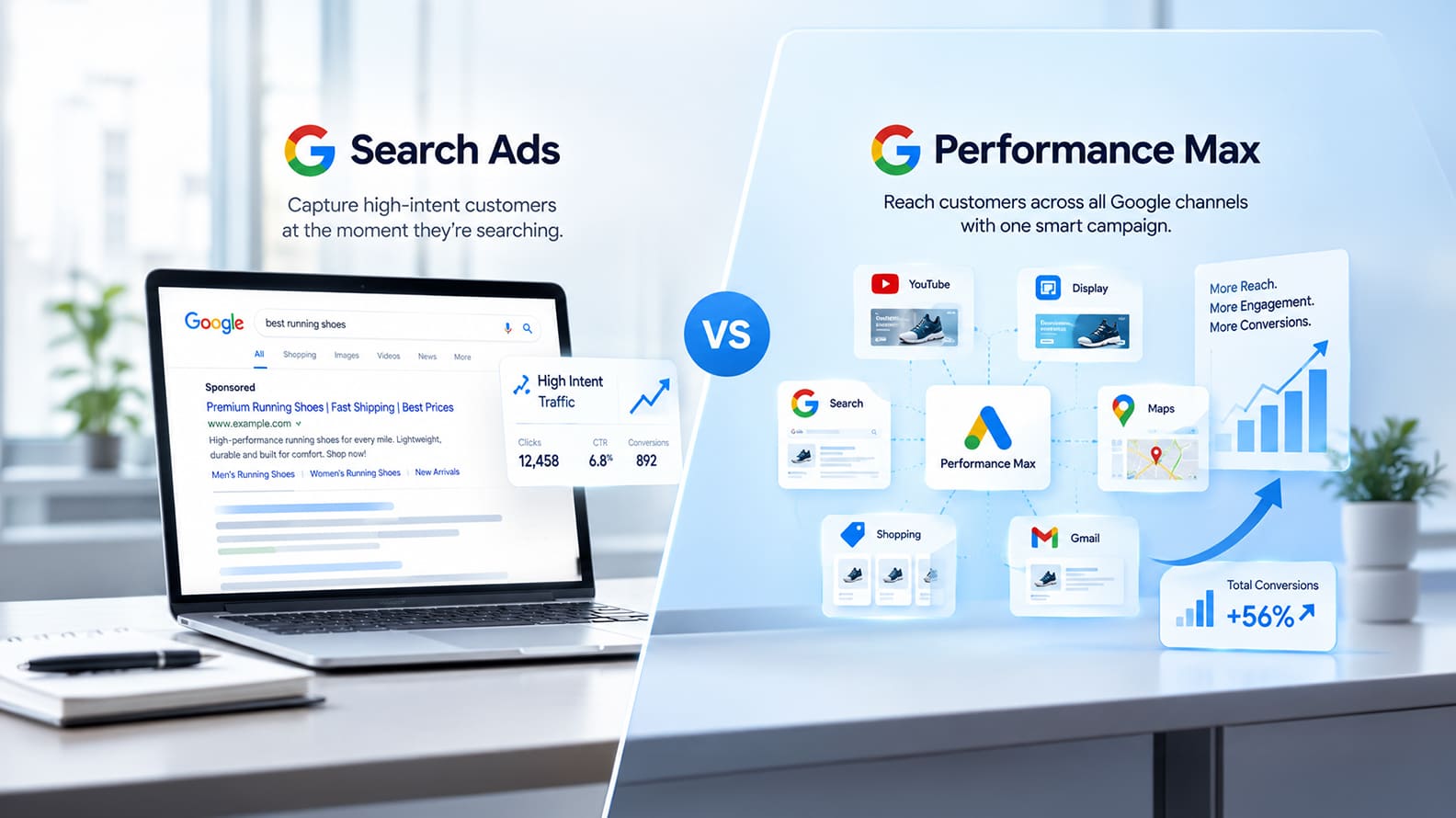
Performance Max vs Search Campaigns: What Should Businesses Use and When?
Sep 23, 2026 / 30 min read
September 22, 2026 / 38 min read / by Team VE
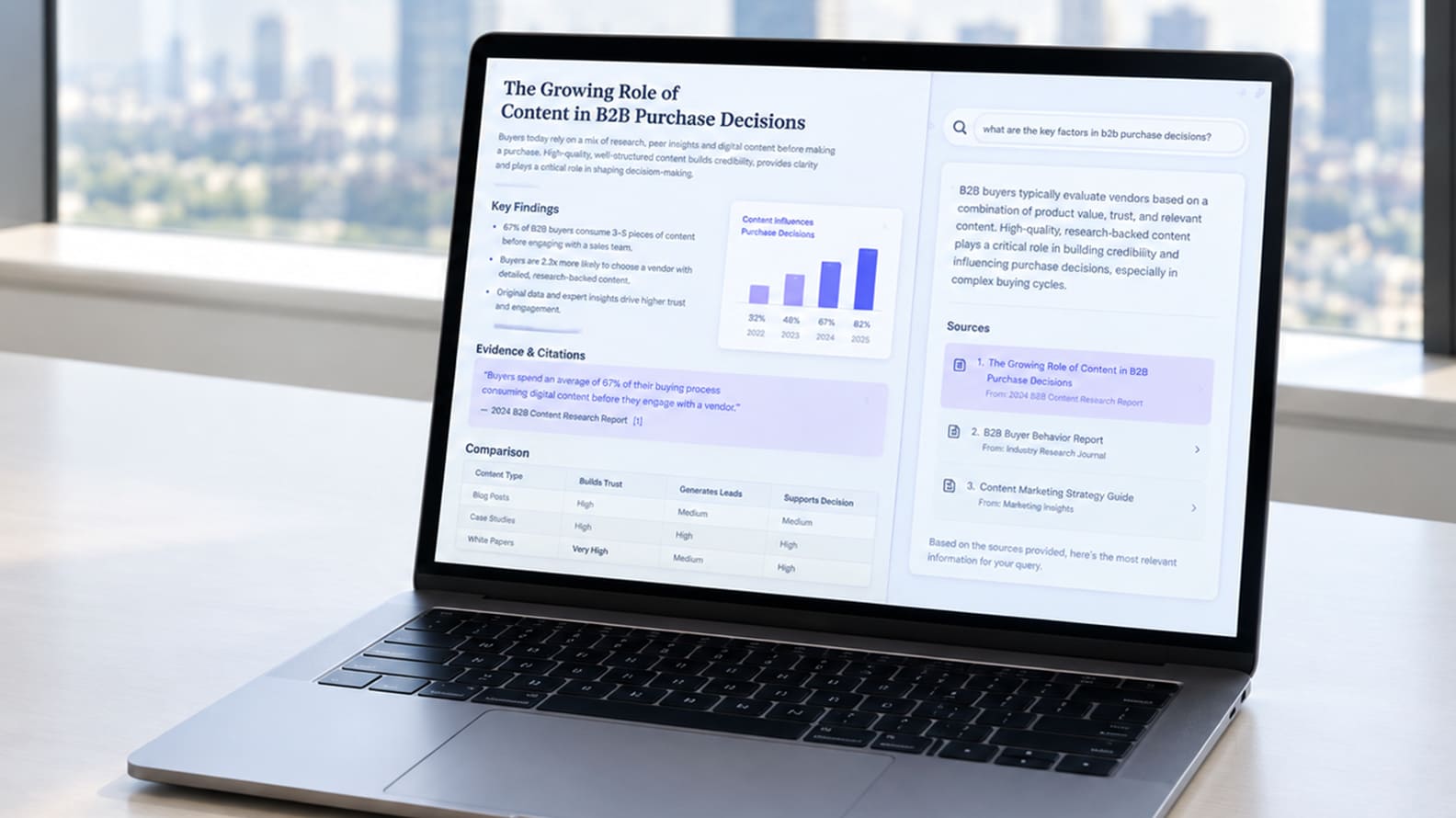
A practical guide for small and mid-sized businesses that want content strong enough to shape buying decisions, earn trust, and travel through search and AI discovery.
The internet has more content than any buyer can reasonably consume. What remains scarce is material that helps someone make a decision with confidence. For small and mid-sized businesses, that changes the content brief. A useful article needs to carry evidence, examples, clear definitions, practical judgment, and enough specificity that a buyer can reuse the argument internally. The same qualities also make content easier for search engines and AI tools to understand, extract, and cite.
Reference-grade content usually starts with a live business question rather than a broad keyword. It explains the trade-offs, shows the evidence, connects the topic to a real operating decision, and gives the reader something worth remembering or sharing. A smaller portfolio of strong source pieces can support SEO, AI visibility, sales enablement, social distribution, email, digital PR, and internal training at the same time. The advantage comes from publishing work that has enough original thinking to survive outside the page where it first appeared.
A lot of marketing teams are dealing with the same uncomfortable problem in 2026. They are producing more content than ever, often with AI helping research, draft, repurpose and distribute it, yet the market is becoming harder to impress. Buyers can get a competent explanation of almost anything in seconds, and Google says people are now using AI Mode for longer, more complex questions that often involve comparison and planning.
AI Mode queries are already substantially longer than traditional searches, which tells you something important about how people are using these systems: they are no longer asking only for definitions. They are asking for help thinking through a decision.
HubSpot’s recent work on AI search is more interesting than a generic citation-growth story. The company already had one of the largest content libraries in B2B software and enormous traditional search visibility. Yet when its team looked closely at how buyers were using answer engines, it found gaps around very specific commercial questions, including whether HubSpot suited a particular industry or use case.
In its 2026 account of the AEO programme, HubSpot explains how it built industry-specific solution pages, comparison content and a glossary around those missing questions. Ninety-two percent of the new industry pages were eventually cited by answer engines, contributing to a 49% lift in AI visibility, while its industry comparison articles recorded a 642% increase in citations.
The more revealing part is why those pages worked. HubSpot did not suddenly discover that it needed more words on the internet. It discovered that buyers were asking questions its existing content estate did not answer precisely enough.
The useful pages were the ones that carried enough product context, customer evidence and industry specificity to help someone determine fit. That is very close to the pressure content teams are facing now. AI has made competent explanations abundant, while the value is moving towards material that helps someone judge which option is right, what the trade-offs are, and what they should do next.
For a small or mid-sized business, that can be an advantage. A regional accounting firm may never publish at HubSpot’s scale, but it can know far more about moving a 70-person company from spreadsheets into a disciplined monthly close. A managed IT provider can explain what actually happens during a Microsoft 365 security rollout. A staffing company can show how different hiring models affect management time, continuity and cost.
A specialist manufacturer can publish tolerances, applications and failure patterns that a general business publication simply cannot reproduce convincingly. When that knowledge reaches the page, content stops competing on volume and starts competing on usefulness. That is the kind of material buyers save, sales teams forward, industry peers quote and AI systems have a reason to reference.
The content that buyers keep coming back to is usually the content that helps them answer a question they cannot settle with a quick summary. A founder choosing between an agency and an in-house hire wants to understand control, cost, continuity and management effort.
A CFO evaluating a new SaaS platform wants to know how implementation risk, switching cost and adoption will play out across the business. A marketing head deciding whether to invest in SEO, paid media or content needs something more useful than three definitions and a list of benefits. The article becomes valuable when it helps the reader think through the decision rather than merely understand the topic.
The 2025 Edelman-LinkedIn B2B Thought Leadership Impact Report is extremely useful for this conversation. The research looked at nearly 2,000 global professionals and focused heavily on “hidden buyers”, the finance, legal, procurement, compliance and operations stakeholders who often influence a deal without becoming the obvious sales contact.
More than 40% of B2B deals can stall because of misalignment inside the buying group, while 63% of hidden buyers spend more than an hour each week consuming thought leadership. Many of them are using content to test the decision long before they speak to sales.
Once you see content through that lens, topic planning changes quickly. A broad article on “the benefits of outsourcing” may attract traffic, but a page comparing agency, freelancer, in-house and dedicated remote models across cost, control, security, speed and continuity is much more likely to get circulated internally.
A managed IT provider will usually create more value from a guide on what a healthcare practice should check before outsourcing IT support than from another general explainer about managed services. A SaaS company can help a buyer much more by explaining where implementation tends to slow down, which teams need to be involved and what adoption risk looks like after the contract is signed.
The research also shows why strong content can be especially useful for smaller brands. Edelman and LinkedIn found that 81% of hidden buyers say high-quality thought leadership helps them understand challenges or opportunities they had not previously recognised, while 95% say strong thought leadership makes them more receptive to sales and marketing outreach.
That gives a mid-sized business room to compete on the quality of its thinking before it can compete on brand familiarity. If the article helps an internal stakeholder frame the problem more clearly, explain the risk to colleagues and defend a recommendation, it has already started doing commercial work before anyone fills out a form.
A good content brief should therefore begin with the decision the buyer is trying to make and the friction around it. Search data can tell you where demand exists. Sales calls, proposal objections, customer reviews, support tickets and community discussions tell you what makes the decision difficult.
When these two sources of intelligence come together, the article stops sounding like a keyword assignment and starts sounding like something written by a company that has actually been in the room.
Original research is becoming one of the clearest ways to make a page harder to replace. In 2026, Search Engine Land published an analysis by Kevin Indig and Amanda Johnson showing that pages with primary research earned around 3.3 times more AI citations per page in the dataset they examined. The finding is useful because it points to something deeper than “add more statistics”.
Pages travel further when they contribute evidence that did not already exist in exactly the same form elsewhere. A benchmark, a recurring pattern, a customer-data point, a survey finding, or a well-documented operational insight gives the article something another writer, buyer, journalist, salesperson, or AI system can actually pick up and carry forward.
Such proof does not require a research department. A 70-person accounting firm could analyse the most common reasons monthly close processes break down across new clients. A managed IT provider could document which security gaps appear most frequently during Microsoft 365 audits.
A staffing company could compare time-to-productivity across different hiring models. A SaaS company could publish adoption patterns from anonymized onboarding data. The quality comes from choosing a question that matters commercially and explaining what the numbers mean, rather than publishing data for the sake of looking authoritative.
The broader B2B market is moving in the same direction. TopRank Marketing’s 2026 State of B2B Thought Leadership research found that 93% of marketers using original research-based content considered it effective at driving engagement and leads, with almost half rating it very effective. That should not be read as a promise that every survey will perform.
It is better understood as evidence that original research gives a content team more raw material to work with across sales, PR, search, social, webinars, executive commentary, and AI discovery. One useful dataset can produce a stronger article, a sharper sales conversation, a media angle, and several follow-on pieces without feeling repetitive because every asset starts from the same underlying evidence.
Neil Patel’s recent writing lands in a similar place. As co-founder of NP Digital and one of the most widely followed practitioners in search and performance marketing, he tends to focus on what a marketing team can actually deploy. In his 2026 analysis of original data and AI citations, the emphasis is on making proprietary findings easy to understand and easy to extract.
A useful number hidden halfway through a vague article is much less valuable than a clearly framed finding with enough context to explain the sample, the situation, and why the result matters. For content teams, that is a good editorial discipline even before AI enters the conversation.
There are several forms of proof an SMB can realistically build into strong content:
A page becomes genuinely reference-worthy when those forms of proof are interpreted rather than simply collected. The reader should come away knowing what the evidence changes. If a benchmark shows implementation delays are common, explain which decisions usually create the delay.
If customer data shows one channel produces higher-quality leads, explain what “quality” means and which businesses are likely to see the same pattern. The authority comes from the connection between evidence and judgment.
A useful page must be clear, but AI search is making clarity more commercially valuable because systems now have to identify the central entities, claims, relationships, and answers inside a page before deciding whether to use it. Search Engine Land’s February 2026 analysis of 1.2 million AI answers found that 44.2% of ChatGPT citations came from the first 30% of the source content, with direct definitions and dense entity information appearing disproportionately often near the top.
That does not mean every article should front-load a robotic summary. It does mean the reader and the machine both benefit when the page establishes early what the topic is, which problem it is solving, and what the important entities are.
The same logic shows up in traditional SEO and AI Overviews. Ahrefs’ March 2026 study of 4 million AI Overview URLs found that only 37.9% of cited URLs also appeared in the first ten search-result blocks for the same query, which means citation behaviour is related to rankings without being confined to them.
Pages outside the conventional top positions can still enter the answer if they contain information the system finds useful. That creates an opening for smaller businesses, especially when they have deeper practical knowledge than larger publishers around a specific service, industry, or operating problem.
A managed IT provider, for example, should make it immediately clear whether it serves healthcare clinics, law firms, manufacturers, or general SMBs, because that context changes almost every recommendation that follows. A cybersecurity article becomes stronger when it names the environment, the threat, the control, and the business impact instead of circling around “digital resilience”.
An accounting firm writing about outsourced finance should explain whether it is talking about bookkeeping, monthly close, controller support, or a full finance function. Buyers appreciate that precision because they can see whether the advice applies to them. AI systems benefit for the same reason because the entities and relationships are easier to interpret.
Google’s own 2026 guidance is moving in the same direction. Its AI optimization guidance tells site owners to focus on useful, distinctive, non-commodity content and makes clear that conventional SEO fundamentals still matter in generative search. The practical implication for an SMB is quite grounded.
Define the important terms, name the companies, products, roles, industries, locations, and use cases clearly, and make the commercial question explicit enough that someone can understand the page without decoding marketing language.
Good clarity also changes how a section is structured. A comparison deserves a comparison table because the reader is weighing options. A pricing article should explain the variables that change cost before presenting generic ranges. A technical guide should define the important term before moving into implementation detail.
A case study should establish the starting condition, the intervention, and the outcome while the reader can still connect them. The structure should follow the way someone is trying to think through the problem, which is what makes the page easier to use, quote, cite, and return to later.
By the time a B2B buyer speaks to sales, a surprising amount of the decision may already be settled. The 2025 6sense Buyer Experience Report surveyed nearly 4,000 buyers and found that 95% ultimately bought from a vendor that was already on the Day One shortlist.
Buyers evaluated around five vendors, had prior experience with most of them, and in 94% of cases had already ranked the shortlist before speaking to sellers. The vendor holding the top position before first contact went on to win roughly four out of five deals. Content, reputation, peer input, reviews and previous experience are doing a great deal of commercial work before the sales conversation begins.
A buyer at that stage is trying to remove uncertainty. Can the platform integrate with what we already use? How disruptive will migration be? What happens to cost when usage doubles? Will the provider understand our industry? How much management time will this require internally? Which part of the proposal will finance challenge? Content becomes valuable when it gives the buying group enough material to work through questions like these together.
Imagine a 150-person company evaluating outsourced finance support. The CFO cares about controls and reporting. Operations wants to know how quickly the team can become functional. IT may care about systems access and data handling. The managing director wants clarity on cost and accountability. One generic article about the benefits of outsourcing cannot carry all of that weight.
The assets buyers tend to keep returning to are usually the ones that remove a specific piece of uncertainty:
The 6sense research on the silent selection phase helps explain why these assets carry so much weight. Buyers can spend months researching privately before a vendor knows an opportunity exists. Content is effectively representing the company during that period. A useful page gives an unseen stakeholder enough confidence to keep the vendor on the shortlist and enough language to explain that choice to colleagues.
Yext’s 2026 research gives us one of the better large-scale views of what AI systems actually cite. Across 17.2 million citations from ChatGPT, Perplexity, Gemini and Claude, the models behaved differently in where they looked for information, but verified and structured brand data accounted for more than half of distinct citation sources in the study.
For marketers, the useful takeaway is straightforward. The easier a company is to identify and describe consistently, the less interpretation the system has to do on its behalf.
A buyer experiences the same problem differently. Imagine a software company calling itself an “AI-powered transformation platform” on its homepage, a workflow automation tool on G2, a productivity solution on LinkedIn and a low-code platform in its sales deck.
Each phrase may sound credible, but together they make the company harder to place. Clear content keeps the category, audience, use cases, product relationships and evidence stable enough that the buyer can build a coherent picture without repeatedly translating the brand’s own language.
The strongest pages therefore satisfy two slightly different needs at once:
| What the Page Needs to Explain | What an AI System Needs | What a Buyer Needs |
| What the company does | Clear category, service and entity relationships | Immediate understanding of whether the company is relevant |
| Who it serves | Industries, locations, company types and use cases | Confidence that the provider understands their situation |
| How the offer works | Explicit processes, components and relationships | Clarity around delivery and responsibility |
| What makes it credible | Reviews, citations, case studies and third-party evidence | Proof that claims survive outside the company’s own marketing |
| How options differ | Structured comparisons between entities | Judgment around fit, cost, risk and trade-offs |
| What happens next | Connections between informational and commercial pages | A practical path towards evaluation or purchase |
The distinction becomes even more useful for local and multi-location businesses. In another 2026 study covering 155.5 million location-grounded AI citations across 1,623 brands, Yext found that around 80% pointed to websites or listings.
For a clinic, law firm, restaurant group or regional service business, accurate locations, service descriptions, practitioner information, opening details, reviews and category language now contribute directly to how AI systems assemble an answer about the company.
Human judgment still carries the article beyond those facts. An outsourced-accounting page should clearly define the service, while also explaining when the model works well, which responsibilities should remain internal, how controls change, what affects cost and what leadership should expect during onboarding.
A cybersecurity guide can define the framework and controls, then tell the reader which risks deserve attention first. Entity clarity gets the business understood. Judgment makes the content worth using.
Content becomes much more valuable once a business stops judging every article as a single deliverable. A strong source piece already contains the research, examples, arguments, and language needed for several other marketing jobs. In HubSpot’s 2026 State of Marketing research, 35.08% of marketers said they were repurposing content across channels, making it one of the year’s most prominent operating trends.
The pressure behind that number is easy to understand. Most teams are expected to maintain websites, email, social, video, sales enablement, and increasingly AI-search visibility without receiving proportionally larger budgets or headcount.
The quality of the source content material determines how far that repurposing can go. A generic blog post rarely gives the team much to work with beyond a shortened social caption. A detailed benchmark, comparison, case-led guide, or expert article can produce several useful assets because the original piece has already done the difficult intellectual work.
A pricing framework can become a sales slide. A customer insight can become a LinkedIn post. A strong comparison can become a webinar segment. A recurring objection can become an email to stalled prospects. The team is no longer inventing another idea for every channel. It is adapting one well-developed idea to the context in which the audience will encounter it.
The distinction between reuse and duplication matters here. HubSpot’s same 2026 research found that 49.4% of teams reuse largely the same content across platforms, while 39.5% adapt it specifically for each channel. The second approach is usually where a source piece starts earning its keep. A 3,500-word article does not belong on LinkedIn in miniature.
The LinkedIn version may need one sharp observation and a practical example. An email may focus on a single objection. A sales asset may strip the argument down to a comparison table. A short video may use one surprising finding and explain why it matters in ninety seconds. The thinking stays consistent while the delivery changes.
A strong source piece can realistically support several different jobs:
B2B teams are already moving in that direction with event content. The 2026 Goldcast B2B Webinar Benchmark Report found that social posts accounted for 37.9% of repurposed webinar assets and email another 35.9%, while blogs represented only 13%.
That distribution makes sense because the audience does not experience a company through one channel. Someone may first encounter an insight on LinkedIn, hear the fuller argument during a webinar, receive the follow-up by email, and later land on the original article when a more specific question appears.
For a small business, the economic advantage is significant. One deeply researched article that sales can use, search can discover, AI tools can cite, leadership can discuss publicly, and customers can receive through email is easier to justify than ten unrelated posts created to maintain publishing frequency.
The best content program starts to resemble an intellectual supply chain. The source piece creates the insight, and every other channel carries the part of that insight that makes sense for its audience.
The volume problem is starting to become a trust problem. In June 2026, Gartner found that 49% of US consumers felt generative AI had made the quality of available content worse, rising to 57% among Gen Z and millennials.
By September, another Gartner survey found that 65% of consumers believed brands were producing too much AI-generated marketing content, while 57% said the flood of AI material had made them less trusting of brand messaging. The problem is not that people suddenly hate AI. It is that the average piece of marketing content is becoming easier to produce and easier to ignore.
This changes what “good content” needs to feel like. A buyer can usually sense when a page has been assembled from familiar talking points, even if every sentence is technically correct. The language is smooth, the examples are generic, and the conclusions arrive exactly where expected. A strong article feels different because it has fingerprints.
It contains a point of view, an observation the company has earned through experience, a specific example, a disagreement worth explaining, or a framing that helps the reader see the problem differently. Distinctiveness becomes valuable because it signals that somebody thought before they published.
For B2B businesses, that has direct commercial weight. The 2024 Edelman-LinkedIn Thought Leadership Impact Report found that 73% of decision-makers considered an organisation’s thought leadership a more trustworthy way to assess its capabilities than conventional marketing material, while 60% said strong thought leadership could make them willing to pay a premium to work with the company behind it. Buyers are effectively using content as a proxy for how a company thinks before they ever experience how it delivers.
A useful editorial check is to ask what makes the page recognisably yours:
Ann Handley has spent much of her career arguing for exactly this kind of recognisable, human business writing. She is the Chief Content Officer of MarketingProfs, a Wall Street Journal bestselling author of Everybody Writes, and one of the most influential voices in modern content marketing. Her relevance here is practical because her work consistently treats writing as a core marketing capability rather than a production task.
In Everybody Writes, she focuses on usefulness, clarity, voice, and creating deeper customer relationships, which feels even more important now that competent first drafts are effectively unlimited. The competitive advantage increasingly sits in the parts AI cannot supply on its own: lived context, editorial judgment, taste, and a point of view that feels earned.
For an SMB, this is one of the few areas where scale can actually work in its favour. A smaller company is often closer to customers, delivery problems, sales objections, and operational detail than a large publisher or generic content team. That proximity creates material with texture.
A founder knows which assumption prospects consistently get wrong. A delivery manager knows where projects usually slow down. A salesperson knows the question that appears one meeting before a deal stalls. When those insights make it into the article, the page starts sounding less like “content” and more like a business with something worth listening to.
A strong article should survive the moment when the reader stops being polite. That usually happens somewhere in the middle of the buying process, when curiosity turns into scrutiny. A founder may like the argument, but finance wants to know what it costs.
Operations wants to know who owns implementation. Legal wants to know what happens to data. Sales wants proof that the recommendation actually works. The page becomes useful when it anticipates those questions and keeps answering them without forcing the reader to hunt across five other assets.
One of the clearest ways to do this is to edit from the buyer’s side of the table. Every vague sentence should trigger a harder follow-up. “We improve efficiency” should raise “how?” “This approach reduces risk” should raise “which risk, under what conditions?” “AI search is changing discovery” should raise “what changes in the budget, the content plan, or the measurement?” The goal is to make the article feel as though someone experienced has already sat through the objections and knows where the uncertainty usually appears.
This is where a buyer-led review becomes more useful than a traditional copy edit. A content team can use a simple set of questions before publication:
The same discipline also makes the page easier for AI systems to use. Google’s guidance on creating helpful, reliable, people-first content asks publishers to think about whether a page demonstrates first-hand expertise, provides substantial value, and leaves the reader feeling they learned enough to achieve their goal.
Those are not abstract quality signals. They are editorial questions. A page that answers them well is usually clearer, more specific, and easier to interpret because the writer has been forced to remove ambiguity.
Experienced practitioners tend to write differently for exactly this reason. They know where the obvious advice stops being useful. They know when a recommendation changes because the company is smaller, the sales cycle is longer, the market is regulated, or the internal team is weak.
They know which metrics can look healthy while the commercial outcome is deteriorating. That is the level of judgment reference-grade content needs, because a buyer does not return to the page for information alone. They return for help thinking through the decision.
A useful article can influence a decision long before analytics gives you a neat conversion event. A prospect may read a comparison page, send it to a colleague, return through branded search a week later, then mention the framework during a sales call.
None of those steps looks especially impressive in isolation, but together they show the content doing exactly what strong B2B marketing should do: helping the buyer make sense of a decision before the company ever gets direct access to the conversation.
Gartner’s 2026 buyer research makes that behaviour much easier to understand. In a survey of 645 B2B buyers, 69% said they prefer to validate AI-generated insights with a sales rep, while buyers reported using an average of seven information sources during a recent purchase and 45% said they had used generative AI.
The interesting part is the combination. Buyers are researching independently across more sources, yet they still want human validation at critical moments. Content has to work across both sides of that journey: giving the buyer enough confidence to keep moving on their own, then giving sales something credible to build on when the conversation becomes real.
The measurement model therefore needs to reflect how content actually travels. A practical view for SMBs can stay fairly simple:
| Signal | What It Tells You |
| Search visibility | Whether the page is being found for commercially useful questions |
| AI citations and mentions | Whether the content is being used in answer-led discovery |
| Returning visitors | Whether people are coming back as the decision develops |
| Branded search | Whether the content is contributing to recognition and recall |
| Internal-link movement | Whether readers are moving from education into service, pricing, or case-study pages |
| Sales usage | Whether sales teams are actually sending or referencing the asset |
| Qualified enquiries | Whether the page is contributing to better-fit leads |
| Assisted influence | Whether the content appears somewhere in the journey before a conversion |
AI visibility needs careful interpretation as well. Semrush’s 2026 analysis of brand visibility in ChatGPT found that brand presence can vary significantly across related prompts, which means a single screenshot or one favourable query tells you very little.
A more useful test is to track a consistent set of buyer questions around category, cost, comparison, use case, risk, and implementation, then watch how often the brand appears, how it is described, and which pages are being cited over time.
Some of the strongest evidence will still come from sales rather than software. If a prospect says, “I shared your comparison with our CFO,” that is reference behaviour. If a salesperson repeatedly uses the same article to answer an objection, that is reference behaviour.
If a partner quotes your benchmark in a webinar, or an AI answer cites your guide when a buyer asks a commercial question, the content is becoming part of the market’s language. That is a much richer signal than traffic alone, because it shows the page is being used to think, explain, and decide.
The teams getting the most out of content in 2026 are not simply producing more. Content Marketing Institute’s 2026 B2B Content and Marketing Trends report surveyed more than 1,000 B2B marketers and found that the biggest contributors to better marketing performance were content relevance and quality at 65%, followed by team skills and capabilities at 53%.
Technology and tools mattered, but they sat behind the quality of the work and the people producing it. That is an important reminder for SMBs because a smaller team can still build a strong content engine if it is disciplined about which assets deserve time.
A monthly publishing target can easily create the wrong incentive. Four blogs a month sounds productive until two of them repeat ideas already on the site, one has no commercial path, and the fourth gets published before anyone from sales or delivery has added useful input. A stronger plan begins by looking at the gaps around the buyer journey.
Is pricing explained properly? Are the important comparisons covered? Is there proof for the claims on service pages? Are customers asking the same questions every week? Does the business have anything original enough to earn an external citation or PR mention? The editorial calendar then becomes a way to fill those gaps, rather than a quota to satisfy.
For a small or mid-sized business, a practical monthly mix could look something like this:
| Content Job | What the Team Produces | What It Should Achieve |
| Source piece | One deeply researched article, benchmark, guide, or comparison | Creates the central idea and evidence for the month |
| Commercial refresh | One or two service, pricing, product, or comparison pages | Improves the pages closest to revenue |
| Proof asset | A case study, customer story, expert interview, or original finding | Gives buyers and AI systems something concrete to trust |
| Distribution assets | LinkedIn posts, email, video clips, carousel, webinar extract | Carries the strongest ideas into other channels |
| Sales asset | One objection-handling page, decision table, or follow-up guide | Helps sales move an active conversation forward |
| Measurement review | Search, AI visibility, engagement, sales usage, qualified leads | Shows which assets are actually being used |
The balance can change by business model. A local service company may need more emphasis on location pages, reviews, and FAQs. A B2B software company may invest more heavily in comparisons, implementation guides, customer proof, and expert-led content. A professional services firm may need fewer articles and more case material, pricing logic, and thought leadership tied to specific client problems. The point is to give each asset a job that makes sense commercially.
Robert Rose, Chief Strategy Advisor at the Content Marketing Institute and one of the industry’s longest-standing voices on content strategy, has been pushing marketers toward exactly this kind of thinking. In CMI’s 2026 research, the strongest teams were described as those building better fundamentals around relevance, skills, first-party data, and customer understanding rather than chasing volume for its own sake.
For an SMB, that is a far more useful operating principle than trying to keep pace with every platform or every new AI feature. Build a smaller number of assets that matter, connect them properly, and make sure the people closest to customers are feeding the work.
The real measure of content in 2026 is not whether it was published, but whether it proves useful once it leaves the page. Strong content helps a buyer clarify a decision, gives a salesperson language for a difficult conversation, offers a partner or colleague a framework worth repeating, and gives search engines or AI tools something clear enough to understand and reference accurately.
The common thread is simple: the page has to contain insight, evidence and explanation strong enough to remain valuable even when it is reused in a different context.
This raises the editorial standard in a healthy way. Content teams need to get closer to the business because the most valuable material is rarely sitting inside a keyword spreadsheet. It lives in customer conversations, delivery experience, implementation problems, pricing discussions, product data, sales objections, technical expertise, and the judgement people accumulate after doing the same work for years.
Search research still helps reveal demand. AI visibility data can show where the brand is appearing. Competitive research can expose gaps. The distinctive part comes from combining all of that with knowledge the company has actually earned.
Rand Fishkin has spent more than two decades examining how people discover brands, first as the co-founder of Moz and now through SparkToro, where his work focuses heavily on audience behaviour and the growing amount of discovery that happens away from a conventional website click. His broader argument around zero-click marketing and demand creation is especially relevant here.
A useful idea does not have to remain attached to the original page to create value. It may be summarized by an AI tool, quoted on LinkedIn, repeated during a sales call, referenced by another publication, or remembered when the buyer searches for the company later. Content becomes more valuable when the thinking can travel without losing the connection to the brand that produced it.
For an SMB, that creates a much more achievable ambition than trying to out-publish the largest companies in the category. Build the service pages that explain the offer properly. Publish the comparison pages buyers actually need. Turn customer outcomes into detailed case studies. Give practitioners room to explain what changes in the real world.
Create original evidence when the business has enough experience or data to say something useful. Keep the company’s language and proof consistent across its own site and the wider web. Over time, these assets begin supporting one another and the content program starts behaving less like a monthly production function and more like a knowledge system for the business.
Reference-worthy content helps someone do something with the information, not simply consume it. It gives the reader a clear answer, enough context to understand the trade-offs, credible evidence to support the argument, and practical examples that make the advice usable. A buyer should be able to take the page into a meeting, share it with a colleague, or use it to explain why one option makes more sense than another.
The strongest pages also have something distinctive inside them. That may be original data, first-hand experience, a useful comparison, a practitioner’s judgment, or a framework that makes a difficult decision easier to understand. When the page contributes something beyond a polished summary of existing advice, it becomes more useful to buyers, sales teams, publishers, and AI systems.
Good content for AI tools still needs the fundamentals of SEO. It should be crawlable, technically sound, clearly structured, and relevant to the topic. The additional layer is clarity. AI systems need to understand the main entities, relationships, claims, and answers without having to infer too much from vague marketing language.
That does not mean writing robotic content for machines. Strong AI-ready content can still be analytical, conversational, and nuanced. Clear definitions, specific examples, descriptive headings, well-used tables, expert context, and credible sourcing simply make the page easier to understand and reference without weakening the writing.
Most evidence-led articles should include external links when they rely on research, platform guidance, market data, or factual claims that come from outside the company. Good sourcing strengthens the argument because the reader can see where the evidence comes from and distinguish external fact from the writer’s own interpretation.
The way links are used matters just as much as the source itself. They should sit naturally inside the sentence where the evidence becomes relevant, not appear as a block of references at the end. The article should still do the analytical work by explaining what the research means for the reader’s decision.
Yes. AI can help with research, outlining, summarization, analysis, and drafting without automatically making the final work weak. What matters is whether the finished page is useful, accurate, well-edited, and supported by genuine expertise and evidence.
The problem begins when AI replaces judgment rather than supporting it. Someone still needs to verify sources, challenge assumptions, add real examples, remove generic language, and make sure the article reflects how the business actually works. The strongest use of AI is to accelerate the production process while keeping the thinking human.
FAQs are valuable when they answer questions customers genuinely ask. Pricing, implementation, timelines, risk, ownership, fit, and comparison questions are especially useful because they often sit close to a real buying decision. Sales calls, support tickets, and customer conversations are usually better sources for FAQ ideas than a generic keyword list.
The format can also help answer systems because each question creates a clear unit of intent. That advantage disappears when FAQs are thin, repetitive, or added simply because a template requires them. A good FAQ should feel like the final part of a serious conversation with the reader.
Length should follow the complexity of the decision. A narrow question may be answered properly in 1,500 words, while a strategic topic involving cost, technology, multiple options, and current research may need several thousand. A word-count target becomes unhelpful when it forces a simple idea to stretch or a complex one to stop before the reader has enough information.
A better test is whether the article has done the work. It should explain the issue, provide evidence, show examples, address the main objections, and help the reader understand what to do next. Once those jobs are complete, additional words need a clear reason to stay.
The best examples resemble the situations the intended reader is likely to face. A local business can make a search or conversion problem concrete. A B2B company can show how longer sales cycles and multiple stakeholders change the decision. A SaaS or ecommerce example can demonstrate how content, product discovery, reviews, paid media, and AI search interact.
A strong example should also carry the argument forward. Simply naming a company adds very little. The reader needs enough context to understand the starting point, what changed, what was done, and what the result or lesson was. That is what turns the example into evidence rather than decoration.
High-value pages should be reviewed whenever the underlying market, platform, pricing, regulation, buyer behaviour, or evidence changes enough to affect the advice. Some commercial topics may deserve quarterly review, while stable evergreen content may remain accurate for much longer.
A meaningful refresh goes beyond changing the publication date. The team should look for outdated evidence, new examples, stronger proof, emerging buyer questions, product changes, and better internal links. The goal is to keep the page useful and current, not simply make it look recently updated.
Internal links help readers continue the decision without having to navigate the entire site themselves. A strong article might naturally lead to a service page, a comparison guide, a case study, or a deeper piece on a related topic. The link works when the next page answers the next logical question.
They also help search systems understand how the company’s knowledge is organized across related subjects. Random links weaken the experience because they feel promotional. A useful internal-link structure grows naturally as the company builds a connected body of strong content.
Start by looking at whether the content is being discovered and used. Search visibility, qualified traffic, AI citations or mentions, branded search, returning visitors, internal-link clicks, backlinks, newsletter sign-ups, and sales-team usage can all help show whether the page is creating value.
The deeper measure is whether the content influences decisions. Track whether prospects mention the article, whether sales sends it during live opportunities, whether partners reference it, whether it assists qualified enquiries, and whether it helps buyers arrive better informed. Reference-grade content earns its value when the market starts using it, not simply viewing it.
Sep 23, 2026 / 30 min read

Sep 21, 2026 / 34 min read

Sep 20, 2026 / 39 min read