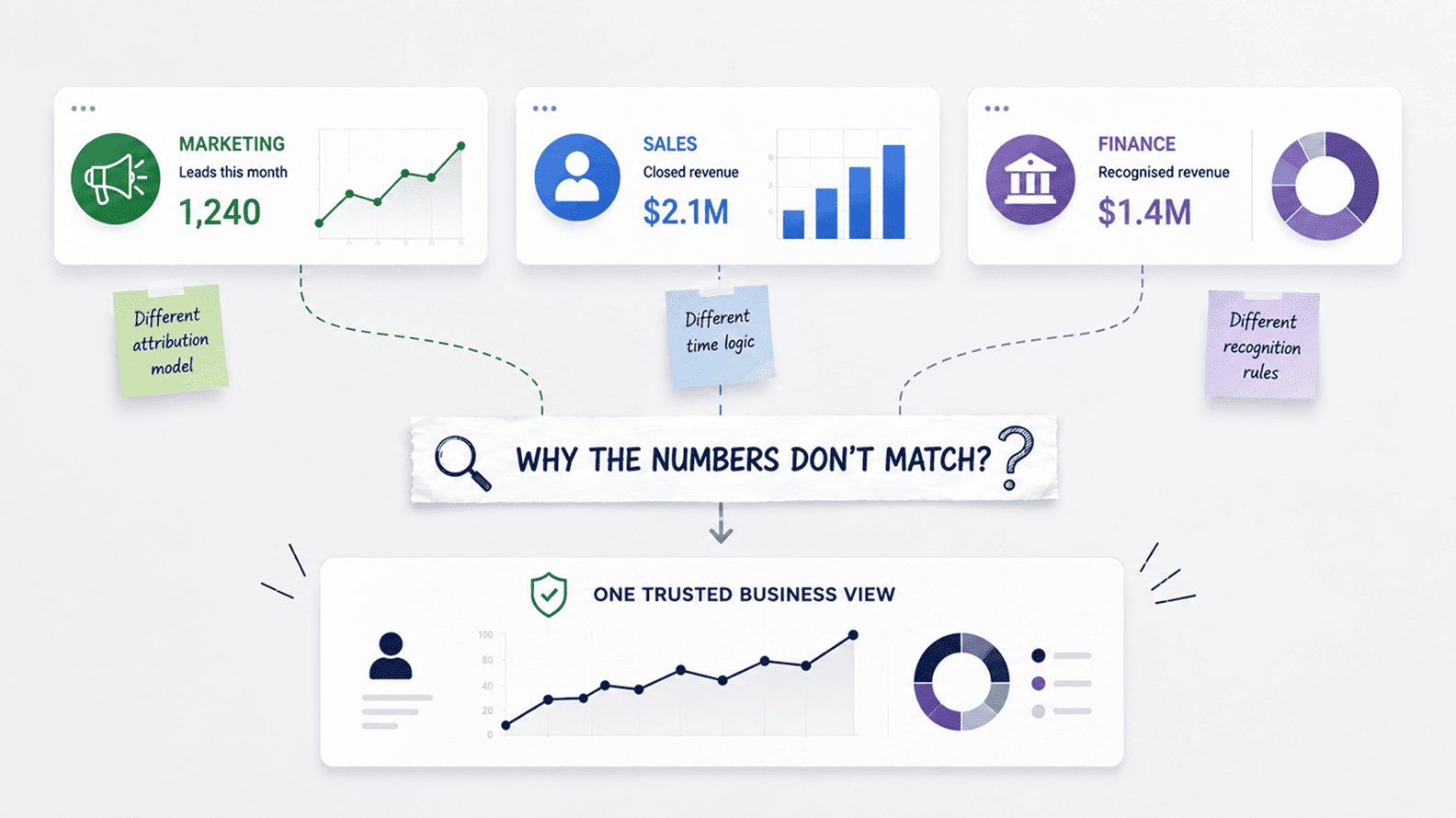
Why Marketing, Sales, And Finance Reports Do Not Match
Aug 04, 2026 / 27 min read
July 24, 2026 / 47 min read / by Team VE
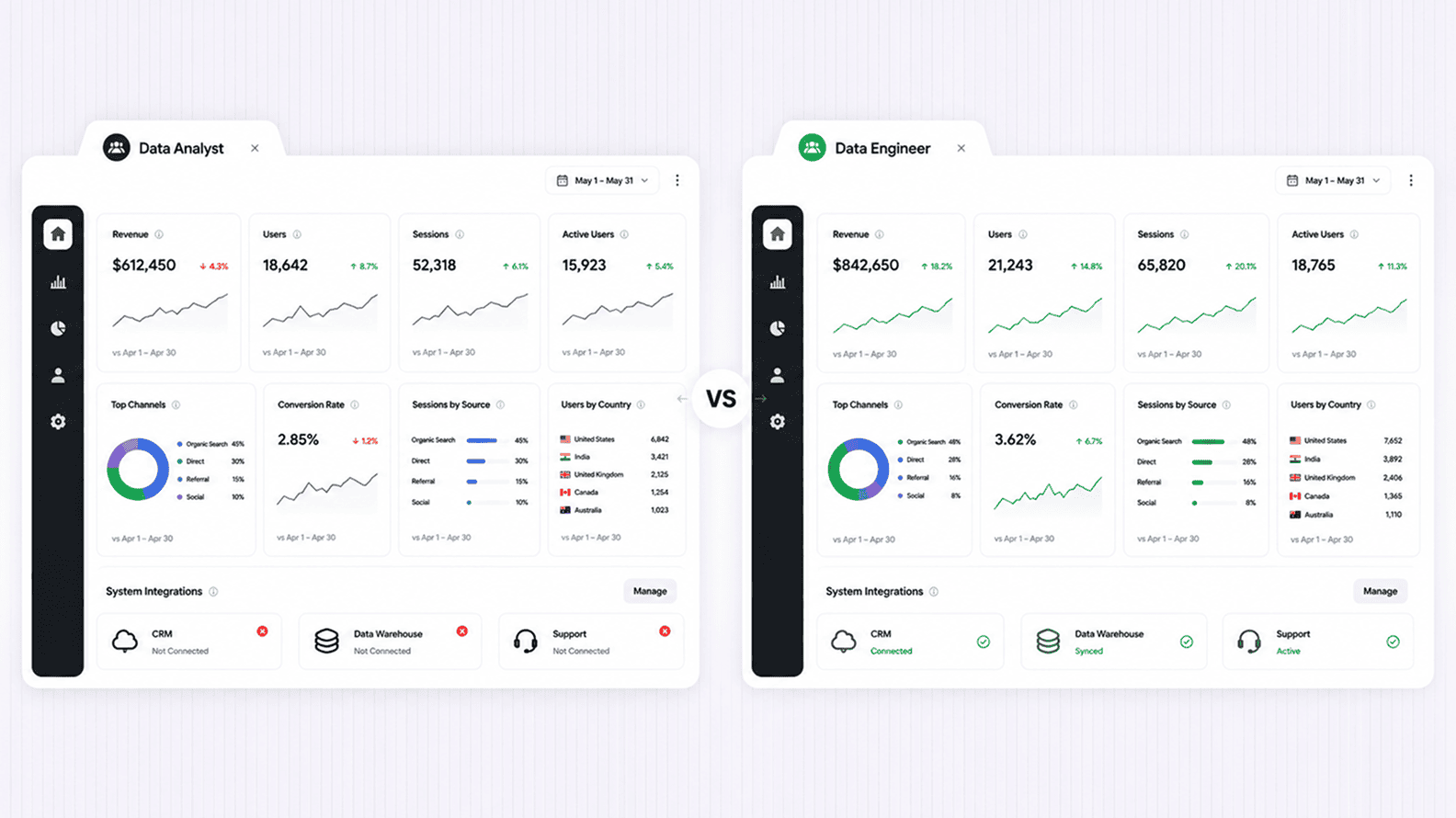
A business should hire a data engineer when the problem is not understanding the data, but getting trustworthy data to exist in the first place.
A business should hire a data engineer before a data analyst when the work needed before analysis is becoming larger than the analysis itself. The signs are usually visible in everyday reporting: dashboards refresh late, data sits across CRM, billing, finance, product, support, marketing, and spreadsheets, recurring reports depend on manual exports, analysts spend days cleaning and joining files, and leaders keep asking whether the numbers are current enough to trust.
A data analyst can explain why revenue moved, why leads slowed, why churn increased, or why one segment is performing better than another, but that work depends on data already being accessible, reliable, joined, documented, and safe to use.
The decision becomes easier when the business looks at the broken workflow rather than the job title. If the company has usable data but lacks interpretation, segmentation, diagnosis, and commercial storytelling, a data analyst is the right hire. If the company cannot reliably collect, move, model, refresh, monitor, and secure the data needed for those questions, a data engineer or analytics engineer should come first.
Many businesses hire an analyst because they want answers, then discover the person is spending most of the week rebuilding datasets, fixing failed refreshes, stitching exports, and cleaning source fields. That is a hiring sequence problem. The company asked for insight before giving someone the infrastructure to produce it.
A data engineer is a technical data professional who builds and maintains the systems that collect, move, store, transform, secure, monitor, and make data usable across the business. A business should hire a data engineer instead of a data analyst when the main problem is data availability, reliability, integration, scale, performance, access control, or pipeline quality, rather than business interpretation.
A data analyst is the right hire when the business already has data that can be trusted enough to analyze, and the missing layer is explanation. The analyst turns available data into insight, diagnosis, recommendations, dashboards, segments, forecasts, performance reviews, and decision support. The engineer makes the data dependable enough for that work to happen repeatedly.
Target Canada is one of the clearest business examples of what happens when data foundations fail before analytics can help. In its detailed account of the retailer’s collapse, Canadian Business reported that Target Canada’s supply-chain software was affected by flawed data, including issues such as incorrect product dimensions, barcodes, and pack sizes, which contributed to severe inventory and replenishment problems.
The company’s stores could look empty while inventory sat elsewhere in the system, and the business could not rely on the operational picture it needed to run the expansion properly.
Most companies feel a smaller version of that failure when they hire an analyst for a problem that is really sitting inside the data foundation. Leadership wants clearer answers on conversion, churn, sales velocity, campaign quality, margin, and customer behaviour, but the analyst cannot reach those questions cleanly because the raw material is scattered across systems that were never joined properly.
CRM data needs cleanup, billing records do not always match customer IDs, website leads arrive without reliable source fields, product usage sits in a separate tool, finance adjustments live in a workbook, and support data cannot be connected confidently to account data. The analyst may have the skill to explain performance, but the business has placed them in a role where too much of the week is spent making the data usable before any real analysis can begin.
Many companies make the wrong hire because the pain presents itself as a need for insight. Leaders feel they do not understand performance clearly enough, so they look for someone who can explain the numbers. The deeper blockage may be sitting earlier in the data chain, where source systems do not feed a reliable reporting layer, customer and account records do not join cleanly, recurring datasets have to be rebuilt, freshness is unclear, access rules are informal, and transformation logic is not documented well enough for others to trust.
In that environment, even a strong analyst ends up carrying the work of a pipeline, because every dashboard, review pack, or business question begins with the same hidden effort of collecting, cleaning, matching, and preparing data.
A data engineer is the better hire when the business needs that foundation built properly before interpretation can scale. The role is to make data arrive reliably from source systems, preserve the history the business needs, standardize identifiers across tools, handle schema changes, monitor freshness, protect sensitive fields, and create stable tables that analysts, BI teams, finance, operations, and leadership can use with confidence.
Once that base is dependable, analysts can spend their time on the questions they were hired to answer: what changed, why it changed, where the risk sits, which segment matters, and what the business should do next.
The difference becomes clear when a leadership team asks what should have been a simple question and the answer turns into a week of preparation. A CEO wants to know why revenue looks healthy while cash feels tight. Sales has the closed-won report, finance has invoices and collections, operations has delivery status, and account managers have client-level context sitting in notes and spreadsheets.
A data analyst can explain the pattern once the pieces are in one dependable view. Until then, the work is less about analysis and more about getting the company’s systems to speak to each other.
A data engineer is needed when that preparation keeps repeating. The business is no longer dealing with one messy report; it is dealing with a reporting supply chain that has become too manual for the decisions being made on top of it. Customer IDs do not line up across CRM and billing.
Product usage sits in an event tool that nobody has properly joined to accounts. Finance adjustments arrive after the dashboard refresh. Support tickets are useful for churn analysis, but the account mapping is weak. Every senior question is reasonable, yet every answer begins with someone rebuilding the same dataset by hand.
IBM’s guide to data engineering describes the work as designing systems for collecting, storing, processing, and making data usable. That is the useful lens for a business leader. The data engineer is not being hired because the company wants a more technical version of an analyst.
They are being hired because the company has reached a point where insight depends on repeatable data movement, cleaner joins, stronger modelling, better monitoring, safer access, and fewer fragile workarounds.
| When The Business Says… | The Analyst Can Help If… | The Engineer Is Needed If… |
| Why is revenue up but cash tight? | Bookings, invoices, collections, and revenue data are already connected. | Sales, billing, payment, and finance data have to be stitched together manually. |
| Which campaigns are producing customers? | Campaign, CRM, opportunity, and revenue data already share a reliable path. | Leads, sources, opportunities, and customer records do not connect cleanly. |
| Which customers are at risk? | Product usage, support, billing, and renewal data are already mapped to accounts. | Customer identity breaks across tools and every team has a different account view. |
| Why did the dashboard change? | The data flow is stable and the analyst can focus on the business movement. | Refreshes fail, source fields change, loads arrive late, or nobody can trace the pipeline. |
| Can we use this data for AI or forecasting? | The dataset is governed, documented, and reliable enough to model. | Inputs are scattered, stale, poorly labelled, or not safe to expose to automated systems. |
The simplest way to decide is to look at what blocks the answer. When the data is available and the business still needs judgement, segmentation, and explanation, hire an analyst. When every important question begins with exports, joins, cleanup, broken refreshes, missing IDs, and uncertainty about which source to trust, hire the person who can make the data usable before asking someone else to interpret it.
In 2020, Public Health England missed 15,841 positive COVID-19 cases from national reporting after a spreadsheet-based process hit a technical limit, with The Guardian reporting that the issue was linked to Excel’s row limit and the use of an older file format.
The case became famous because the stakes were public health, but the underlying pattern is familiar inside ordinary companies as well. A spreadsheet starts as a convenient bridge between systems, then quietly becomes the process everyone depends on, even though it was never designed to carry that level of pressure.
The same pattern shows up in a less dramatic form when a growing company still runs weekly reporting through exports. The CRM file comes from sales, billing sends another file later, marketing adds campaign data, finance applies adjustments, and someone combines everything because the leadership review needs one view by morning.
The first few times, the workaround feels practical. Over time, it becomes a hidden reporting operation with no proper monitoring, no clear ownership, no dependable refresh rhythm, and too much reliance on the person who knows which file, field, exception, and adjustment to trust.
A data engineer becomes the stronger hire when this hidden operation is now carrying decisions the business can no longer afford to prepare by hand. The company needs recurring data flows to land in a controlled environment, keep history, handle source changes, show freshness, protect sensitive fields, and feed dashboards without a weekly scramble.
The value is not in making reporting look more technical. The value is in removing the fragile middle where business-critical numbers depend on manual extraction, personal memory, and last-minute repair.
| Reporting Reality | What It Tells You |
| The leadership pack depends on the same exported files every week. | A recurring data flow is being handled like a temporary task. |
| One person knows which fields need cleaning before the report works. | Critical reporting logic is living as personal knowledge. |
| The dashboard is trusted only after someone checks it against a workbook. | The system has not earned enough confidence on its own. |
| A source-system change breaks reports without warning. | The company needs monitoring, ownership, and stronger data contracts. |
| Sensitive customer, finance, or employee data moves through shared files. | Informal reporting has become a security and governance risk. |
The clearest signal is repetition. A one-off export can be perfectly sensible. A recurring export that supports leadership reporting, revenue review, campaign performance, customer health, staffing, margin, or cash collection is no longer a small workaround. It is a data supply chain pretending to be a spreadsheet routine, and that is the moment engineering usually needs to enter before another analyst is asked to carry the same burden.
A dashboard can look polished and still fail the business if people are never fully sure whether the data behind it arrived properly. The sales number freezes after a CRM change, campaign leads disappear because a form field was renamed, refund data arrives after the revenue view has already refreshed, or product usage drops sharply because one event stopped firing after a release.
The chart may still load, the filters may still work, and the layout may still look professional, but the meeting has already lost confidence because users are now asking whether the dashboard is showing performance or a data-flow issue.
This is the point where another analyst rarely solves the underlying pain. An analyst can spot that the number looks strange, compare it with a source export, and explain the likely cause to leadership. A data engineer makes the system more dependable so that the same failure does not keep returning through a different door.
That means the data flow has to be scheduled, monitored, tested, logged, and designed around the reality that source systems change, records arrive late, jobs fail, and dashboards become dangerous when they quietly present incomplete data as current.
The ecommerce version is easy to recognize. Monday’s dashboard shows weaker weekend revenue, so the trading team starts discussing pricing, traffic quality, discounts, and conversion. Later, someone discovers that one payment feed loaded late and refund data was processed before the final order table arrived.
Nothing meaningful had changed in customer demand, but the business spent the first part of the day interpreting a reporting artefact as commercial movement. That is the kind of avoidable confusion data engineering is meant to reduce.
Tools such as Apache Airflow are built around this reality because recurring data work usually depends on ordered tasks: one source has to load before another transformation runs, a failed job needs to be visible, and downstream reporting should not pretend everything is fine when an upstream step has not completed.
The specific tool matters less than the discipline behind it. A growing business needs data flows that can be observed, recovered, and trusted without relying on someone to notice a broken number during the meeting.
| What The Business Sees | What Is Usually Happening Underneath | Why A Data Engineer Matters |
| A dashboard refreshes, but the number looks behind. | The report refreshed before one or more source tables arrived. | Source-level freshness and dependency checks prevent false confidence. |
| A KPI drops suddenly after a website, CRM, or product update. | A field, tag, event, or schema changed upstream. | Monitoring and change handling catch breakages before leaders interpret them as performance. |
| The same report breaks whenever one person is away. | The logic sits in scripts, workbooks, or jobs only one person understands. | Pipelines, documentation, alerts, and ownership make the flow less fragile. |
| Users keep asking whether the dashboard is updated. | Refresh status, source timing, and data completeness are not visible. | The reporting layer needs freshness indicators and operational checks. |
| Analysts repeatedly verify dashboards before reviews. | Quality control is happening manually at the end instead of inside the data flow. | Validation moves earlier, where errors are cheaper and easier to isolate. |
The hiring signal is consistent doubt. When every important dashboard needs a human check before it can be trusted, the company is asking analysts to compensate for weak reliability.
A data engineer gives the business a stronger reporting supply chain: source data arrives in the right order, failures are visible, late records are handled, sensitive fields are protected, and dashboards are fed by flows that can survive normal business change. Once that reliability exists, analysts can focus on explaining what changed in the business rather than proving whether the data arrived at all.
A company usually feels the need for data engineering when its questions start crossing the borders between tools. A CRM can tell sales what is happening in the pipeline, a billing platform can show invoices and payments, a support tool can show tickets, a product system can show usage, and a finance system can protect the official ledger.
Each tool may work perfectly well for the team that uses it every day. The difficulty begins when leadership asks a question that needs all of those systems to agree long enough to produce one usable view of the customer, the account, the order, the project, or the margin.
The pressure is easy to see in a business that wants to understand which customers are genuinely profitable. Revenue may live in billing, cost may sit in finance, delivery effort may come from timesheets, support load may sit in a helpdesk, and relationship history may live in CRM notes.
A data analyst can study profitability once those pieces are joined with enough consistency to trust the pattern. Without that foundation, the analyst spends the first part of the work matching company names, cleaning duplicate accounts, guessing which invoice belongs to which client, and checking whether support tickets, delivery hours, and billing records are even describing the same customer.
This is why the market keeps moving toward connected data environments rather than isolated reporting. Snowflake’s explanation of data integration describes the work as unifying data from multiple sources so it can be analyzed and used for decisions, with a governed central view becoming possible when quality and governance practices are in place.
That is the business case for hiring a data engineer in plain terms. The role matters when the company’s most important questions can no longer be answered from one system, and the joins between systems have become too important to leave to manual effort.
| When Data Lives Across Systems | What The Business Wants To Know | Why Engineering Comes First |
| CRM, billing, finance, and delivery tools all describe the same client. | Which customer groups are actually profitable? | Customer, contract, invoice, cost, and delivery records need stable IDs and reliable joins. |
| Marketing tools, CRM, and finance all touch the funnel. | Which campaigns create revenue, not just enquiries? | Lead source, opportunity, customer, and revenue data need a repeatable path. |
| Product, support, billing, and renewal data sit separately. | Which accounts are likely to churn? | Usage, ticket history, contract value, and renewal dates need to meet at account level. |
| HR, project, timesheet, and finance systems operate separately. | Which teams or services are overstaffed, underpriced, or overloaded? | People, projects, costs, utilization, and billing data need a shared model. |
| Operations, inventory, orders, and customer service all report separately. | Where is margin or service quality actually breaking? | Order, fulfilment, refund, support, and cost data need consistent grain and timing. |
The strongest signal is the amount of business judgement being made from data that has never been properly connected. Once leaders depend on cross-system answers, the company needs more than smart analysis on top of scattered inputs.
It needs a dependable place where those inputs can meet, keep their history, preserve their meaning, and support decisions without a weekly reconstruction exercise. This is when a data engineer becomes a practical hire.
A business can survive early analytics with a few exports, a few dashboards, and a few people who know how the numbers are assembled. That arrangement starts to crack when the company adds more customers, more products, more regions, more transactions, more events, and more decisions that depend on the same reporting base.
The visible symptom may be a slow dashboard or a report that takes too long to prepare, but the deeper pressure is that the company has outgrown a data setup built for a smaller version of itself.
At small scale, a spreadsheet can carry a weekly revenue file, a simple dashboard can query a source table directly, and an analyst can repair a messy dataset before a review. At a larger scale, the same habits become fragile.
Product events arrive continuously, customer histories grow across years, finance needs clean period logic, sales wants near-current pipeline movement, and operations needs performance views that do not collapse when the business adds another team or service line. The data system now has to deal with volume, timing, history, access, performance, and failure handling together.
Netflix’s engineering team has written about this problem at a very different scale. Its Keystone real-time stream processing platform was described as a data backbone handling more than a trillion events per day, supporting the kind of operational and product decisions that cannot depend on casual data movement.
A normal company does not need Netflix-scale infrastructure, but the business lesson still travels well: once data volume and decision speed rise together, data work becomes a systems problem rather than a reporting convenience.
| Scale Signal | What The Business Starts Feeling | What Engineering Has To Solve |
| Dashboards slow down as usage grows | Teams avoid the report or ask analysts for extracts. | Better modelling, indexing, partitioning, query design, and warehouse structure. |
| Product or website events increase quickly | Important behaviour becomes hard to process, store, or interpret cleanly. | Event design, ingestion, deduplication, late-arriving records, and history management. |
| More teams depend on the same data | One broken flow disrupts several meetings and decisions. | Monitoring, alerts, dependency management, ownership, and recovery paths. |
| More regions, products, or service lines are added | Old reporting logic no longer fits the business shape. | Scalable models that handle new dimensions without constant rebuilds. |
| Sensitive data spreads across more reports | Access becomes harder to control informally. | Permission design, masking, audit logs, and safer data environments. |
A data engineer becomes necessary when growth changes the nature of the work. The business is no longer asking someone to produce another report from a manageable dataset. It needs a data foundation that can expand without slowing the company down, breaking every time the source changes, or pushing sensitive information through informal routes. That is the point where better analysis depends on better engineering first.
AI usually enters the business conversation with exciting promises: faster forecasts, smarter lead scoring, churn prediction, automated insight summaries, internal copilots, and dashboards that can explain themselves. The practical trouble appears when those ideas reach the company’s actual data.
A churn model needs customer history, product usage, support tickets, renewal dates, contract value, billing status, and cancellations tied to the same account. A lead-scoring model needs clean campaign sources, CRM stages, sales outcomes, disqualification reasons, and revenue history. An internal AI assistant needs trusted tables, permissions, definitions, freshness signals, and enough lineage for people to know where an answer came from.
This is where many AI conversations become data engineering conversations. A leadership team may ask for a model that predicts which clients are likely to leave, but the company may first have to solve a more basic problem: the product system calls the customer one thing, billing calls it another, support tickets sit against different identifiers, and account ownership changes are recorded in CRM notes rather than a clean table. The analyst or data scientist may be capable of building the model, yet the model will only be as useful as the data foundation feeding it.
A 2024 Fivetran report found that nearly half of surveyed enterprise AI projects failed because of poor data readiness, with organizations reporting problems around data access, governance, and quality before AI could deliver reliable value.
That finding matches what many growing businesses discover the hard way. AI does not remove the need for pipelines, clean identifiers, governed definitions, documented tables, access control, and monitoring. It puts more pressure on all of them because weak data now produces polished answers faster.
| AI Use Case | What The Business Wants | What A Data Engineer Has To Make Reliable First |
| Churn prediction | Identify accounts likely to leave before renewal. | Customer IDs, renewal dates, product usage, support history, billing status, and cancellation records. |
| Lead scoring | Prioritize enquiries with the highest chance of becoming revenue. | Campaign sources, CRM stages, sales outcomes, disqualification reasons, and revenue attribution. |
| Revenue forecasting | Understand likely bookings, collections, and recognized revenue. | Pipeline, contract, invoice, payment, delivery, and finance data connected with clear date logic. |
| Internal AI assistant | Let teams ask business questions in natural language. | Governed datasets, metric definitions, permissions, freshness, lineage, and source documentation. |
| Automated insight summaries | Explain KPI movement without manual reporting effort. | Stable dashboards, trusted semantic models, anomaly checks, and reliable refreshes. |
A business should hire a data engineer when AI plans are moving faster than the company’s ability to trust its basic reporting. The warning sign is simple enough: leaders want prediction, automation, or copilots, while teams still argue about which revenue number is current, whether lead sources are reliable, or how customer usage connects to renewal risk.
AI can be a powerful layer on top of analytics, but the company needs dependable data movement, clean modelling, security, and ownership before that layer can produce answers worth trusting.
Early reporting often grows through convenience. A sales file is shared with finance, a revenue workbook is copied into a leadership folder, a customer list is sent to operations, a support export is joined with renewal data, and someone gives a dashboard link to a manager because the review is tomorrow morning.
In a small team, that informality can feel harmless because everyone knows the context and the same few people handle the numbers. As the company grows, the same habit starts moving customer details, contracts, margins, payroll-adjacent data, pipeline value, usage behaviour, support history, and employee information through routes that were never designed for control.
A data engineer becomes important when the business needs useful access without allowing sensitive data to spread through files, personal folders, and unmanaged reports. The work is partly technical and partly operational: data should land in the right environment, users should see only what their role requires, sensitive fields should be masked or separated where needed, production systems should not become the default playground for reporting, and access should be easy to review when people change roles or leave the company.
The UK ICO’s guidance on data protection by design and by default makes the same point in governance language, including the need to make sure only the right staff can access personal information through role-based or named access controls.
The business version is simple enough. A finance analyst may need customer revenue by segment, but they may not need every contract attachment. A marketing analyst may need campaign source and conversion outcome, but they may not need full billing history.
A customer success manager may need account health and renewal risk, but they may not need to see company-wide margin. A product analyst may need usage events, but they may not need personally identifiable details when aggregated behaviour is enough. Once these boundaries matter, the company needs engineering discipline around access, masking, auditability, and safe data environments.
| When Access Starts Looking Like This | What It Usually Means | What A Data Engineer Helps Create |
| Customer, finance, or employee data is shared through recurring spreadsheets. | Sensitive data is moving outside controlled systems. | Governed tables, safer extracts, permissions, and reviewable access paths. |
| Teams copy production data for reporting or analysis. | Analysts need data, but the environment is not designed for safe usage. | Separate analytics environments, masked fields, and controlled refreshes. |
| Dashboard access is granted informally because a meeting is urgent. | Convenience is replacing access governance. | Role-based permissions, owner approval, and periodic access review. |
| Different teams need different levels of detail from the same dataset. | One broad report is exposing more data than some users need. | Row-level access, column masking, curated datasets, and business-specific views. |
| Nobody is sure who can see revenue, payroll-adjacent, contract, or customer data. | The company has outgrown informal reporting control. | Audit logs, access inventory, ownership, and clearer data stewardship. |
Security is one of the clearest signs that the company has moved beyond casual analytics. A careful analyst can handle data responsibly, but responsibility should not depend only on individual caution. The safer model is built into the data environment itself, so people can answer business questions without moving sensitive information through unmanaged files or overexposing data they do not need.
When access, privacy, and governance start becoming part of everyday reporting conversations, the company is usually ready for engineering support before it adds more analysis capacity.
One of the clearest signals appears in the analyst’s calendar. The job may have been created for sharper business thinking, but the week fills up with work that happens long before interpretation begins. Monday goes into refreshing last week’s files. Tuesday goes into matching customer names across billing and CRM.
Wednesday disappears into checking why the dashboard changed after a source update. Thursday is spent rebuilding the dataset needed for a revenue or churn review. By Friday, the analyst has produced the pack, but the real analysis has been squeezed into the margins.
That pattern can look productive from the outside because reports are still getting delivered. Inside the team, it feels very different. A capable analyst is using judgement, commercial understanding, and analytical skill to hold together a data flow that should have become repeatable by now. The business keeps asking for insight, but the person hired for insight is still acting as the bridge between scattered systems, fragile files, and unfinished reporting logic.
This is often the moment an analytics engineer enters the conversation as well. If raw data already reaches a warehouse but the tables are messy, undocumented, inconsistent, or difficult for business users to trust, the company may need someone who can turn that raw material into tested, reusable, business-ready models.
The modern analytics engineering role grew around that gap, and dbt’s explanation of analytics engineering is useful because it describes the work of transforming raw data into clean, reliable datasets that analysts and stakeholders can use with more confidence.
| What The Analyst’s Week Looks Like | What The Business Has Really Learned |
| The same dataset is rebuilt before every review. | A recurring business view needs to become a reusable model. |
| Reports depend on exports from several teams. | Source data needs a dependable route into one controlled environment. |
| Dashboard issues are found only after users complain. | Freshness, quality checks, and monitoring are missing from the flow. |
| Customer, account, or product records are matched manually. | Identity logic needs to be standardized across systems. |
| Analysis time keeps shrinking behind cleanup work. | The company is spending expensive judgement on repeatable preparation. |
Some preparation will always be part of analysis. A one-off deep dive may need cleanup, assumptions, and careful handling. A recurring dataset used for weekly leadership, customer health, sales forecasting, margin review, campaign performance, or churn analysis should not be rebuilt by hand every time.
Once the same preparation work keeps returning, the company has a role-design decision to make. Data engineering or analytics engineering can absorb the repeatable foundation work, so analysts can spend more of their time on the business questions that justified hiring them in the first place.
The wrong hire usually happens when the company starts with the job title instead of the blockage. Leaders say they need a data analyst because they want clearer answers, or they say they need a data engineer because the data setup feels messy. The better question is where the work is getting stuck.
If useful data already exists and the business still cannot explain performance, an analyst will probably create value quickly. If every useful question begins with exports, failed refreshes, missing IDs, slow dashboards, unclear access, or fragile joins, the company is asking for analysis before the data is ready to support it. A practical decision table can remove a lot of confusion:
| Business Situation | Better First Hire | Why |
| Data is scattered across CRM, billing, finance, product, support, marketing, and spreadsheets. | Data Engineer | The business needs integration and reliable movement before deeper analysis can scale. |
| Dashboards refresh properly, but leaders do not understand why KPIs changed. | Data Analyst | The missing value is interpretation, diagnosis, and sharper decision support. |
| Reports depend on the same manual exports every week. | Data Engineer | A recurring reporting routine has become a pipeline problem. |
| Data exists, but leaders need better segmentation, margin diagnosis, or funnel insight. | Data Analyst | The foundation is usable; the business needs someone to explain what the data means. |
| Dashboards are slow, stale, fragile, or often broken after source-system changes. | Data Engineer | Reliability, monitoring, performance, and source-change handling need ownership. |
| Sales, marketing, and finance mainly disagree on definitions. | Data Analyst With Governance Support | The gap is business meaning, metric ownership, and reporting language. |
| Raw data lands in the warehouse, but tables are messy and hard to use. | Analytics Engineer | The company needs business-ready models between engineering and analysis. |
| Data volume is growing and reports are slowing down. | Data Engineer | The system needs scalable design, optimized models, and stronger processing logic. |
| AI projects are planned, but basic reporting is still unreliable. | Data Engineer First | Predictive and generative tools need trusted, governed, connected data underneath them. |
| Analysts spend most of their time cleaning recurring datasets. | Data Engineer Or Analytics Engineer | Repeatable preparation work should become reusable infrastructure or governed models. |
| Dashboards are accurate, but decisions remain unclear. | Data Analyst | The business needs explanation, judgement, and recommendations. |
The table also shows why one data hire often disappoints. A data analyst hired into a pipeline problem will spend too much time preparing the data and too little time interpreting it. A data engineer hired into an interpretation problem may build a cleaner platform while leaders still struggle to understand what the numbers are saying.
A BI developer may improve reporting surfaces without fixing the source flows or the business definitions behind them. The right hire is the person whose work removes the current constraint.
In many growing companies, the answer may be a sequence rather than a single role. Data engineering may come first to stabilize source flows, analytics engineering may follow to create reusable business models, and data analysis may then deepen interpretation.
Smaller companies may start with a strong hybrid person who can cover light engineering, modelling, dashboards, and analysis for a while. The title matters less than the work that is currently stopping the business from making better decisions.
A good first quarter for a data engineer is usually visible in one place where the business already feels pain. It may be the revenue view that depends on sales, billing, collections, and finance files. It may be the customer-health dataset that needs product usage, support history, contract value, and renewal dates to come together.
It may be the weekly leadership dashboard that works only after someone manually checks the source data every Monday morning. The early win is not a grand data platform. It is one important flow becoming dependable enough that people stop treating every report as a fresh rescue job.
The first few weeks are best spent understanding where the company’s data work is being held together by people rather than systems. Which reports depend on manual exports? Which dashboard creates the most doubt before reviews? Which source change breaks downstream reporting?
Which dataset is rebuilt again and again? Which sensitive data is moving through shared files because no safer route exists? Once that picture is clear, the engineer can focus on one or two flows that matter commercially instead of trying to connect every system at once.
| First-Quarter Focus | What The Business Should See |
| Map the most painful manual reporting flows. | A clear view of which dashboards, workbooks, and recurring reports depend on fragile preparation. |
| Stabilize one or two high-value pipelines. | CRM, billing, product, support, finance, or marketing data arriving in a controlled environment without weekly rebuilding. |
| Add basic monitoring and freshness checks. | Users can see whether the data arrived, when it arrived, and whether a pipeline failed before the report was used. |
| Document ownership and source logic. | Analysts and BI teams no longer depend on one person’s memory to understand how the dataset works. |
| Tighten access around sensitive fields. | Useful reporting continues without spreading customer, finance, employee, or contract data through informal files. |
Reliability is the point. Google’s SRE guidance on monitoring distributed systems puts the idea plainly for production systems: without thoughtful monitoring, teams are effectively flying blind. The same principle applies to business data flows.
A dashboard fed by unmonitored jobs can look calm while the pipeline behind it is late, partial, broken, or reading from yesterday’s source. A data engineer’s early work should make those risks visible before they become meeting-room confusion.
A strong data engineer is not simply the person who knows the most cloud services or can name the largest number of warehouse, orchestration, and streaming tools. Tool knowledge matters, but the deeper value is how they think about failure.
They assume that source systems will change, jobs will break, schemas will drift, records will arrive late, duplicates will appear, permissions will need tightening, and dashboards will be trusted by people who never see any of that complexity. The best engineers design for those realities before they become business surprises.
This matters because a growing company rarely suffers from one neat technical problem. It suffers from several small weak points that keep appearing in different reports. A CRM field is renamed and the pipeline dashboard changes. A billing export lands late and margin looks wrong.
A product event is removed during a release and usage appears to fall. A support tool changes ticket categories and churn analysis loses context. A good engineer does not only repair the immediate break. They look for the pattern behind the break and strengthen the route from source system to business decision.
The skill set therefore has to go beyond Python, SQL, APIs, cloud tools, warehouses, and orchestration. Those are the working instruments. The real capability is building data flows that can survive normal business change.
That means designing stable ingestion, clear data models, sensible naming, documented transformations, freshness checks, logs, alerts, access controls, and recovery paths. It also means knowing when to keep things simple, because an overbuilt platform can slow the business just as much as an underbuilt one.
Martin Kleppmann’s widely respected book Designing Data-Intensive Applications is useful here because it frames modern data systems around reliability, scalability, and maintainability. Those three words are a good lens for hiring.
The business needs data that arrives dependably, grows with the company, and can be understood or repaired by more than one person. A candidate who thinks this way will usually talk less about shiny architecture and more about what happens when the source breaks on a Monday morning before the leadership meeting.
| What To Look For | Why It Matters In A Business |
| Strong SQL and data modelling judgement | Reports become easier to trust when the tables underneath them reflect how the business actually works. |
| Experience with APIs, ingestion, and warehouse design | Data from CRM, billing, product, support, finance, and marketing needs a stable place to meet. |
| Orchestration and monitoring mindset | Recurring reporting cannot depend on someone noticing that a job failed after the dashboard is already in use. |
| Schema-change and late-data handling | Source systems change constantly, and reporting should not collapse every time a field or event changes. |
| Security and access awareness | Sensitive customer, finance, employee, and contract data needs safer paths than shared files and broad dashboard access. |
| Practical communication with analysts and business teams | Data flows become more useful when the engineer understands which decisions the tables are meant to support. |
The best hire is usually someone who can make the invisible parts of reporting less fragile. They may not be the loudest person in a meeting, and their work may not look as dramatic as a new dashboard, but they change the operating rhythm of analytics.
Reports refresh without a scramble. Analysts stop rebuilding the same dataset. Leaders ask fewer basic trust questions before using the numbers. When that starts happening, the business feels the difference long before anyone praises the architecture.
There are companies where the choice between a data engineer and a data analyst is too clean for the mess on the ground. The business may have two problems moving at the same time: the data is not dependable enough, and leaders still need sharper interpretation once it becomes dependable.
In that situation, hiring one person and expecting them to repair the data flow, build the reporting layer, explain performance, support leadership, govern definitions, and prepare the company for AI usually creates disappointment.
A logistics company gives a good example. Leadership wants to know why delivery margin varies so much across clients that appear similar on paper. The answer may need contract terms, shipment volume, route density, driver time, fuel cost, failed delivery attempts, support tickets, credits, and invoice data. A data engineer can build the dependable route that brings those inputs together.
An analyst can then study whether the margin issue is coming from pricing, route design, service expectations, client behaviour, operational exceptions, or poor contract structure. When both problems exist, the company needs a hiring sequence rather than a debate over one title. The order should follow the pressure inside the business:
| Current Reality | First Priority | What Comes Next |
| Data is scattered, manual, stale, or hard to join. | Data Engineer | Stabilize source flows, pipelines, identifiers, access, and refresh reliability. |
| Raw data reaches the warehouse but tables are hard to use. | Analytics Engineer | Turn raw data into tested, documented, business-ready models. |
| Dashboards exist but are confusing or underused. | BI Developer Or Analyst | Improve reporting design, metric clarity, and decision workflows. |
| Data is usable but leaders lack explanation. | Data Analyst | Diagnose performance, segment behaviour, interpret movement, and recommend action. |
| AI or forecasting is planned on top of weak reporting. | Data Engineer First | Build trusted datasets before predictive or generative layers are added. |
This is also why hybrid hiring can work for a while in smaller companies. A strong analytics generalist may be able to connect a few tools, clean datasets, write SQL, build dashboards, and explain performance in the same role. That can be enough when the stack is simple and the reporting stakes are manageable.
As the company grows, the work separates naturally because reliability, modelling, visualization, and interpretation each demand more attention than one person can keep carrying well.
Google Cloud’s Professional Data Engineer certification gives a useful signal of how broad the engineering side has become, covering the ability to design data processing systems and operationalize data workloads securely and reliably.
For a business leader, the point is practical: engineering creates the dependable base, analytics engineering shapes that base into usable business models, BI makes the view consumable, and analysis turns the view into judgement. The right sequence is the one that removes the current constraint without pretending one hire can carry the whole data chain indefinitely.
The cleanest distinction is that a data engineer makes the company’s data dependable enough to use, while a data analyst turns dependable data into business understanding. That distinction matters because many companies feel the pain at the end of the chain, inside dashboards, meetings, and leadership questions, even though the blockage sits much earlier.
If the data is scattered across systems, refreshed manually, joined inconsistently, exposed too widely, or breaking after source changes, the company is still fighting the supply-chain problem. If the data is already available and trusted but leaders still do not know what changed, why it changed, or what to do next, the company needs stronger analysis.
A business should hire a data engineer first when the recurring work is about collection, movement, storage, modelling, monitoring, security, scale, and reliability. The engineer creates the foundation that lets CRM, billing, product, finance, marketing, support, operations, and customer data meet in a way the company can use more than once.
A business should hire a data analyst first when the foundation is good enough and the missing value is judgement: understanding customer behaviour, explaining revenue movement, diagnosing funnel quality, interpreting margin changes, finding risk, and helping leaders choose the next move.
The mistake is expecting one title to solve every layer of the problem. A company can hire a brilliant analyst and still get weak insight if the data has to be rebuilt before every question. It can hire a capable engineer and still make poor decisions if nobody turns the cleaner data into commercial interpretation.
The right hire is the one that removes the current constraint. When the route to the data is broken, build the route. When the data is usable but under-explained, hire the person who can turn it into decisions. When both are true, accept the sequence instead of forcing one person to carry the entire data function.
| If The Business Reality Looks Like This | Hire First |
| Data does not arrive reliably, systems do not connect cleanly, and reports depend on manual preparation. | Data Engineer |
| Raw data lands somewhere central, but the tables are messy, undocumented, and hard for analysts to use. | Analytics Engineer |
| Dashboards exist, but users struggle to find, trust, or consume the right view. | BI Developer |
| Data is accessible, reports refresh, and leaders need clearer explanation or recommendations. | Data Analyst |
| AI, forecasting, or automation is planned while basic reporting is still unstable. | Data Engineer before advanced analytics |
A company becomes more data-driven when the right part of the data chain has ownership. Engineering gives the business dependable data movement. Analytics engineering gives it usable business models. BI gives it shared visibility. Analysis gives it interpretation and judgement. Hiring works when the company knows which layer is weak, and stops asking the wrong person to compensate for it.
A business should hire a data engineer first when the real blockage sits before analysis begins. The clearest signs are manual exports, fragile dashboards, disconnected systems, missing IDs, unreliable refreshes, slow reports, unclear access rules, and analysts spending too much of the week preparing the same datasets again and again. In that environment, hiring a data analyst may feel logical because leaders want answers, but the analyst will spend most of their time making the data usable enough to answer anything.
A data analyst becomes the better first hire when the company already has accessible and reasonably trusted data, but leaders need sharper interpretation. That means explaining why revenue moved, why conversion changed, why churn increased, why one segment is more profitable, or where the next business risk sits. The useful test is the work itself: when the problem is dependable data movement, hire engineering; when the problem is business understanding from usable data, hire analysis.
A data engineer works on the foundation that makes data usable across the company. They connect source systems, build pipelines, manage warehouses or lakehouses, create reliable data models, monitor freshness, handle source changes, protect sensitive fields, and make sure analysts and dashboards are not depending on fragile manual work. Their value is often felt when reports stop breaking, recurring datasets stop being rebuilt by hand, and people can trust that the data has arrived properly.
A data analyst works closer to the business decision. They use available data to understand performance, diagnose movement, find patterns, build segments, explain trade-offs, and help leaders decide what to do next. The analyst is strongest when the data is ready enough for interpretation. The engineer is needed when the business keeps struggling to get the data into a dependable shape in the first place.
The most obvious sign is repeated manual preparation around important data. If weekly reporting depends on exported files, if dashboards need checking before every leadership review, if customer records cannot be joined across CRM and billing, if product usage cannot be tied to renewals, or if finance adjustments sit outside the reporting layer, the company has likely crossed into data engineering territory.
Another strong sign is fragile trust. Users keep asking whether the dashboard is current, whether a source has refreshed, whether the latest numbers include late records, or whether a source-system change has broken the report.
These questions may sound like ordinary reporting concerns, but they point to reliability, monitoring, modelling, and integration gaps. A data analyst can explain the symptoms. A data engineer helps reduce the repeat failure behind them.
A startup should hire the role that matches the first real constraint in the business. If the company has a simple stack, clean enough data, and leaders mainly need to understand growth, acquisition quality, retention, pricing, margin, or customer behaviour, a data analyst or strong analytics generalist may create value faster. The work at that stage is usually less about building a large data platform and more about turning available signals into sharper decisions.
The answer changes when the startup has already become a multi-system business. Product events sit in one tool, billing in another, CRM in another, support in another, marketing in another, and finance adjustments in spreadsheets.
A founder may want to know which customers are profitable, which channels create retained revenue, or which behaviours predict churn, but those questions cannot be answered cleanly if the data has no reliable place to meet. At that point, a data engineer or analytics engineer may need to come before a pure analyst, because the business first needs a trustworthy operating base.
A data analyst can often handle light engineering work, especially in smaller companies. Many analysts write SQL, clean datasets, automate parts of reporting, build simple transformations, create dashboards, and join data from a few systems. That can work when the volume is manageable, the risks are low, and the reporting process is still close to the people using it.
The boundary appears when the work has to run reliably without constant manual attention. Production pipelines, orchestration, schema-change handling, monitoring, access control, historical storage, sensitive-data protection, late-arriving records, and recovery after failures need a different level of engineering discipline.
An analyst can keep a business moving for a while with smart workarounds, but a recurring reporting flow that supports leadership, finance, sales, product, or customer decisions should not depend on workarounds forever.
A data engineer builds the routes that make business data usable repeatedly. In practice, that can mean pipelines from CRM, billing, finance, product, marketing, support, HR, operations, or internal systems into a warehouse or controlled data environment. It can also mean transformation logic, reusable tables, freshness checks, logs, alerts, access controls, documentation, and data models that help dashboards and analysts work from a stable base.
The business value is felt in quieter ways than a dashboard launch. Reports stop depending on weekly file stitching. Analysts stop rebuilding the same dataset. Leaders see fewer unexplained refresh issues. Customer, account, product, and revenue data begin to connect more cleanly. Sensitive fields become easier to protect. A good engineer gives the company a dependable data supply chain, so analysis becomes a repeatable capability rather than a weekly rescue effort.
A data analyst is the better hire when the company already has data that people can reach, trust, and use, but the business still needs sharper interpretation. The dashboard may be working, the reports may refresh properly, and the key datasets may already exist, yet leaders may still struggle to understand why revenue changed, why margins moved, why conversion weakened, why churn rose, or which customer segment deserves more attention. In that situation, the business needs someone who can turn available data into judgement.
The analyst’s value comes from asking better questions of the data and connecting the findings to decisions. They can separate a temporary dip from a real trend, explain why one channel brings volume but weak pipeline, show which accounts create margin pressure, or help a leadership team decide where to focus next.
Hiring a data engineer first in that situation may improve the infrastructure, but it may not solve the real gap. When the data is already usable and the decision still feels unclear, the analyst is usually the stronger first hire.
An analytics engineer usually fits between the data engineer and the data analyst. The role becomes useful when data is already landing in a warehouse or central environment, but the tables are still too raw, inconsistent, undocumented, or difficult for analysts and business teams to use confidently. The business may not need deeper ingestion first, and it may not need pure analysis yet. It may need someone to turn raw data into tested, reusable, business-ready models.
This matters in companies where the data technically exists but every report still requires too much translation. Customer tables may need clearer grain, revenue tables may need approved logic, funnel stages may need consistent modelling, and dashboards may need trusted metric layers behind them. A data engineer gets data into the platform.
An analytics engineer makes that data easier to use safely and repeatedly. A data analyst then uses it to explain the business. The boundaries can overlap in smaller companies, but the distinction becomes valuable as reporting becomes more important and more teams depend on the same data.
A data engineer’s first 90 days should be tied to one or two business flows that already cause pain. The priority may be a revenue dataset that depends on CRM, billing, and finance data; a customer-health view that needs product usage, support, renewal, and account data; or a leadership dashboard that still needs manual checks before every review. The early goal is practical trust. One important flow should become easier to refresh, easier to understand, and less dependent on one person’s manual preparation.
A strong first quarter usually includes a source-system audit, a list of recurring manual exports, a map of fragile dashboards, and one or two stabilized pipelines with basic monitoring, documentation, access rules, and freshness checks.
The business should feel the difference quickly: fewer recurring files, fewer unexplained dashboard issues, clearer ownership, and more confidence that the data has arrived properly. A large platform roadmap can come later. The first win should prove that engineering is removing the hidden effort that was slowing analysis.
The decision becomes clearer when the company names the weakest layer in the data chain. A data engineer is the better hire when source data is scattered, unreliable, slow, insecure, or difficult to combine. An analytics engineer is useful when raw data is available but needs tested, reusable, business-ready modelling.
A BI developer is the stronger choice when the main problem is dashboard design, reporting usability, metric presentation, and stakeholder consumption. A data analyst is the right hire when the data and reports exist, but leaders need sharper explanation and decision support.
Many companies eventually need all four capabilities, but the order matters. Hiring a data analyst into a broken data foundation creates frustration because the analyst spends too much time preparing data. Hiring a data engineer when the real gap is interpretation may produce cleaner infrastructure without better decisions. The best choice is the role that removes the current constraint and gives the next role a stronger base to build on.
Aug 04, 2026 / 27 min read
Aug 04, 2026 / 22 min read
Jul 31, 2026 / 24 min read