
How to Create a Cybersecurity Checklist for New Employees and Contractors
Sep 15, 2026 / 24 min read
August 19, 2026 / 34 min read / by Team VE
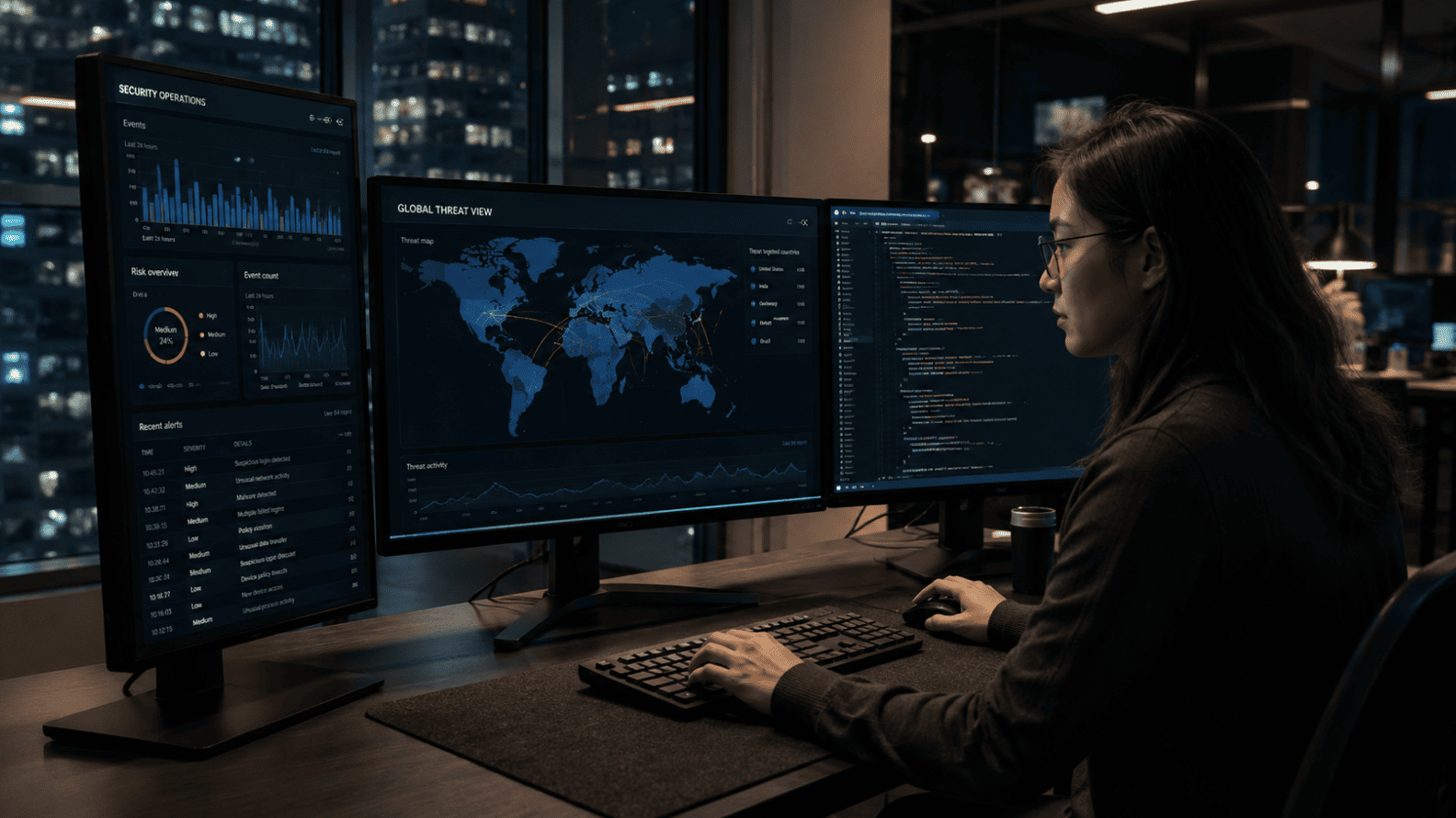
Round-the-clock monitoring does not require a room full of analysts on your payroll. For most growing companies, the smarter model is to combine strong internal ownership with managed detection, centralized telemetry, clear escalation, and enough external coverage to make sure suspicious activity is investigated when the internal team is offline.
A 24/7 cybersecurity monitoring model is less about keeping someone awake all night and more about making sure the right signals are collected, prioritized, investigated, and acted on continuously.
Growing companies can build that capability without staffing a full internal SOC by combining endpoint, identity, cloud, email, and network telemetry with an MDR or co-managed security provider that handles after-hours monitoring and investigation while the internal team retains business context, decision-making, and ownership of critical systems.
The model works best when responsibilities are explicit. The external team should know what constitutes an escalation, which actions it can take immediately, and who inside the company needs to be contacted for higher-impact decisions.
Internal staff should focus on architecture, remediation, business risk, and the systems that matter most. That division gives the company continuous security coverage without trying to recreate an enterprise SOC before the business has enough scale to support one.
On February 12, 2024, attackers used compromised credentials to enter a Change Healthcare Citrix remote-access portal. The account did not have multi-factor authentication enabled. According to UnitedHealth CEO Andrew Witty’s subsequent testimony to the U.S. Senate, the attackers gained that initial access and then moved through the environment before ransomware was deployed on February 21.
UnitedHealth’s written responses to the Senate record the February 12 initial compromise, while congressional investigators later focused heavily on the missing MFA and the access that followed.
That nine-day window is a useful way to think about 24/7 monitoring because most serious incidents contain a period between entry and obvious impact. Credentials are used, privileges change, endpoints behave differently, data is accessed, persistence is created, or an attacker begins moving through systems that the legitimate user rarely touches.
Mandiant’s latest incident-response research reinforces the point: its 2025 data put the global median attacker dwell time at 11 days, while organisations that discovered malicious activity themselves did so in a median of 10 days. Mandiant’s M-Trends 2025 analysis shows why detection speed matters so much. Every additional day inside the environment gives the attacker more time to understand identities, infrastructure, backups, and business processes.
The practical challenge for a growing company is that useful security signals rarely arrive through one neat dashboard. An endpoint platform may flag suspicious execution, Microsoft 365 may record an unusual login, the identity provider may see a privilege change, and the firewall may show unexpected outbound traffic.
Microsoft Sentinel is designed to correlate security data across multicloud and multiplatform environments, which illustrates the architectural side of the problem, but the operational side still requires somebody to look at those signals together, decide what they mean, and respond quickly enough for the correlation to matter.
A full internal SOC solves that problem by putting analysts, tooling, escalation, and response under one roof, but the staffing requirement quickly becomes substantial once the company wants nights, weekends, leave coverage, senior escalation, detection engineering, and incident investigation.
Managed Detection and Response exists largely because many organisations reach the need for continuous security operations before they reach the scale required to staff all of those functions themselves. Gartner describes MDR as remotely delivered, human-led security operations designed to detect, analyse, investigate, disrupt, and contain threats, which is much closer to the capability a growing company actually needs than simply paying someone to watch a dashboard.
The model that works in practice is therefore usually hybrid. The internal team keeps ownership of the environment, business priorities, architecture, remediation, and high-consequence decisions, while an external monitoring team provides the continuous analyst coverage that would be expensive and difficult to reproduce internally.
The result is a security operation that can still investigate a suspicious administrator login at 2 a.m., isolate an endpoint on Sunday morning, and escalate a genuine compromise immediately, without requiring the company to employ an entire round-the-clock SOC before the economics make sense.
The first design decision is to define what needs to be watched continuously. Companies often jump too quickly to the staffing question, but 24/7 coverage only has value if the monitoring layer can actually see the systems attackers are likely to use.
For most growing businesses, that means identity, endpoints, email, cloud infrastructure, remote access, and critical business applications. The exact mix will vary, but the principle is consistent: coverage should follow the attack surface and the business processes that would cause the most damage if compromised.
Identity deserves particular attention because so many modern attacks begin with a valid account rather than malware. A stolen Microsoft 365 credential, a compromised VPN account, or an abused privileged identity can give an attacker a path into the environment while looking superficially legitimate.
Microsoft’s guidance around identity protection and risk-based detections reflects this shift by focusing on signals such as unfamiliar sign-ins, leaked credentials, atypical travel, and other anomalous authentication behaviour. Those signals become far more useful when they are combined with endpoint and cloud activity rather than reviewed in isolation.
A practical monitoring baseline usually looks something like this:
| Monitoring layer | What the team should be able to see |
| Identity | Suspicious sign-ins, MFA abuse, privilege changes, impossible or unusual access patterns |
| Endpoints | Malware execution, suspicious processes, persistence, credential dumping, lateral movement |
| Phishing, malicious attachments, unusual forwarding rules, account takeover indicators | |
| Cloud | Privilege escalation, exposed services, unusual API activity, configuration changes |
| Remote access | VPN anomalies, new devices, unusual geographies, repeated failed authentication |
| Network | Unexpected outbound traffic, command-and-control patterns, unusual internal connections |
| Critical applications | Administrative changes, unusual transactions, suspicious data access |
The important part is deciding which of these signals require continuous investigation and which can wait for normal business hours. A suspected ransomware execution on a finance server needs immediate attention. A low-confidence policy violation on a development laptop may not. If every alert is treated as equally urgent, the monitoring team will eventually spend most of its time clearing noise.
This is also where many companies discover that buying more security tools does not automatically improve coverage. A business may already have endpoint detection, Microsoft 365 security, firewall logs, cloud audit trails, and vulnerability scanners, yet still lack a coherent view of what those systems are collectively saying.
The monitoring model therefore needs a central place for correlation, whether that is a SIEM, an XDR platform, an MDR provider’s technology stack, or a combination of those approaches.
Once the company knows what must be visible around the clock, the staffing decision becomes much easier. The internal team can concentrate on the systems and decisions that require business context, while the external monitoring layer handles continuous triage, investigation, and escalation. That division is what makes 24/7 coverage achievable without trying to recreate an enterprise SOC from scratch.
A 24/7 monitoring model becomes useful only when detection is tied to authority. If an external analyst sees a compromised endpoint, a suspicious privileged login, or clear signs of lateral movement at 2 a.m., they need to know whether they can act immediately or whether they are limited to opening a ticket and waiting for someone internally to wake up. That difference can determine whether an incident is contained early or allowed to spread for several more hours.
The operating model should therefore separate investigation authority from business authority. An MDR or co-managed SOC can usually be trusted to perform low-regret containment actions that reduce attacker movement without creating major business consequences.
Microsoft Defender, for example, supports isolating a compromised device from the network while retaining the connectivity needed for security operations. Capabilities such as device isolation, session revocation, or temporary identity containment can give the monitoring team a way to interrupt an attack while the internal incident owner is being contacted.
The more consequential the action, the more clearly approval should be defined in advance.
| Situation | External monitoring team | Internal owner |
| Suspicious endpoint with strong malicious indicators | Investigate and isolate under pre-approved conditions | Review business impact and remediation |
| Compromised user account | Revoke sessions or contain identity if authorised | Confirm account status and restore access |
| Malware execution on employee laptop | Contain device and collect evidence | Coordinate recovery with user and IT |
| Suspicious activity on critical production server | Investigate and escalate immediately | Decide on isolation or shutdown |
| Possible ransomware spreading laterally | Execute approved containment playbook | Activate incident leadership and recovery process |
| Large-scale data exfiltration | Preserve evidence and escalate at highest severity | Legal, executive, privacy, and incident-response decisions |
This distinction matters because automated and analyst-led response can now move far beyond simple alerting. Microsoft’s current MDR documentation, for example, includes managed response actions such as isolating devices and disabling compromised users.
The technology can act quickly, but organisations still need to decide where they are comfortable allowing that authority to operate. A finance laptop can usually be isolated with relatively limited consequence. Taking a production database or identity service offline can affect hundreds of people and may require senior approval even during an active incident.
The escalation path matters just as much as the technical playbook. A serious alert should not disappear into a generic overnight mailbox. The provider should know who is on call, how they can be reached, what constitutes a severity-one event, and how long they should wait before escalating to the next person.
NIST’s current incident-response guidance treats incident response as an organisational capability rather than an isolated security task, which is useful here because serious incidents often involve operations, legal, communications, executives, and third parties alongside the security team.
The companies that get this right effectively decide their 2 a.m. rules before 2 a.m. arrives. The external team knows what it can contain immediately, what requires human approval, and who owns the next decision. The internal team retains control over high-impact business choices while avoiding the worst version of outsourced monitoring: paying for someone to detect an attack overnight and then waiting until morning before anyone is allowed to do anything about it.
Once coverage and response authority are defined, the next problem is volume. Modern security platforms can produce an enormous number of alerts from endpoints, identities, cloud services, email, firewalls, and applications.
A monitoring operation that sends every one of those alerts to an analyst will struggle regardless of whether the analysts are internal or outsourced. The useful capability is therefore not simply collecting more telemetry. It is turning thousands of individual events into a much smaller number of investigations that deserve human attention.
This is where correlation and detection engineering become central to the model. An unusual login by itself may be harmless. The same login becomes much more interesting if it is followed by a new MFA registration, access to an administrative console, an unfamiliar PowerShell process on the user’s laptop, and a large download from SharePoint.
MITRE’s ATT&CK framework maps adversary behaviour across tactics such as credential access, persistence, privilege escalation, lateral movement, and exfiltration, giving security teams a useful way to think about sequences of behaviour rather than isolated alerts. A good MDR or SOC should be able to connect those signals into an investigation and explain what the suspected attacker is trying to accomplish.
Automation is useful at the repetitive end of that workflow. Low-risk enrichment can happen without analyst involvement: looking up an IP address, checking whether a domain has appeared in threat intelligence, identifying the user and device involved, collecting nearby authentication events, or determining whether the endpoint has generated related detections.
When the evidence reaches an agreed threshold, the case moves to an analyst with much of that context already assembled. Human attention can then be spent on interpretation, containment decisions, and unusual behaviour rather than gathering basic facts for every alert.
A practical operating model can separate the work into layers:
| Activity | Best handled by |
| Log collection and normalization | Platform / automation |
| Threat-intelligence enrichment | Automation |
| Duplicate and known-benign alert suppression | Detection rules and tuning |
| Cross-system event correlation | SIEM / XDR / MDR platform |
| Initial investigation | 24/7 monitoring analyst |
| Complex attack-path analysis | Senior analyst / threat hunter |
| Business-impact assessment | Internal security or IT owner |
| Major containment decisions | Internal incident leadership |
| Deep forensics or breach investigation | Specialist incident-response team |
Tuning also has to continue after the service goes live. A rule that generates useful signals during the first month may become noisy after an application change, while legitimate administrative behaviour can look suspicious until the monitoring team understands how the company actually operates.
The provider should therefore be able to explain which detections are generating the most volume, which are repeatedly being closed as benign, what rules have been changed, and whether important attack techniques are adequately covered. Continuous monitoring without continuous tuning gradually becomes an alert-processing service rather than a security operation.
This is also one of the areas where outsourcing can work particularly well. A specialist provider can spread detection engineering, threat intelligence, tooling, and senior analyst expertise across multiple customers while still giving each organisation dedicated context and response procedures.
The company does not need to employ every specialist skill continuously, but it should still retain visibility into how detections are designed and how incidents are prioritised. The objective is a monitoring layer quiet enough that an alert at 2 a.m. means somebody should genuinely pay attention, while retaining enough sensitivity that unusual attacker behaviour does not disappear inside the noise.
A hybrid monitoring model works because the company does not try to duplicate every security function internally. The internal team provides the context that an external provider cannot easily manufacture: which systems matter most, which business processes are sensitive, which administrators normally behave in unusual ways, and which production environments cannot be disrupted casually. The external team provides the depth and continuous staffing needed to watch the environment around the clock.
For a growing company, that can mean a surprisingly lean internal structure. One security lead or senior IT-security owner may be enough initially if that person has authority, access to the right stakeholders, and external support behind them. As the organisation grows, that internal layer can expand into architecture, governance, cloud security, engineering, or incident leadership without necessarily taking over the overnight monitoring function.
A practical division of responsibility often looks like this:
| Internal team owns | External team supports |
| Security strategy and architecture | 24/7 monitoring and triage |
| Business and asset context | Initial alert investigation |
| Identity and access decisions | Threat correlation and enrichment |
| Remediation priorities | Detection tuning |
| Major containment approvals | Pre-approved containment actions |
| Vendor and application ownership | Threat hunting |
| Risk acceptance | After-hours escalation |
| Executive and legal coordination | Incident evidence collection |
The important thing is to avoid hollowing out the internal capability completely. If every security decision is pushed to the provider, the company can become dependent on a third party that understands the tools better than it understands the business.
Someone internally still needs to challenge assumptions, review recurring incidents, understand where detection gaps exist, and decide whether the organisation is reducing risk or simply processing more alerts.
The reverse problem is common as well. Some companies buy an MDR service but continue expecting the internal IT team to investigate everything meaningful. In that arrangement, the provider becomes little more than an alert forwarding layer.
A stronger model gives the external team enough responsibility to investigate thoroughly and act within defined boundaries, while the internal owner steps in where business context, remediation, or higher-risk decisions are required.
This balance is what makes the economics work. The company avoids building a full multi-shift SOC years before it needs one, while still retaining the knowledge and authority required to run security properly.
As the business grows, it can selectively bring capabilities in-house where there is enough workload or strategic value to justify dedicated specialists, while keeping continuous monitoring external for as long as that remains operationally efficient.
Once the internal and external responsibilities are clear, the next decision is how much of the monitoring operation should sit outside the company.
There is a meaningful difference between buying a managed service that watches alerts, using an MDR provider that investigates and contains threats, and running a co-managed SOC where the internal team and external analysts work from the same tooling and playbooks. Those models can look similar during procurement, but they create very different day-to-day operating relationships.
For smaller security teams, MDR is usually the most complete starting point because the provider takes responsibility for continuous monitoring, triage, investigation, and at least some response.
A co-managed model makes more sense when the company already has internal analysts, a SIEM or XDR platform, and enough security maturity to share detection engineering and investigation work. A lighter monitoring service may still be useful where the internal team wants visibility outside business hours but intends to retain most of the investigation and containment responsibility itself.
| Model | Internal capability required | External role | Best fit |
| Managed monitoring | Moderate | Watches alerts and escalates | Companies with internal responders but limited after-hours coverage |
| MDR | Lower to moderate | Detects, investigates, and responds | Growing companies that need complete 24/7 operational coverage |
| Co-managed SOC | Moderate to high | Shares monitoring, hunting, and engineering | Companies with an existing security team that needs scale |
| Fully internal SOC | High | Limited specialist support | Larger organisations with sustained workload and mature security operations |
The distinction matters because service descriptions often sound broader than the actual contract. “24/7 monitoring” can mean an analyst reviews alerts overnight, while “managed response” can mean the provider is authorised to isolate endpoints, disable identities, or execute containment playbooks.
Likewise, “threat hunting” may be a continuous activity in one service and a periodic exercise in another. The buyer needs to understand exactly what happens between the moment a suspicious signal appears and the moment someone takes action.
A good evaluation therefore focuses on the operating mechanics. Ask who investigates the alert, how senior escalation works, whether the provider has access to the telemetry it needs, what response actions are included, how quickly high-severity incidents are reviewed, and whether the service learns from false positives over time.
It is also worth asking who owns detection content and investigation history if the company changes providers later, because that operational knowledge can become valuable after several years.
The right model is the one that removes the coverage gaps the company actually has. If the internal team already understands the environment well but cannot staff nights and weekends, co-managed coverage may be enough. If the company has strong IT operations but limited security investigation capability, MDR can fill a much larger gap. The choice should follow the maturity of the internal team rather than the size of the provider’s feature list.
A 24/7 monitoring service is only as effective as the escalation path behind it. The external team may be able to identify suspicious activity quickly, but once an incident crosses into business impact, legal exposure, customer communication, or production disruption, somebody inside the company has to take ownership. That transition needs to be designed in advance rather than improvised during a live incident.
The escalation model should define both severity and authority. A low-confidence phishing alert can stay with the monitoring team for investigation. A confirmed endpoint compromise may justify immediate containment.
A suspected ransomware event involving multiple systems should trigger the internal incident lead, IT operations, and senior management without waiting for normal business hours. For regulated or customer-facing environments, privacy, legal, and communications teams may also need to be brought in depending on what data or services are affected.
A simple escalation ladder can look like this:
| Severity | Typical example | Expected action |
| Low | Suspicious but unconfirmed activity | Investigate and document |
| Medium | Confirmed malicious activity on a single endpoint | Contain, notify internal owner, begin remediation |
| High | Privileged account compromise or lateral movement | Immediate containment and on-call escalation |
| Critical | Ransomware, major data theft, or widespread compromise | Activate incident leadership and specialist response support |
The contact structure also matters. The monitoring provider should have more than one way to reach the company and more than one person to call. If the primary incident contact does not respond within a defined period, the escalation should move automatically to a secondary contact and then to executive leadership where appropriate.
The process should be tested periodically so everyone knows the calls, messages, and approvals will work when the incident happens outside office hours.
This is also where incident-response specialists fit into the broader model. A growing company does not necessarily need forensic investigators on payroll, but it should know who will handle deeper investigation if an incident exceeds the MDR team’s scope.
That can be an incident-response retainer, a specialist cyber forensics firm, or a broader security partner that can move from monitoring into containment, evidence preservation, recovery support, and root-cause analysis.
The goal is to create continuity from the first suspicious signal through to full incident handling. The overnight analyst should know exactly when the event stops being a monitoring issue and becomes a business incident, while the internal team should know who takes over next. That is what turns 24/7 monitoring into a real response capability rather than a collection of alerts being watched around the clock.
Once the service is operating, the next challenge is judging whether it is doing more than generating tickets. Alert counts are easy to report, but they are weak evidence of security maturity. A provider can process thousands of alerts every month while still missing the incidents that matter.
The better measures focus on how quickly suspicious activity is detected, how confidently it is investigated, how fast containment happens, and whether the same weaknesses continue creating incidents.
Mean time to detect and mean time to respond are useful starting points, but they need context. A ten-minute response to a low-risk endpoint alert is less important than reducing the time required to contain a compromised privileged account.
The company should therefore track response performance by severity and attack type rather than compressing everything into one average. High-risk identity events, ransomware behaviour, data exfiltration, and suspicious activity on critical systems should have much tighter expectations than routine policy violations.
A practical scorecard can include:
| Metric | What it tells you |
| Time from detection to analyst review | Whether 24/7 coverage is genuinely responsive |
| Time from confirmed incident to containment | How quickly attacker activity is interrupted |
| Percentage of high-severity alerts fully investigated | Whether serious detections receive enough attention |
| False-positive rate | Whether detection rules are becoming more accurate |
| Repeat incidents from the same root cause | Whether remediation is actually improving security |
| Percentage of critical assets sending usable telemetry | Whether the monitoring team has visibility where it matters |
| After-hours incidents successfully escalated | Whether the overnight operating model works in practice |
| Detection gaps identified during incidents | Where monitoring coverage still needs improvement |
The quality of the investigation matters as much as speed. A useful incident record should explain what happened, which accounts and systems were involved, what the analyst observed, what containment was performed, what remains uncertain, and what the internal team should do next. That gives the company something it can use to improve controls rather than simply closing another case.
Regular service reviews should therefore look beyond SLA compliance. The internal security owner should ask which detections are producing the most useful findings, which attack techniques remain difficult to see, where telemetry is incomplete, which recurring alerts point to deeper configuration problems, and whether the provider is changing its detection logic as the environment evolves. A 24/7 service should become more familiar with the business over time, not remain equally generic six months after deployment.
The strongest sign that the model is working is that the company becomes better at recognising and containing meaningful attacker behaviour while the amount of unnecessary analyst work gradually falls. That is the outcome worth paying for: faster detection, faster containment, fewer blind spots, and a monitoring operation that improves as the organisation grows.
For most growing companies, the economic argument for a hybrid monitoring model appears well before the operational argument for a fully internal SOC. Continuous internal coverage means more than hiring a few analysts. Once nights, weekends, leave, attrition, management, senior investigation, detection engineering, tooling administration, and incident escalation are included, the staffing requirement expands quickly.
A company may discover that it needs several people simply to keep one function continuously staffed, before adding the more specialised skills needed for threat hunting, cloud security, malware analysis, or forensic investigation.
That creates an awkward stage in the company’s growth. The business may be large enough that serious incidents can happen outside office hours, but still too small to justify a broad internal security operations structure.
A hybrid model allows the company to buy that continuous operational layer while keeping the smaller set of capabilities that benefit most from business context in-house. Internal staff remain close to systems, architecture, risk, and remediation, while external analysts provide the shift coverage and investigation depth that would otherwise be expensive to maintain continuously.
The comparison is better made around capabilities than salaries:
| Capability | Full internal model | Hybrid model |
| 24/7 analyst coverage | Requires multiple shifts and leave coverage | Provided as part of managed service |
| Senior investigation | Dedicated internal expertise required | Shared specialist capability available on demand |
| Detection engineering | Internal team builds and maintains content | Provider handles much of the tuning and research |
| Threat intelligence | Separate feeds, analysts, and integration | Often incorporated into service |
| Business context | Strong | Retained internally |
| Remediation ownership | Internal | Internal |
| Incident forensics | Internal specialists or external retainer | Usually escalated to specialist support |
| Scaling coverage | Additional hiring | Service scope can usually expand faster |
There is also a utilisation problem with highly specialised security roles. A growing company may genuinely need an experienced incident responder during a major breach, but it may not need that person working full-time every week.
The same applies to threat hunters, malware specialists, and forensic investigators. Buying access to those skills when required can be considerably more efficient than trying to maintain every capability permanently inside the organisation.
Cost alone should not decide the architecture, because a cheap monitoring contract that simply forwards alerts creates little value. The useful comparison is the cost of delivering the same outcome internally: continuous triage, investigation, tuning, escalation, response, tooling, and access to senior expertise.
Once those pieces are included, the hybrid model often makes sense for several years before the company reaches a scale where bringing more of the operation in-house becomes strategically worthwhile.
The transition does not need to be permanent either. A company can begin with heavily outsourced monitoring, gradually add internal engineering and security specialists, move toward a co-managed SOC, and eventually internalise selected functions if the workload justifies it. The architecture should therefore leave room for that progression rather than forcing the business into an all-or-nothing decision from the beginning.
Most growing companies do not need to build the entire monitoring operation at once. The more realistic approach is to establish visibility first, define ownership and escalation next, and then increase automation and response authority as the internal team and external provider become more familiar with the environment.
That reduces the risk of buying an expensive service before the underlying telemetry, processes, and responsibilities are ready to support it.
A useful rollout can be structured around three stages:
| Stage | Primary objective | What should be in place |
| First 30 days | Establish visibility | Critical asset list, identity logs, endpoint telemetry, cloud and email signals, initial alert routing |
| Days 30-60 | Build the operating model | Severity definitions, escalation contacts, response authority, containment playbooks, service-level expectations |
| Days 60-90 | Improve quality and automation | Detection tuning, alert correlation, automated enrichment, response testing, coverage-gap review |
During the first stage, the company should resist the temptation to ingest every possible log source simply because the platform allows it. Start with the systems that would matter most during a real attack: identity providers, endpoints, email, remote access, cloud control planes, and critical production systems. Once those sources are flowing reliably, the team can add additional telemetry where it improves a specific detection or investigation use case.
The second stage is where the service becomes operational rather than technical. The company and provider should walk through realistic scenarios together: a compromised administrator account, malware on a finance laptop, suspicious activity on a production server, or possible ransomware spreading between endpoints.
For each scenario, everyone should know who investigates, what can be contained automatically, who gets called, and which decisions require internal approval. Running those exercises usually exposes weaknesses in escalation much faster than reviewing a service contract.
The third stage is about reducing friction. Repetitive benign alerts should be tuned, common investigation steps should be automated, and high-confidence response actions should become faster where the company is comfortable delegating authority. Coverage gaps identified during the first few months should feed back into telemetry, detection rules, and asset onboarding so that the service improves as the environment changes.
By the end of that process, the company should be able to answer a handful of practical questions confidently: what is being monitored, who is watching it overnight, how quickly serious activity is investigated, what the external team can do without approval, who takes over during a major incident, and how the organisation knows whether the model is getting better.
If those answers are clear, the company has effectively built a 24/7 security operation even if only a small portion of the people involved sit on its own payroll.
A company does not need to replicate a large enterprise SOC to get meaningful round-the-clock protection. What it needs is continuous visibility across the systems that matter, a monitoring layer that can distinguish genuine threats from noise, analysts who can investigate at any hour, and a clearly defined path from detection to containment and business decision-making.
For many growing organisations, the hybrid model is the most practical way to get there. Internal teams retain control over architecture, remediation, business priorities, and high-impact decisions, while an MDR or co-managed provider supplies the staffing depth, tooling, threat expertise, and overnight coverage that would otherwise take years to build internally.
Specialist incident-response capability can then sit behind that operating layer for the smaller number of events that require deeper forensic or recovery expertise.
The quality of the arrangement depends far more on integration than on the provider’s marketing language. The external analysts need the right telemetry, enough understanding of the environment, clear response authority, working escalation routes, and regular feedback from the internal team.
The internal team, in turn, needs visibility into how alerts are being investigated, which controls are repeatedly failing, where detection gaps exist, and whether response times are improving.
That is ultimately what separates genuine 24/7 security operations from outsourced alert watching. A useful model can detect suspicious activity at 2 a.m., understand enough context to judge its significance, take safe containment action where appropriate, and bring the right people into the incident without losing hours to uncertainty.
When that capability exists consistently, the company has the outcome that matters, regardless of how many of the analysts happen to appear on its own payroll.
Yes. The company needs continuous detection, investigation, escalation, and response capability, but those functions do not all have to be staffed internally. A growing business can keep a small internal security or IT team and use an MDR provider or co-managed SOC for overnight coverage, alert triage, threat investigation, and defined containment actions.
The internal team should retain responsibility for business context, architecture, remediation priorities, risk acceptance, and major incident decisions. That balance is important because an external analyst may recognise malicious behaviour quickly, but the internal team understands which systems are critical, which applications can tolerate disruption, and which executives or business functions need to be involved.
There is no universal headcount, but many growing companies can start with one experienced internal security lead or senior IT-security owner supported by external monitoring. That person needs enough authority to coordinate IT, cloud, application owners, management, and third-party providers when something serious happens.
As the business becomes larger or more complex, additional internal roles can be added around cloud security, security engineering, governance, architecture, or incident response. Continuous monitoring can remain outsourced even after the internal team grows. The decision should be based on workload and strategic value rather than assuming that security maturity eventually requires every SOC function to move in-house.
The biggest difference is usually the depth of investigation and response. Traditional managed monitoring services may collect security alerts, review them, and notify the customer when something appears suspicious. MDR services generally go further by combining technology with analysts who investigate suspicious activity, correlate evidence across systems, hunt for related threats, and perform or recommend containment actions.
The exact scope varies significantly between providers, which is why the label alone should not drive the decision. A company should ask what happens after an alert appears, whether analysts investigate beyond the original detection, what containment actions they can perform, whether threat hunting is included, and how serious incidents are escalated.
Possibly, although the architecture depends on the provider and the environment. Some MDR services operate on top of the company’s existing SIEM or XDR platform, while others provide their own technology for collecting, correlating, and analysing security telemetry. Larger or more mature organisations may prefer to retain their own SIEM because it gives them greater control over data, detections, integrations, and long-term investigation history.
The important requirement is centralised visibility rather than owning a particular product category. Identity, endpoint, cloud, email, network, and critical application signals need to reach a place where they can be correlated and investigated. If the MDR platform already provides that capability effectively, adding another SIEM simply for the sake of having one may increase cost and complexity without improving detection.
Start with the systems that give attackers the greatest access or would create the greatest business impact if compromised. Identity platforms, endpoint detection tools, email systems, remote-access infrastructure, cloud control planes, internet-facing services, privileged accounts, and important production systems usually belong near the top of the list.
Coverage can then expand based on actual risk. A payment platform or customer database may justify detailed application monitoring, while a low-risk internal system may only need normal logging and business-hours review. The objective is to concentrate continuous analyst attention on signals that can reveal meaningful compromise rather than collecting every possible event immediately.
For carefully defined situations, yes. Giving the external team authority to perform low-regret containment actions can substantially reduce the time an attacker has to move through the environment. A compromised employee laptop, clearly malicious endpoint behaviour, or a confirmed stolen account may justify immediate containment under a pre-approved playbook.
Higher-impact actions should normally require internal approval. Disconnecting a production server, disabling a critical administrator account, or shutting down an important business service can create operational consequences of its own. The safest model defines these boundaries before an incident and specifies exactly which actions are automatic, which require approval, and who can approve them after hours.
The provider should have a documented escalation tree rather than a single email address or phone number. Serious incidents need a primary on-call contact, a secondary contact if the first person does not respond, and an executive or incident leader for events involving major operational or data impact.
The company should also define severity levels and expected response times. A low-confidence detection can remain under investigation, while suspected ransomware, privileged account compromise, or active data theft should trigger immediate escalation. Periodic testing of the contact process is useful because escalation plans that exist only in documents often fail when the first real 2 a.m. incident occurs.
Avoid judging the service primarily by the number of alerts or tickets processed. Better measures include time from detection to analyst review, time from confirmed compromise to containment, investigation quality, false-positive rates, successful after-hours escalations, repeat incidents, and the percentage of critical systems providing usable telemetry.
You should also look at whether the service improves over time. A good provider should understand more about the environment after six months than it did during onboarding, reduce repetitive noise, identify coverage gaps, improve detection logic, and provide increasingly useful investigation context. If the service remains a generic stream of alerts with little evidence of learning or tuning, the operational value is limited.
A full internal SOC becomes more attractive when there is enough sustained security workload to justify dedicated analysts across several functions, when the company needs unusually deep knowledge of proprietary systems, or when regulatory, operational, or strategic requirements make direct control particularly valuable. Large organisations with complex environments may also want their own detection engineering, threat hunting, and incident-response capabilities.
Even then, the transition can be gradual. A company can bring detection engineering or daytime investigation in-house while continuing to use external analysts for overnight coverage. Specialist forensic support may remain outsourced indefinitely. The goal is to internalise capabilities when doing so provides better control, expertise, or economics rather than treating a fully internal SOC as an automatic destination.
Begin by identifying the systems that matter most and confirming that useful security telemetry exists for them. Then define who owns security internally, select the monitoring model, establish severity levels, document escalation contacts, and agree on the actions the external team can take without waiting for approval.
The first few months should be treated as an operational tuning period. Test escalation, review false positives, improve telemetry, run incident scenarios, and refine containment authority as confidence grows. A successful 24/7 model is built through that combination of visibility, people, authority, and repeated operational testing rather than through a single technology purchase.
Sep 15, 2026 / 24 min read
Sep 14, 2026 / 31 min read

Sep 13, 2026 / 27 min read