How the Cybersecurity Talent Shortage Is Weakening Business Resilience
Sep 19, 2026 / 22 min read
September 6, 2026 / 22 min read / by Team VE
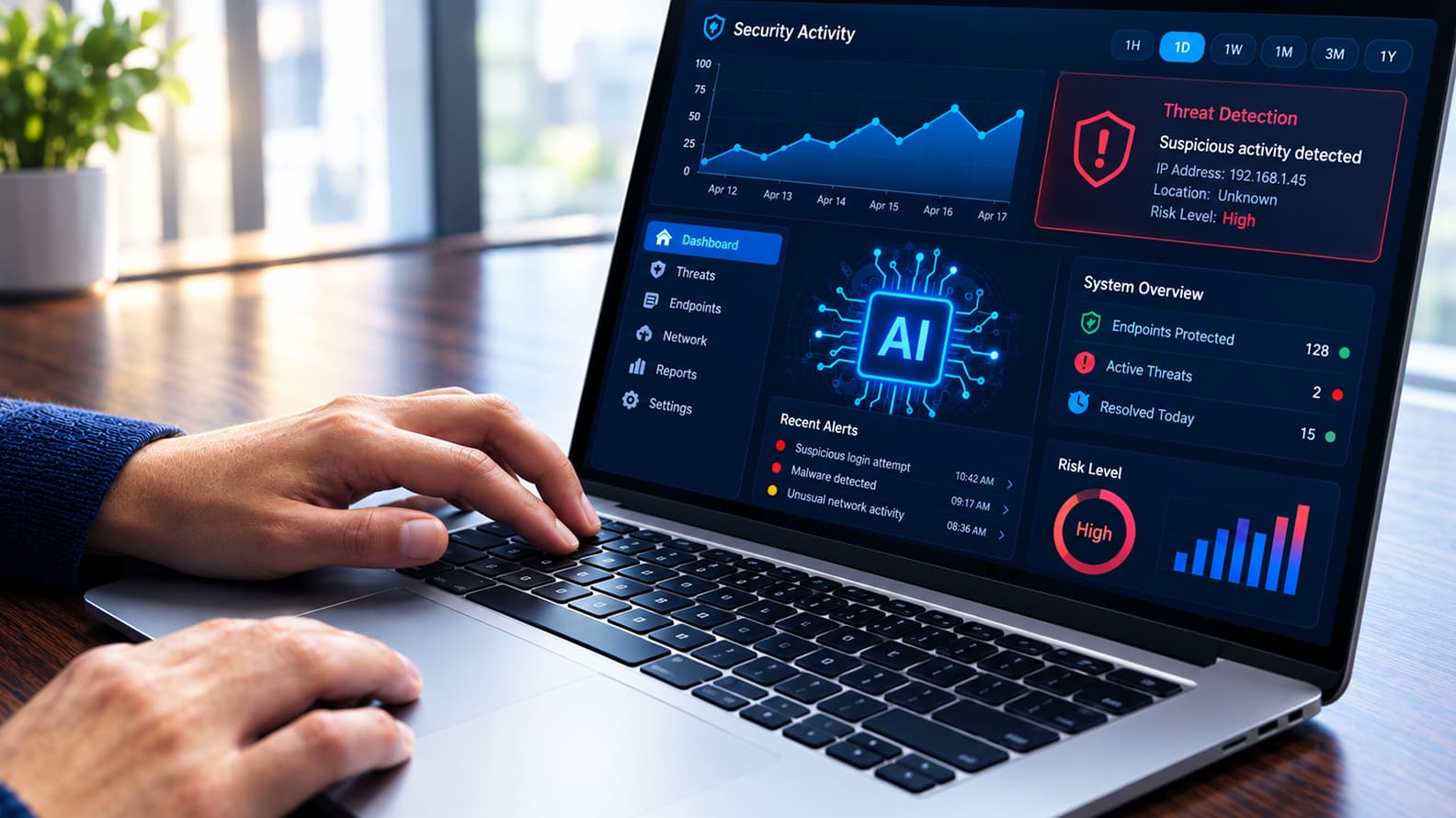
AI is making detection faster, broader, and more context-aware, but the hardest security decisions still depend on people who understand the business, the environment, and the consequences of getting the call wrong.
AI is changing threat detection by doing more of the work that traditionally consumed analyst time. It can correlate signals across endpoints, identities, cloud services, SaaS platforms, email, and network telemetry, then turn thousands of low-level alerts into a smaller number of higher-value investigations.
It is also improving enrichment, anomaly detection, alert summarisation, and the speed at which security teams can understand what may be happening across a complicated environment.
What AI still struggles with is judgment. It can identify suspicious behaviour, but it does not reliably understand whether that behaviour makes sense in the context of a particular business, whether an unusual action is genuinely dangerous, how much operational disruption a response will cause, or which competing risks leadership should accept.
The strongest model is therefore not autonomous detection replacing analysts. It is a security team where AI handles more correlation, enrichment, triage, and repetitive investigative work while humans retain responsibility for validation, containment, escalation, and the decisions that carry real business consequences.
Traditional threat detection has always suffered from a volume problem. Security teams collect signals from endpoints, identities, email, cloud platforms, SaaS tools, and network controls, but the difficult part is turning those signals into something an analyst can act on.
Rules fire, alerts accumulate, and much of the analyst’s time disappears into enrichment, correlation, duplicate checking, and reconstructing what actually happened before any meaningful decision can be made.
AI is changing that layer of the work first. Instead of treating every event as an isolated alert, modern detection platforms can connect activity across users, devices, sessions, and applications, then summarise the sequence into a more coherent investigation.
That matters because attackers rarely produce one perfectly obvious signal. A compromised account may show an unusual login, a new device, a suspicious OAuth grant, a bulk download, and a privilege change across several systems. Individually, each event may look inconclusive. Together, they tell a much stronger story.
Google’s Security AI Workbench is a useful example of where the market is heading. The emphasis is not simply on generating more alerts, but on helping defenders analyse security data, investigate threats, and work across large volumes of telemetry faster. The same direction is visible across the security industry: AI is being inserted into the investigative workflow because that is where analysts lose the most time.
The harder part comes after the pattern has been found. An AI system may recognise that an administrator downloaded an unusual amount of data at 2 a.m., but it still needs context to know whether that behaviour reflects an incident, an emergency maintenance window, a legitimate migration, or an executive-approved project. The technical signal can be strong while the business meaning remains ambiguous.
That is why AI is most valuable when it improves the quality and speed of the analyst’s decision rather than pretending to remove the decision itself. The real gain is a security team that spends less time assembling evidence and more time deciding whether the activity matters, how far the incident has spread, what should be contained, and what the business can safely tolerate.
The biggest advantage AI brings to threat detection is not that it suddenly sees threats humans cannot. It is that it can assemble context much faster. A single alert rarely tells an analyst enough. The useful picture usually sits across authentication logs, endpoint activity, process execution, cloud events, email telemetry, network connections, and user behaviour. Pulling that together manually is slow, especially when the same investigation touches several systems.
AI can accelerate that work by enriching an alert with the surrounding evidence, grouping related events, identifying patterns that would otherwise be scattered across different consoles, and prioritising the cases that deserve attention first. That can turn a queue of hundreds of low-confidence alerts into a smaller set of investigations with clearer timelines and better context.
The strongest use cases tend to be operational rather than dramatic:
That matters because analyst time is usually lost before the real decision begins. If AI can reduce the time spent gathering evidence, switching between tools, and reconstructing activity, the analyst can spend more time on the questions that actually require judgment: whether the activity is malicious, how much of the environment may be affected, and what response is proportionate.
The limitation is that better correlation still depends on good inputs. Missing logs, weak endpoint coverage, poor identity telemetry, inconsistent asset inventories, and badly configured controls do not become reliable simply because an AI layer sits on top of them. AI can make a strong detection program faster, but it cannot compensate indefinitely for a weak data foundation.
AI is very good at identifying patterns, correlating events, and surfacing unusual behaviour. The harder part begins when the investigation moves from what happened to what it means. Security incidents rarely arrive with perfect evidence, and the same technical signal can have very different implications depending on who generated it, which system is involved, and what the business was doing at the time.
A privileged account logging in from a new location at 2 a.m. may indicate compromise. It may also belong to an administrator responding to an outage. A large download from a customer database could be data theft, or it could be part of an approved migration.
An unusual PowerShell command may be malicious, or it may come from an internal automation script that has been running for years. AI can rank these situations by probability, but it does not always have enough business context to make the final call.
This is where experienced analysts still matter. They can pull in information that may never appear in the security telemetry, such as a planned maintenance window, an acquisition, a contractor engagement, a new executive assistant, or a rushed finance process at quarter end.
In many organisations, that context sits with infrastructure teams, application owners, finance, Human Resources, or senior management rather than inside the detection platform.
The stakes become even higher when the response itself can cause damage. Isolating a laptop is usually straightforward. Disabling a domain administrator, shutting down a production server, blocking a cloud workload, or freezing a finance account is different. Those actions may stop an attacker, but they can also interrupt payroll, customer transactions, production systems, or a live deployment.
A useful way to think about the boundary is:
| AI Can Often Do Well | Human Judgment Is Still Critical |
| Correlate related alerts | Decide whether unusual behaviour is legitimate |
| Build an investigation timeline | Understand business context |
| Enrich events with threat intelligence | Assess operational impact |
| Suggest likely attack paths | Decide whether evidence is strong enough |
| Recommend containment actions | Approve disruptive or irreversible actions |
| Summarise the incident | Communicate risk to leadership and business teams |
There is also a subtler risk. AI can produce a very convincing explanation even when the underlying evidence is incomplete. A polished summary can make an investigation feel more certain than it really is. Analysts still need to go back to the raw events, confirm the sequence, challenge assumptions, and check whether important telemetry is missing before acting on the conclusion.
AI can shorten the time it takes to understand an incident, but the final decisions about containment, escalation, business impact, and acceptable risk still belong with people who understand both the technology and the organisation.
AI is unlikely to remove the need for security analysts, but it is already changing how much work one analyst can realistically handle. That matters because many Security Operations Centers (SOCs) do not suffer from a lack of alerts. They suffer from too many alerts competing for too little analyst time.
A large part of the workload is still repetitive. Analysts collect evidence from different tools, check whether events are related, enrich alerts with user and asset information, review threat intelligence, document timelines, and close cases that ultimately turn out to be benign. AI can take a meaningful share of that work and compress what previously took twenty or thirty minutes into a few minutes.
The impact is especially important for smaller security teams. A large enterprise may have separate teams for threat hunting, endpoint security, cloud security, identity, incident response, and detection engineering. A mid-sized company may have the same three or four people covering most of those functions. In that environment, AI can create capacity that the organisation would otherwise struggle to build through headcount alone.
The gain is not simply speed. It is what analysts can do with the time that becomes available. Instead of spending most of the day clearing queues, they can spend more time on work that improves the security program itself:
There is also a skill shift. Analysts still need strong technical knowledge, but the work becomes less about processing alerts one by one and more about validating conclusions, understanding attacker behaviour, and deciding where to investigate more deeply. Someone who can challenge an AI-generated explanation and recognise that an important piece of evidence is missing may become more valuable than someone who is simply fast at closing tickets.
This is where AI can have the biggest operational impact. A team of five analysts may not become the equivalent of a team of fifty, but it can operate with far more reach than before. The strongest benefit comes when AI reduces the manual work around investigations and gives experienced people more time to focus on the threats, weaknesses, and decisions that actually matter.
The first wave of AI in threat detection has focused heavily on the analyst workflow. It summarises alerts, correlates activity, enriches investigations, and helps analysts reach a conclusion faster. The next shift is happening slightly earlier in the chain. AI is beginning to influence how detections themselves are written, tested, and improved.
Detection engineering has traditionally required security teams to understand attacker behaviour, identify the telemetry that would reveal it, and then translate that logic into queries or rules for their own environment. That work is highly technical and often slow. A detection written for one logging platform may need to be rewritten for another, while a change in endpoint tooling or cloud architecture can break assumptions that previously made the rule useful.
AI can shorten some of that work. An engineer can describe suspicious behaviour in natural language and use AI to help generate an initial query, translate detection logic between formats, identify relevant data sources, or suggest additional signals that might strengthen the detection. It can also help analysts understand unfamiliar rules and investigate why a detection is producing too many false positives.
The connection with the MITRE ATT&CK framework is particularly useful here. ATT&CK describes adversary behaviour as techniques rather than individual malware signatures, giving detection teams a common language for thinking about how attackers gain access, execute code, move through environments, escalate privileges, and steal data.
AI can help security teams navigate that large knowledge base and connect observed behaviour with the techniques they should be looking for in their own telemetry.
Some of the most useful applications are likely to include:
The important word is first. A generated detection still has to be tested against the company’s own environment. Field names differ, logging coverage varies, legitimate administrative behaviour can resemble malicious activity, and a rule that performs well in one organisation may flood another with noise.
This is where AI can make a mature detection program move faster without pretending that detection engineering has become automatic. It can reduce the work involved in getting from an idea to a testable rule. Experienced engineers still need to decide whether the rule sees the right behaviour, whether the data is trustworthy, and whether the resulting alerts are useful enough to put in front of analysts.
AI is improving defence, but it is also making some familiar forms of attack easier to scale. Phishing, impersonation, reconnaissance, credential theft, and social engineering are not new. What has changed is the speed and quality with which attackers can produce convincing messages, voices, images, and other material around them.
That weakens some of the signals defenders relied on in the past. Poor grammar, awkward wording, generic phishing language, or badly imitated branding once helped employees and security teams spot suspicious communication. AI can remove many of those clues and produce content that is more personalised to the target, including the language, role, company, and context of a particular employee.
The fraud involving engineering firm Arup showed how far this can go. In its own 2024 financial statement, Arup said criminals had used fake voice, signatures, and images to execute a fraud in January 2024. Reporting around the Hong Kong case described an employee being drawn into a video meeting in which people appearing to be senior colleagues were deepfake recreations, before more than $25 million was transferred.
The lesson for threat detection is that teams cannot rely only on whether an email, call, or video looks convincing. They increasingly need to examine what happens around and after the interaction:
This moves detection deeper into behaviour. A convincing email or synthetic voice may get an attacker through the first stage, but the activity that follows still leaves traces across identity, endpoints, cloud platforms, and business applications.
AI therefore raises the bar on both sides. Attackers can make the initial deception more believable, while defenders can use AI to connect the signals that appear afterwards. The stronger detection programs will increasingly be the ones that understand the full sequence of activity rather than depend on a single obvious indicator that something is wrong.
Threat detection has traditionally been built around a mix of known indicators, rules, behavioural baselines, and analyst experience. The problem is that attacker behaviour changes faster than many detection programs do. New cloud services appear, users adopt different workflows, identities move across more systems, and attackers constantly change the sequence of actions they use to avoid established rules.
AI can help security teams adapt faster because it can identify emerging patterns across much larger volumes of activity and surface behaviours that do not neatly match an existing signature. That is particularly useful in environments where the same attack technique may look different depending on the user, device, application, or cloud platform involved.
The practical value is not that AI removes the need for detection rules. It gives teams another way to discover where those rules are becoming stale. If analysts repeatedly see the same type of suspicious behaviour emerging outside the current detection logic, AI can help surface those patterns earlier and give detection engineers something concrete to investigate and turn into better controls.
This also changes how teams think about tuning. Instead of treating detections as something that is written once and reviewed occasionally, the stronger model is a continuous cycle where analyst feedback, incident findings, behavioural changes, and new attacker techniques feed back into the detection program.
That makes the program more adaptive without making it autonomous. AI can help identify where the environment is changing and where the old assumptions are starting to break. Human teams still need to decide which patterns matter, which ones are harmless, and which ones deserve a new rule, stronger telemetry, or a different response.
AI is already changing how threat detection works. It can connect signals faster, reduce repetitive investigation work, help analysts understand complex incidents, and make detection engineering more efficient. For security teams dealing with growing volumes of endpoint, identity, cloud, SaaS, and network data, that is a meaningful improvement.
The bigger shift is that analysts can spend less time assembling evidence and more time interpreting it. That matters because the hardest part of threat detection has never been producing another alert. It is deciding whether the activity is genuinely malicious, how serious the situation is, what should be contained, and how much disruption the business can tolerate.
AI will also force detection programs to become more adaptive. Attackers are using the same technology to make phishing, impersonation, reconnaissance, and social engineering harder to recognise through obvious clues. Defenders will therefore need to rely more heavily on behaviour, identity signals, attack sequences, and context across multiple systems.
The organisations that benefit most from AI will not be the ones that automate the most. They will be the ones that use it to make analysts faster, improve the quality of investigations, strengthen detection coverage, and adapt more quickly as attacker behaviour changes. AI can shorten the path from signal to understanding. Human analysts still decide what that understanding means and what should happen next.
AI can detect certain patterns faster than humans, especially when the evidence is spread across a large number of logs, alerts, devices, identities, and cloud events. It is particularly useful for clustering related alerts, spotting unusual behavior, enriching events with context, and presenting an incident timeline quickly. A human analyst might take 30 minutes to collect context that AI can assemble in seconds if the required telemetry exists.
That does not make AI “better” at security judgment. A human analyst still has to decide whether the pattern is malicious, whether it matters to the business, whether containment is safe, and whether the evidence is strong enough to act. AI is better at scale and speed. Analysts are better at context and accountability.
AI will reduce some entry-level repetitive work inside the SOC, especially basic enrichment, first-pass summarization, duplicate alert handling, and routine documentation. That will change the analyst career path because teams will expect more people to understand detection logic, business context, cloud identity, automation, and incident response. The work becomes less about clicking through queues and more about improving the system.
Full replacement is not a serious operating model for companies that face real risk. Security decisions often affect legal obligations, customer trust, business continuity, insurance claims, employee access, and production systems. Those decisions need accountable humans, even when AI helps prepare the evidence.
Threat detection can use several forms of AI: machine learning for anomaly detection, behavioral analytics for user and entity patterns, natural language models for investigation assistance, automation for enrichment and response, and generative AI for summaries or detection drafting. Some tools also use AI agents that can perform specific investigation tasks across security platforms.
The type matters less than the workflow. A model that flags unusual behavior is useful only if analysts can understand the reason, inspect the evidence, and take action. A chatbot that summarizes alerts is useful only if it is grounded in real telemetry and does not invent context. AI should be judged by operational usefulness, not by the label attached to it.
The biggest risk is false confidence. AI can produce fluent, structured, persuasive answers even when data is missing, context is weak, or the recommendation is unsafe. In a security environment, that can lead to missed incidents, unnecessary containment, bad executive reporting, or overreliance on a tool that has not been tested against the company’s real conditions.
The mitigation is governance. AI output should show evidence, assumptions, confidence reasons, missing data, and recommended next steps. High-impact actions should require human approval. Teams should review model errors, analyst overrides, and missed detections as part of the normal security improvement cycle.
Yes, but they should start with focused use cases rather than trying to build a sophisticated AI SOC overnight. The best early uses are alert summarization, automated enrichment, identity anomaly detection, phishing triage, endpoint alert grouping, and managed detection support where remote experts review AI-assisted cases. These use cases can reduce pressure on small teams without handing over control.
The foundation still matters. A small business needs MFA, endpoint visibility, basic logging, secure backups, patching, email security, and clear escalation rules. AI can help identify suspicious activity faster, but it cannot compensate for a company that has no logs, no asset ownership, and no response plan.
It can, especially when it groups related alerts, suppresses duplicate noise, uses behavioral baselines, and enriches signals with context before presenting them to analysts. Instead of seeing ten separate alerts from one suspicious login chain, the analyst may see one incident story with supporting evidence. That can reduce fatigue and improve triage speed.
False positives do not disappear automatically. AI can also create new noise if it is poorly tuned, if it misunderstands normal business patterns, or if it produces overly cautious recommendations. The practical goal is not zero false positives. The goal is manageable, explainable, and continuously improving detection quality.
AI helps threat hunting by giving analysts faster ways to explore telemetry. A hunter can ask questions about unusual behavior, rare process execution, strange identity activity, abnormal cloud API calls, or patterns related to a known attacker technique. AI can suggest hypotheses, queries, related events, and possible ATT&CK mappings.
Threat hunting still requires human curiosity and skepticism. The analyst decides which hypothesis matters, whether the query is valid, whether the results are meaningful, and whether the activity deserves escalation. AI can widen the search space, but hunters still need to know what they are looking for and why it matters.
Humans should approve actions that can disrupt business operations, affect employee access, expose legal obligations, or trigger customer communication. This includes disabling executive or finance accounts, quarantining production servers, blocking critical vendors, revoking service credentials, shutting down cloud workloads, filing breach notifications, or declaring a major incident.
AI can recommend these actions and provide evidence, but approval should remain with accountable roles. The more irreversible or business-disruptive the action, the stronger the approval process should be. That is not bureaucracy. It is risk control.
Analysts will need stronger skills in detection engineering, identity security, cloud telemetry, data interpretation, automation review, incident communication, and AI output validation. They will also need to understand how to ask better questions of AI systems, check evidence quality, and recognize when a model answer is incomplete or misleading.
This means the analyst role becomes more analytical, not less. The best analysts will not simply read alerts. They will improve detections, shape playbooks, validate AI recommendations, communicate business impact, and help the organization learn from every incident and near miss.
Measure outcomes, not feature usage. Useful metrics include mean time to triage, mean time to investigate, false positive rate, analyst time saved, percentage of alerts grouped into meaningful incidents, detection coverage across ATT&CK techniques, number of detections tuned or retired, and number of incidents where AI materially improved speed or clarity.
Also measure trust. If analysts routinely ignore AI output, rewrite every summary, or avoid AI-generated detections, the tool is not working no matter how advanced it looks. A good AI detection system should make analysts faster, more accurate, and more confident without hiding uncertainty or weakening accountability.
Sep 19, 2026 / 22 min read
Sep 18, 2026 / 23 min read
Sep 16, 2026 / 26 min read