
Building a Regex Application
That Finds Better Energy Deals
in 20 Seconds
Quick Overview
Most organizations depend on accurate data, but the information they receive often arrives in messy, inconsistent formats. When the input isn’t clean, automation stalls, decisions slow down, and teams spend time fixing data instead of using it. The goal of the project was to turn that unstructured input into clear, reliable data that systems can act on automatically. Doing this required specialized pattern-matching talent - a niche skill that’s hard to find. VE provided the expertise to build it.
A Platform That is Making
Australia’s Energy Bills Transparent

Reading Energy Bills Sounds Simple
Until You Try it at Scale

The Project
Most Australians overpay for energy simply because there’s no platform that clearly shows when a cheaper option exists. Every retailer presents their bills differently, and key details like rates and usage are often buried in text that’s hard to compare. For example, two homes using the same amount of electricity might be paying completely different rates, but neither household can spot it because the details are buried in messy, unstructured text.
Saive set out to remove that barrier. Led by COO Nathan Long, the goal was to build a system that could read any bill, understand the customer’s real usage, calculate potential savings instantly, and switch them to a cheaper plan automatically - all without the customer having to do anything.

The Challenge
To make this possible, Saive needed technology that could interpret energy bills from more than 130 suppliers across multiple states. Each bill came with its own structure, format, and quirks. Even the same supplier - like Red Energy or Lumo - issued completely different text outputs in VIC and NSW. Key data points like NMI, supply address, or peak/off-peak usage were sometimes missing labels, split across lines, or buried deep in freeform text.
Saive needed a solution that could parse all of it. What it really called for was a developer who could write regex code - reliably, repeatedly, and fast.
Building an Engine That Reads Bills Like a Human —
But at Machine Speed
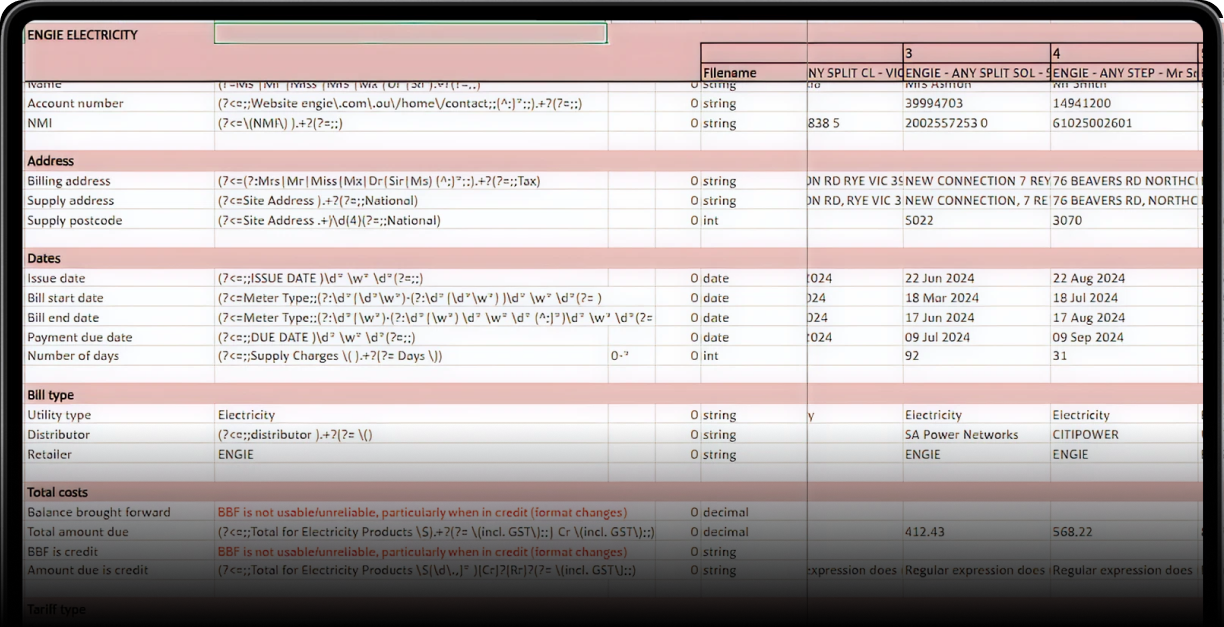
To solve the problem at its core, Saive brought in Shubhankar, a specialist in pattern-matching logic, to lead the regex development from VE. He built a universal regex framework- flexible enough to handle format variations across states, suppliers, and billing layouts. From identifying NMIs buried without labels to parsing usage split across lines, the system was designed to extract critical data points with precision, regardless of how or where they were written.
Built to Keep Up
With Australia’s Energy Reality

Structured Input
The first challenge was the raw data. Every electricity or gas bill came as plain text—no layout, formatting, or structure. Key fields like customer name, NMI, address, or balance were often unlabeled, split across lines, or hidden in free text. Even bills from the same supplier varied by state. Regex wasn’t just helpful—it was the only practical way to convert this messy text into usable data.

Parsing Complexity
The complexity lay not in the data itself, but in its unpredictability. With 130+ suppliers issuing bills in wildly different formats and many fields without clear identifiers, traditional extraction methods failed. The engine needed to recognize context, not just keywords. That meant writing regex expressions that could infer meaning even when labels were missing, detect fields regardless of position, and capture multi-line data.

Logic-Driven Patterns
To tackle this, VE developer Shubhankar built an advanced pattern-matching system that prioritized context over position. Using lookaheads, lookbehinds, alternations, and fallback patterns, it reliably extracted NMIs, addresses, usage breakdowns, and total charges. Patterns were iteratively tested and refined on regex101.com against real-world edge cases before deployment.

Performance First
Accuracy alone wasn’t enough—the system had to scale. The engine processed thousands of bills in milliseconds without losing precision. As patterns grew complex, they were optimized for speed, ensuring fast recursive matching across massive text. The result: a regex framework delivering clean, structured data in real time for instant plan comparisons and automated switching.

Integrated and Live
Once stabilized, the regex layer was fully integrated into Saive’s backend platform. Now, whenever a user uploads a bill, the system instantly extracts every relevant data point in the background - no manual review, no additional steps. The structured output is automatically stored and pushed into Saive’s analytics pipeline, where it fuels price comparisons, savings calculations, and real-time switching decisions.

Always Saving Something
Extraction wasn’t treated as a one-time task; it was engineered for continuity. Every parsed data point becomes part of a continuously growing dataset, ready to power analytics dashboards, customer savings reports, and deeper usage insights. Over time, this structured intelligence becomes the foundation for a more transparent and competitive energy market.

Training the Future
Regex application laid the groundwork for Saive’s future. The structured outputs are now used as ground-truth training data for Saive’s upcoming AI-driven extraction engine, ensuring the machine learning models start from a validated, high-accuracy benchmark. As the AI evolves, the regex layer remains a critical reference point - a reliable standard against which machine predictions are tested, refined, and improved.
The Result
This Is What Makes
Energy ‘Smart’—Finally

On average, users save $663 per year, but for some, like business owners, savings exceed $12,000 with Saive’s system.

With over 91 million units of energy data parsed, Saive’s system exposes how inconsistent billing conceals true pricing. Each standardized data point improves market transparency and moves the industry toward fairer, consumer-led pricing.

As V2G rolls out in 2025, clean usage data becomes essential. Saive’s system helps households align energy plans with solar, batteries, and EVs - so they can store, use, or sell power smartly.

Smarter plans drive cleaner habits - like off-peak use and rightsized solar. Saive’s system quietly cuts emissions and supports the shift to renewables.
When the Work Speaks for Itself
“Not only is he very friendly, he's always punctual and on time. He's very efficient and accurate at writing the code for our app. Probably what I love most about Shubhankar is he always takes time to ask clarifying questions to get things right the first time.”
Nathan Long
CEO, Saive, Australia