
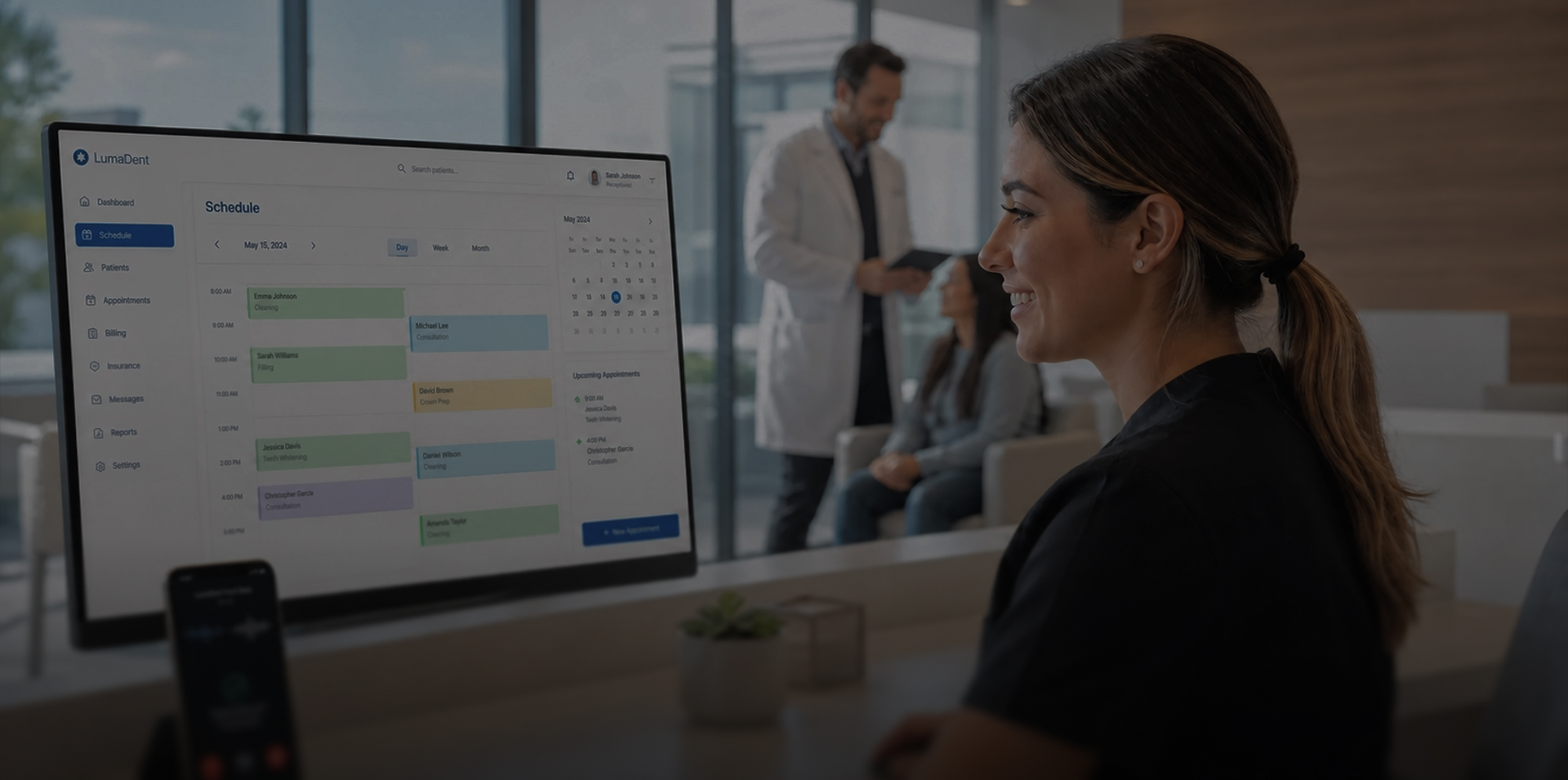

Domain
AI Voice Receptionist
Technology
AI Voice, VAPI, Python, Dentally API
Industry
Healthcare
Book an appointment. Reschedule a visit. Cancel a slot. Confirm a reminder. Most dental calls are simple, but they still take time away from the front desk.
Unscripted Digital wanted an AI voice assistant to answer those calls, understand each patient’s request, and complete the action during the same call. We made that happen.

Unscripted Digital is led by Qasim Ahmed, an entrepreneur who left a £100,000 job to build businesses shaped by AI and automation. His ventures now span AudioFlow, an AI-powered podcast automation tool, a marketing and talent agency, and a growing creator community.

Dental clinics lose valuable front-desk time to calls that are important but repetitive - bookings, reschedules, cancellations, and confirmations. Unscripted Digital saw the need for an AI receptionist that could handle these conversations and move each request toward action.

VE came in as the AI development arm behind the product. From voice workflow logic to appointment-system integration, fallback handling, testing, and deployment, VE helped Unscripted Digital move from an AI concept to a reliable voice assistant ready for real dental calls.
Dental clinics have digitized almost everything - records, calendars, reminders, and payments. But when a patient calls, the workflow often jumps back to human memory, handwritten notes, and manual scheduling. Unscripted Digital wanted to change that with an AI voice receptionist.
The application has to work inside milliseconds of human patience. It must convert speech to meaning, track intent, remember context, manage interruptions, handle unclear answers, and respond before the caller feels the machine has frozen. Unscripted Digital needed that level of voice intelligence for dental appointment calls.
A dental call is full of small decisions. The patient may be anxious, rushed, in pain, or unsure of the exact appointment details. They do not speak like a form field. They pause, correct themselves, change their mind, or ask something halfway through booking. A receptionist can read that messy human rhythm and still guide the call safely.
AI cannot rely on instinct. It needs intent logic, appointment rules, patient checks, fallback paths, and the confidence to know when not to act. The real challenge was not making AI sound like a receptionist. It was making AI behave like one.
The Solution

Unscripted Digital was not just looking for someone who could connect an AI voice tool to an appointment system. They needed a technology partner who understood what happens when AI has to operate inside a patient-facing workflow. In healthcare, a polished demo is not enough. The AI has to understand context, follow rules, handle uncertainty, recover from unclear inputs, and know when not to act. VE had already worked in this kind of environment through GIEQS, a voice-guided endoscopy application built around clinical workflows, live procedure support, and medical training. That experience made VE a stronger fit for building AI that had to work beyond the script.
VE built the working layer behind the AI receptionist. A custom FastAPI webhook connected the voice AI platform with the clinic’s appointment system and turned speech into safe system action. It handled patient matching, appointment rules, availability checks, booking, rescheduling, cancellations, reminders, GDPR removal requests, API retries, fallback handling, UK-localized time display, production deployment, and client-led testing. The final system was not designed to sound like a receptionist. It was engineered to work like one - listening, deciding, and acting inside a healthcare workflow.

The assistant was built to turn natural patient speech into clear appointment intent. It had to understand whether the caller wanted to book, reschedule, cancel, confirm, or ask for a reminder without forcing them into a fixed script.

Dental calls rarely move in a straight line. The system had to remember earlier answers, keep track of the patient’s request, and continue the flow even when the caller changed their mind halfway through the conversation.

The voice experience had to feel responsive. The assistant needed to listen, process, and respond fast enough so the caller did not feel like they were speaking to a frozen machine.

Not every caller gives perfect information. The assistant was built with fallback paths, retries, and clarification logic so it could recover when answers were incomplete, unclear, or different from what the system expected.

The AI could not simply place appointments anywhere. It had to follow clinic rules, check available slots, and understand different booking paths for new and existing patients.

Before taking action, the system needed to identify the right patient record. VE built matching logic using details such as mobile number, date of birth, and name, helping the assistant avoid wrong updates.

Rescheduling needed more control than a normal booking. The system had to find the existing appointment, understand the new preference, check availability again, and update the record without creating duplicates.

The assistant also handled cancellations by connecting the caller’s request to the correct appointment record and freeing the slot inside the clinic’s scheduling workflow.

VE built a custom FastAPI webhook to act as the bridge between the AI voice platform and the clinic’s practice management system. This middleware turned live conversations into safe system actions.

The clinic system’s API had its own limitations and quirks. VE added retry logic, fallback handling, and structured API flows so the assistant could continue working even when responses were slow, incomplete, or difficult to process.

The system could not rely on simple server-side filtering. VE handled paginated patient lookups and built smarter search logic so the AI could find the right patient record when needed.

Appointment slots were enriched with UK-localised display times, making the voice experience clearer for callers and reducing confusion around available booking options.

The backend was developed as a FastAPI webhook, giving the AI assistant a dedicated logic layer for patient matching, appointment rules, system calls, retries, and response handling.

The application was deployed on a Hostinger VPS, giving Unscripted Digital a live production environment for running and improving the AI receptionist.

Live deployments were set up to auto-update through GitHub Actions on push, making the development cycle faster and keeping production updates smoother.

The assistant was improved through a structured 25+ test case evaluation cycle with the client, covering real appointment scenarios, edge cases, and call-flow improvements.

Patients can speak naturally, such as asking to see a doctor next week. The AI understands the request, checks availability, and guides the booking flow without making the caller fill out a form.

The assistant connects with the clinic’s scheduling system to show only available appointment slots, helping prevent double bookings and reducing manual checking by the front desk.

The voice workflow can support scheduling across different doctors, departments, or locations, allowing one assistant to manage more than one appointment path.

Patients can change or cancel appointments through voice. The system updates the appointment workflow and helps free up slots that would otherwise need manual handling.

When preferred slots are unavailable, the assistant can support waitlist handling by recording patient interest and helping clinics follow up when suitable slots open.

After an appointment action is completed, patients can receive confirmation details through SMS or email, giving them a clear record of the booking, change, or reminder.
The Result
The AI receptionist helped cover after-hours windows and peak-volume spikes, so appointment requests could still be handled when the front desk was unavailable, overloaded, or outside normal working hours.
Patients can now complete appointment booking calls without human intervention. The AI understands the request, checks the scheduling system, follows booking rules, and completes the action during the call.
The system handled complex patient lookups across 22,000+ records, overcoming API limitations, paginated searches, and strict new-versus-existing patient booking rules.
The assistant was tested through 25+ client-led scenarios, improving accuracy, edge-case handling, patient matching, rescheduling flows, and overall reliability before and after production use.
The production system now auto-updates through GitHub Actions on push, helping Unscripted Digital improve the assistant faster without slowing down the live development cycle.
"VE quickly understood our vision and built an AI receptionist that performs reliably in real-world dental workflows. Their technical expertise and commitment made them a valuable technology partner."
Qasim Ahmed
Owner, Unscripted Digital (UK)


